## Heatmap: Syllogism Format Performance by Language Condition
### Overview
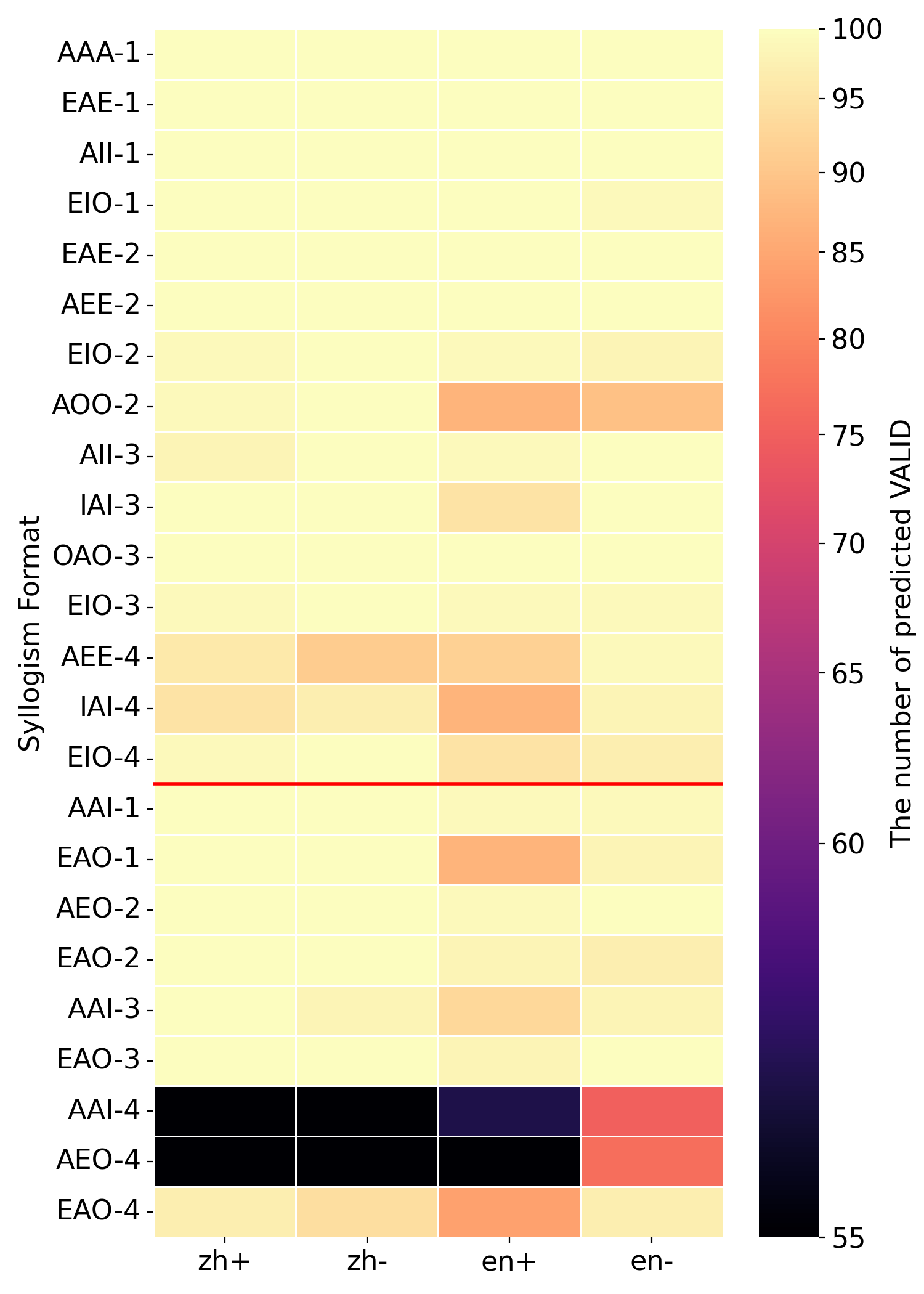
This image is a heatmap visualizing the performance of various syllogism formats across four different language conditions. The performance metric is "The number of predicted VALID" responses, represented by a color gradient. The chart is organized with syllogism formats as rows and language conditions as columns. A prominent red horizontal line divides the syllogism formats into two distinct groups.
### Components/Axes
* **Y-Axis (Vertical):** Labeled "Syllogism Format". It lists 24 distinct syllogism formats, each a combination of three letters (A, E, I, O) and a number (1-4). The formats are, from top to bottom:
* AAA-1, EAE-1, AII-1, EIO-1, EAE-2, AEE-2, EIO-2, AOO-2, AII-3, IAI-3, OAO-3, EIO-3, AEE-4, IAI-4, EIO-4
* *(Red Horizontal Line)*
* AAI-1, EAO-1, AEO-2, EAO-2, AAI-3, EAO-3, AAI-4, AEO-4, EAO-4
* **X-Axis (Horizontal):** Contains four categorical labels representing language conditions. The labels are:
* `zh+` (Chinese, positive?)
* `zh-` (Chinese, negative?)
* `en+` (English, positive?)
* `en-` (English, negative?)
* *Note: The "+" and "-" symbols are part of the labels.*
* **Color Bar/Legend (Right Side):** A vertical gradient bar titled "The number of predicted VALID". It maps color to numerical value, ranging from **55 (black/dark purple)** at the bottom to **100 (light yellow)** at the top. The scale has major ticks at intervals of 5: 55, 60, 65, 70, 75, 80, 85, 90, 95, 100.
### Detailed Analysis
The heatmap displays a grid of colored cells. The color of each cell corresponds to the estimated number of predicted VALID responses for a specific syllogism format under a specific language condition. Values are approximate, inferred from the color bar.
**General Trend:** The vast majority of cells are light yellow, indicating high performance (values between ~95 and 100). Performance drops significantly (darker colors) only in specific, isolated cells, primarily in the bottom two rows (AAI-4, AEO-4) and a few others.
**Row-by-Row Data Extraction (Approximate Values):**
* **Top Group (Above Red Line):** Generally very high performance (~95-100) across all four columns (zh+, zh-, en+, en-).
* **Notable Exceptions (Lower Performance):**
* **AOO-2:** `en+` and `en-` columns are orange, estimated ~80-85.
* **IAI-3:** `en+` column is light orange, estimated ~85-90.
* **AEE-4:** `zh-` and `en+` columns are light orange, estimated ~85-90.
* **IAI-4:** `en+` column is orange, estimated ~80-85.
* **EIO-4:** `en+` column is light orange, estimated ~85-90.
* **Bottom Group (Below Red Line):** Shows more variability and the lowest performance values on the chart.
* **AAI-1, AEO-2, EAO-2, AAI-3, EAO-3:** Mostly high performance (~95-100), similar to the top group.
* **EAO-1:** `en+` column is orange, estimated ~80-85.
* **AAI-4:** This row contains the lowest values.
* `zh+`: Black, value ~55.
* `zh-`: Black, value ~55.
* `en+`: Dark purple, value ~60-65.
* `en-`: Red/pink, value ~70-75.
* **AEO-4:** Also shows very low performance.
* `zh+`: Black, value ~55.
* `zh-`: Black, value ~55.
* `en+`: Black, value ~55.
* `en-`: Red/pink, value ~70-75.
* **EAO-4:** Performance recovers.
* `zh+`: Light yellow, ~95-100.
* `zh-`: Light orange, ~85-90.
* `en+`: Orange, ~80-85.
* `en-`: Light yellow, ~95-100.
### Key Observations
1. **Severe Performance Drop for Specific Formats:** The syllogism formats **AAI-4** and **AEO-4** exhibit dramatically lower performance (55-75) compared to all others, especially under the `zh+`, `zh-`, and `en+` conditions.
2. **Language Condition Impact:** For the problematic formats (AAI-4, AEO-4), performance is worst in the Chinese conditions (`zh+`, `zh-`) and the `en+` condition. There is a notable, though still reduced, improvement in the `en-` condition for these formats.
3. **Isolated Dips in Top Group:** Even within the generally high-performing top group, specific formats (AOO-2, IAI-3, AEE-4, IAI-4, EIO-4) show localized performance dips, primarily in the `en+` column.
4. **Structural Division:** The red line separates the syllogism formats into two groups. The bottom group contains all the formats with the most severe performance issues (AAI-4, AEO-4), suggesting a categorical difference between the formats above and below the line.
### Interpretation
This heatmap likely presents results from an experiment testing an AI model's ability to identify logically valid syllogisms. The "number of predicted VALID" is the count of times the model correctly identified a valid argument format.
* **What the Data Suggests:** The model is highly proficient (near-perfect) with most classical syllogism formats (like AAA-1, EAE-1). However, it has a critical failure mode with specific, less common formats (AAI-4, AEO-4). The performance collapse for these formats is severe and consistent across multiple language conditions.
* **Relationship Between Elements:** The x-axis conditions (`zh+/-`, `en+/-`) likely represent different prompt phrasings or language contexts (e.g., positive vs. negative framing in Chinese and English). The model's weakness is most pronounced in Chinese contexts and a specific English context (`en+`) for the problematic formats. The `en-` condition appears to partially mitigate the issue for AAI-4 and AEO-4.
* **Notable Anomalies:** The stark contrast between the near-perfect performance for 90% of the grid and the catastrophic failure for AAI-4/AEO-4 is the central finding. This indicates the model's logical reasoning is not robust; it has "blind spots" for particular syntactic structures of valid arguments. The red line may separate more standard syllogistic forms (above) from more complex or atypical ones (below), highlighting that the model's competence is not uniform across logical syntax.