## Directed Graph Diagram: System Flow with Feedback Loop
### Overview
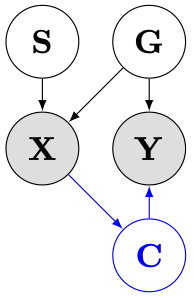
The image displays a directed graph (node-link diagram) consisting of five circular nodes connected by directional arrows. The diagram illustrates a flow or relationship between components, with a distinct feedback loop involving a blue-colored node. The structure suggests a system where initial inputs (S, G) influence intermediate states (X, Y), which are then modulated by a controller or condition (C) that feeds back into the system.
### Components/Axes
**Nodes (Circles):**
1. **S**: A white-filled circle located in the top-left quadrant. Labeled with a black, uppercase "S".
2. **G**: A white-filled circle located in the top-right quadrant. Labeled with a black, uppercase "G".
3. **X**: A gray-filled circle located in the middle-left area, below S. Labeled with a black, uppercase "X".
4. **Y**: A gray-filled circle located in the middle-right area, below G. Labeled with a black, uppercase "Y".
5. **C**: A blue-outlined circle with a white interior, located in the bottom-center. Labeled with a blue, uppercase "C".
**Edges (Arrows):**
* **Black Arrows:**
* From **S** (top-left) pointing downward to **X** (middle-left).
* From **G** (top-right) pointing diagonally down-left to **X** (middle-left).
* From **G** (top-right) pointing downward to **Y** (middle-right).
* **Blue Arrows:**
* From **X** (middle-left) pointing diagonally down-right to **C** (bottom-center).
* From **C** (bottom-center) pointing upward to **Y** (middle-right).
### Detailed Analysis
**Spatial Layout & Flow:**
* The diagram has a clear top-to-bottom flow, originating from nodes S and G.
* Node **X** is a convergence point, receiving inputs from both S and G.
* Node **Y** receives a direct input from G and a secondary, modulated input via the path X → C → Y.
* The blue elements (node C and its connecting arrows) form a distinct feedback or control loop that connects the left branch (X) to the right branch (Y).
**Color Coding:**
* **White Nodes (S, G):** Likely represent primary sources, inputs, or independent variables.
* **Gray Nodes (X, Y):** Likely represent intermediate states, processes, or dependent variables.
* **Blue Node & Arrows (C):** Visually distinct, indicating a special role such as a controller, condition, comparator, or feedback mechanism.
### Key Observations
1. **Asymmetric Input Structure:** Node X has two incoming edges (from S and G), while node Y has one direct incoming edge (from G) and one indirect incoming edge (from C).
2. **Feedback Loop:** The path **X → C → Y** creates a loop where the state of X influences Y not only directly (via the implicit system flow) but also indirectly through C. This is the most architecturally significant feature.
3. **Visual Hierarchy:** The use of color (blue) and positioning (bottom-center) strongly emphasizes node C as a critical, active component within the system, distinct from the passive flow of S/G to X/Y.
### Interpretation
This diagram represents a **system with a feedback control loop**. The white nodes (S, G) are the primary drivers or setpoints. Their effects propagate to intermediate states X and Y. However, the system is not purely feedforward; the blue node C introduces regulation.
* **What it suggests:** The state of X is monitored or used by C, which then sends a signal to influence Y. This is a classic structure for a **control system** (where C is a controller), a **comparator** (where C checks X against a threshold and adjusts Y), or a **conditional gate** (where the path from X to Y is mediated by condition C).
* **Relationships:** S and G are the foundational inputs. X is a combined function of S and G. Y is a function of G and the feedback from C. C is a function of X. Therefore, Y ultimately depends on S (via X → C) and G (both directly and via X → C).
* **Notable Anomaly/Purpose:** The absence of a direct arrow from X to Y is notable. All influence from X on Y must pass through C. This implies that C is an essential mediator, filter, or decision-maker in the relationship between X and Y. The diagram's purpose is to highlight this mediated relationship and the resulting feedback structure.