## Diagram: Data Compression Pipeline for Key/Value Cache
### Overview
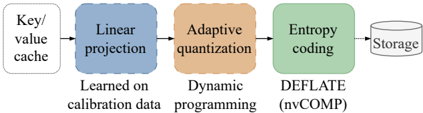
The image is a horizontal process flow diagram illustrating a four-stage pipeline designed to compress "Key/value cache" data. The process moves from left to right, transforming raw cache data through projection, quantization, and entropy coding before sending the final output to storage.
### Components/Axes
The diagram is composed of five distinct nodes arranged linearly from left to right, connected by arrows.
* **Node 1 (Far Left):** A white, rounded rectangular box labeled "Key/value cache".
* **Node 2 (Center-Left):** A blue, rounded rectangular box labeled "Linear projection". Below this box is the text "Learned on calibration data".
* **Node 3 (Center-Right):** An orange/tan, rounded rectangular box labeled "Adaptive quantization". Below this box is the text "Dynamic programming".
* **Node 4 (Right):** A light green, rounded rectangular box labeled "Entropy coding". Below this box is the text "DEFLATE (nvCOMP)".
* **Node 5 (Far Right):** A gray cylinder icon labeled "Storage".
**Connectors:**
* Solid arrows connect Node 1 to Node 2, Node 2 to Node 3, and Node 3 to Node 4.
* A dashed arrow connects Node 4 to Node 5 (Storage).
### Detailed Analysis
The pipeline describes a specific sequence of operations for data reduction:
1. **Input:** The process begins with the **Key/value cache**, which is the raw data source.
2. **Transformation (Linear Projection):** The data undergoes a "Linear projection." The sub-label "Learned on calibration data" indicates that the parameters for this projection are derived from a representative dataset, suggesting a machine learning-based approach to dimensionality reduction.
3. **Quantization (Adaptive Quantization):** The projected data is then processed via "Adaptive quantization." The sub-label "Dynamic programming" suggests that the quantization levels or bit-widths are optimized algorithmically to minimize information loss while maximizing compression.
4. **Encoding (Entropy Coding):** The quantized data is passed to "Entropy coding." The sub-label "DEFLATE (nvCOMP)" specifies the algorithm used. "DEFLATE" is a standard lossless compression algorithm, and "nvCOMP" refers to NVIDIA's compression library, indicating this pipeline is optimized for GPU-accelerated environments.
5. **Output:** The final compressed data is sent to "Storage."
### Key Observations
* **Pipeline Logic:** The flow represents a lossy-to-lossless compression strategy. The first two stages (Linear projection and Adaptive quantization) are likely lossy, reducing the data size significantly, while the final stage (Entropy coding) is lossless, further compacting the representation.
* **Optimization:** The inclusion of "Learned on calibration data" and "Dynamic programming" implies that this is a highly optimized, context-aware compression method rather than a generic compression algorithm.
* **Hardware Context:** The explicit mention of "nvCOMP" strongly suggests this diagram describes a technique for compressing the KV cache in Large Language Models (LLMs) to reduce VRAM usage on NVIDIA GPUs.
### Interpretation
This diagram outlines a sophisticated strategy for managing the memory footprint of Large Language Models.
In modern LLM inference, the "Key/value cache" (KV cache) grows linearly with the sequence length and batch size, often becoming the primary bottleneck for memory capacity. This pipeline addresses that bottleneck by:
1. **Dimensionality Reduction:** Using "Linear projection" to map the high-dimensional KV cache into a lower-dimensional space.
2. **Precision Reduction:** Using "Adaptive quantization" to reduce the bit-precision of the values, likely using dynamic programming to ensure that the most important information is preserved while less important information is compressed more aggressively.
3. **Final Compression:** Using "DEFLATE" via "nvCOMP" to squeeze the remaining data into the smallest possible footprint for storage.
The "Learned on calibration data" aspect is critical; it implies that the compression is not universal but is tuned to the specific model or data distribution, allowing for higher compression ratios with minimal impact on model accuracy. This is a classic "model compression" or "KV cache quantization" workflow.