## Diagram: System Architecture of PSRB Evaluator Module
### Overview
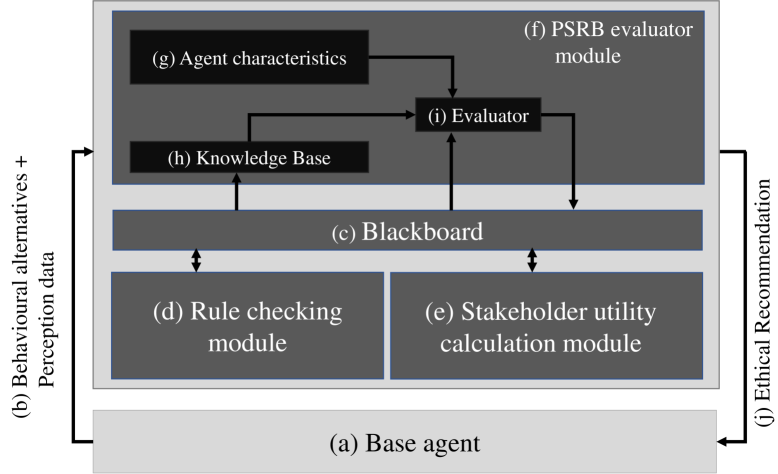
This diagram illustrates the system architecture of a "PSRB evaluator module" and its operational relationship with a "Base agent." The architecture utilizes a "Blackboard" pattern, which serves as a central repository and communication hub for various modules, including rule checking, utility calculation, and knowledge management, to generate ethical recommendations for the base agent.
### Components/Axes
The diagram is organized into three primary horizontal layers, with input/output flows on the vertical sides:
**1. Top Layer: PSRB Evaluator Module (f)**
* **Location:** Top-center, enclosed in a large dark grey container.
* **Components:**
* **(g) Agent characteristics:** Located in the top-left of the module.
* **(h) Knowledge Base:** Located in the bottom-left of the module.
* **(i) Evaluator:** Located in the top-right of the module.
**2. Middle Layer: Blackboard (c)**
* **Location:** Center, a horizontal bar spanning the width of the system.
* **Function:** Acts as the central data exchange and state management system.
**3. Bottom Layer: Base Agent (a)**
* **Location:** Bottom, a horizontal bar spanning the width of the diagram.
* **Function:** The primary entity interacting with the evaluator system.
**4. Side Flows:**
* **(b) Behavioural alternatives + Perception data:** Located on the left, represented by an arrow pointing upward from the Base Agent (a) to the Blackboard (c).
* **(j) Ethical Recommendation:** Located on the right, represented by an arrow pointing downward from the PSRB evaluator module (f) to the Base Agent (a).
**5. Supporting Modules (Below Blackboard):**
* **(d) Rule checking module:** Located in the bottom-left, below the Blackboard.
* **(e) Stakeholder utility calculation module:** Located in the bottom-right, below the Blackboard.
### Detailed Analysis
The system operates through a series of interconnected data flows:
* **Input Phase:** The "Base agent" (a) sends "Behavioural alternatives + Perception data" (b) upward to the "Blackboard" (c).
* **Internal Processing (PSRB Evaluator Module):**
* The "Evaluator" (i) receives direct inputs from "Agent characteristics" (g) and the "Knowledge Base" (h).
* The "Evaluator" (i) has a bidirectional relationship with the "Blackboard" (c).
* The "Knowledge Base" (h) has a bidirectional relationship with the "Blackboard" (c).
* **Module Interaction (via Blackboard):**
* The "Rule checking module" (d) has a bidirectional connection with the "Blackboard" (c), allowing it to read state and write validation results.
* The "Stakeholder utility calculation module" (e) has a bidirectional connection with the "Blackboard" (c), allowing it to read state and write utility scores.
* **Output Phase:** The "PSRB evaluator module" (f) processes the aggregated data and sends an "Ethical Recommendation" (j) downward to the "Base agent" (a).
### Key Observations
* **Centralized Communication:** The "Blackboard" (c) is the critical nexus. No module (d, e, h, i) appears to communicate directly with another; all communication is mediated through the Blackboard.
* **Modular Design:** The system separates "Rule checking" (d) from "Stakeholder utility calculation" (e), suggesting a dual-track evaluation process: one based on hard constraints (rules) and one based on optimization (utility).
* **Hierarchical Control:** The "PSRB evaluator module" (f) acts as a supervisor, containing the core logic ("Evaluator") and reference data ("Knowledge Base"), while the "Base agent" remains external to this specific evaluation logic.
### Interpretation
This architecture describes a **Decision Support System for Autonomous Agents**, specifically designed to ensure ethical compliance.
* **The Logic:** The "Base agent" proposes potential actions (Behavioural alternatives). Before executing these, the system runs them through a "Blackboard" where specialized modules (Rule checking and Utility calculation) analyze the proposal.
* **The "PSRB" Context:** While the acronym is not defined, the structure suggests a "Policy, Safety, and Rule-Based" (or similar) evaluation framework. The system is designed to prevent the "Base agent" from acting solely on its own perception data by forcing it to consult an external, ethically-aligned evaluator.
* **Why it matters:** This design pattern is common in AI safety research. By decoupling the "Base agent" from the "Evaluator," the system ensures that the agent's primary objective function can be overridden or constrained by an external ethical layer without needing to modify the agent's internal code directly. The use of a Blackboard allows for "plug-and-play" modules, meaning new rules or utility metrics can be added to the system without disrupting the existing architecture.