\n
## Diagram: Agent Architecture
### Overview
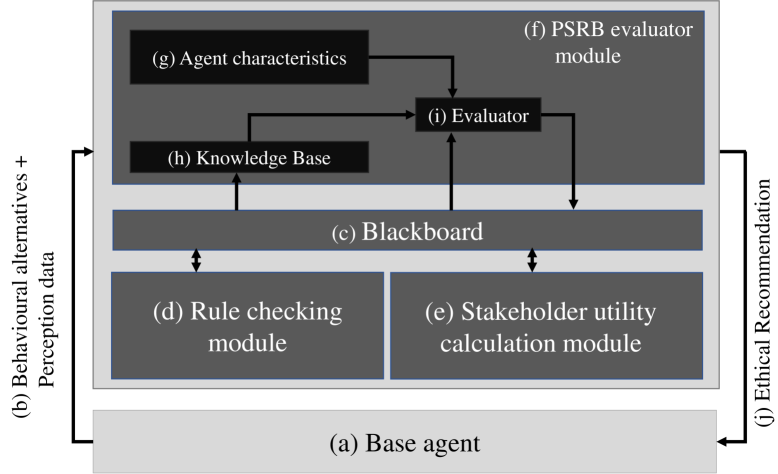
The image depicts a block diagram illustrating the architecture of an agent system, likely for decision-making or ethical reasoning. The diagram shows several modules interacting with each other, built upon a base agent. Arrows indicate the flow of information between these modules.
### Components/Axes
The diagram consists of the following labeled components:
* **(a) Base agent:** Located at the bottom of the diagram.
* **(b) Behavioural alternatives + Perception data:** Label on the left-hand side, indicating input to the system.
* **(c) Blackboard:** A central component, positioned in the middle of the diagram.
* **(d) Rule checking module:** Located below the Blackboard.
* **(e) Stakeholder utility calculation module:** Located to the right of the Rule checking module.
* **(f) PSRB evaluator module:** Located at the top of the diagram.
* **(g) Agent characteristics:** Located within the PSRB evaluator module, at the top-left.
* **(h) Knowledge Base:** Located within the PSRB evaluator module, to the left of the Evaluator.
* **(i) Evaluator:** Located within the PSRB evaluator module, in the center.
* **(j) Ethical Recommendation:** Label on the right-hand side, indicating output from the system.
Arrows indicate the direction of information flow.
### Detailed Analysis or Content Details
The diagram shows a layered architecture. The Base Agent (a) receives input (b) and feeds it to the Rule checking module (d) and the Stakeholder utility calculation module (e). Both of these modules communicate with the Blackboard (c). The Blackboard (c) also receives input from the Agent characteristics (g) and Knowledge Base (h), which are part of the PSRB evaluator module (f). The Evaluator (i) within the PSRB evaluator module (f) receives input from the Knowledge Base (h) and the Blackboard (c), and outputs an Ethical Recommendation (j).
The flow of information can be summarized as follows:
1. Base Agent (a) -> Behavioural alternatives + Perception data (b)
2. (b) -> Rule checking module (d) & Stakeholder utility calculation module (e)
3. (d) & (e) -> Blackboard (c)
4. Agent characteristics (g) & Knowledge Base (h) -> Blackboard (c)
5. Blackboard (c) & Knowledge Base (h) -> Evaluator (i)
6. Evaluator (i) -> Ethical Recommendation (j)
### Key Observations
The diagram highlights a modular design, with distinct components responsible for specific tasks. The Blackboard (c) appears to be a central hub for information exchange. The PSRB evaluator module (f) seems to be responsible for higher-level reasoning and ethical evaluation. The diagram does not contain any numerical data or specific values.
### Interpretation
This diagram represents a cognitive architecture for an agent capable of ethical reasoning. The separation of concerns into modules like rule checking, utility calculation, and a dedicated evaluator suggests a sophisticated approach to decision-making. The Blackboard serves as a shared memory space, allowing different modules to collaborate and contribute to the final ethical recommendation. The PSRB evaluator module, with its components for agent characteristics and knowledge, indicates that the agent's internal state and external knowledge are considered during the evaluation process. The diagram suggests a system designed to not only generate behavioral alternatives but also to assess their ethical implications based on predefined rules, stakeholder interests, and the agent's own characteristics. The absence of numerical data implies that the diagram focuses on the structural organization of the system rather than its quantitative performance.