## Diagram: System Architecture for Ethical Decision-Making Agent
### Overview
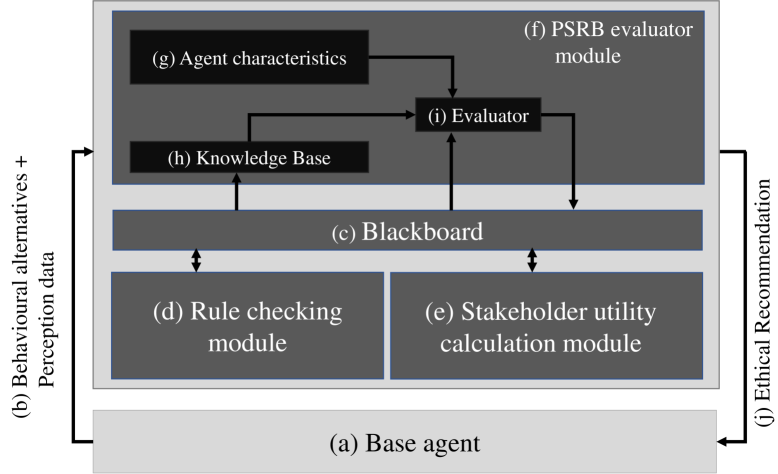
The diagram illustrates a multi-component system architecture for an ethical decision-making agent. It depicts the flow of data and processes between modules, emphasizing ethical evaluation and behavioral alternatives. The system integrates a base agent, knowledge base, evaluator modules, and ethical recommendation outputs.
### Components/Axes
1. **Base Agent (a)**
- Central component initiating behavioral alternatives and perception data.
- Connected bidirectionally to the Blackboard (c).
2. **Blackboard (c)**
- Central hub for data exchange.
- Receives input from the Base Agent (a) and sends data to:
- Rule Checking Module (d)
- Stakeholder Utility Calculation Module (e)
3. **Rule Checking Module (d)**
- Processes data from the Blackboard (c).
- Feeds into the Evaluator (i).
4. **Stakeholder Utility Calculation Module (e)**
- Processes data from the Blackboard (c).
- Feeds into the Evaluator (i).
5. **Evaluator (i)**
- Integrates inputs from:
- Rule Checking Module (d)
- Stakeholder Utility Calculation Module (e)
- Agent Characteristics (g)
- Knowledge Base (h)
- Outputs to:
- PSRB Evaluator Module (f)
- Ethical Recommendation (j)
6. **Agent Characteristics (g)**
- Describes properties of the Base Agent (a).
- Directly feeds into the Evaluator (i).
7. **Knowledge Base (h)**
- Provides contextual or domain-specific information.
- Feeds into the Evaluator (i).
8. **PSRB Evaluator Module (f)**
- Receives output from the Evaluator (i).
- Likely assesses compliance with Probabilistic Safety-Related Behaviors (PSRB).
9. **Ethical Recommendation (j)**
- Final output from the Evaluator (i).
- Represents the system's ethical guidance.
### Flow and Relationships
- **Bidirectional Flow**: The Base Agent (a) and Blackboard (c) exchange data iteratively, suggesting a feedback loop for adaptive decision-making.
- **Sequential Processing**: Data from the Blackboard (c) is processed by the Rule Checking Module (d) and Stakeholder Utility Calculation Module (e) before reaching the Evaluator (i).
- **Integration**: The Evaluator (i) synthesizes inputs from multiple modules (d, e, g, h) to produce outputs for the PSRB Evaluator Module (f) and Ethical Recommendation (j).
### Key Observations
1. **Ethical Focus**: The system explicitly prioritizes ethical considerations, with a dedicated Ethical Recommendation module (j).
2. **Modular Design**: Components are decoupled, allowing independent updates (e.g., Knowledge Base (h) can be modified without affecting the Base Agent (a)).
3. **Feedback Mechanism**: The bidirectional link between the Base Agent (a) and Blackboard (c) enables real-time adjustments based on perceptual data.
### Interpretation
This architecture represents a **hybrid decision-making system** that balances autonomous agent behavior with ethical oversight. The Blackboard (c) acts as a shared memory space, enabling coordination between perception, rule-based checks, and stakeholder utility calculations. The Evaluator (i) serves as the core decision engine, integrating technical (e.g., rule compliance) and ethical (e.g., stakeholder impact) factors. The PSRB Evaluator Module (f) likely ensures safety-critical behaviors, while the Ethical Recommendation (j) provides actionable guidance for human-AI collaboration. The bidirectional flow between the Base Agent (a) and Blackboard (c) suggests the system is designed for dynamic environments where perception data continuously refines decision-making. The absence of explicit numerical values implies the system operates on qualitative or rule-based logic rather than quantitative optimization.