## Cognitive Theory Summary
### Overview
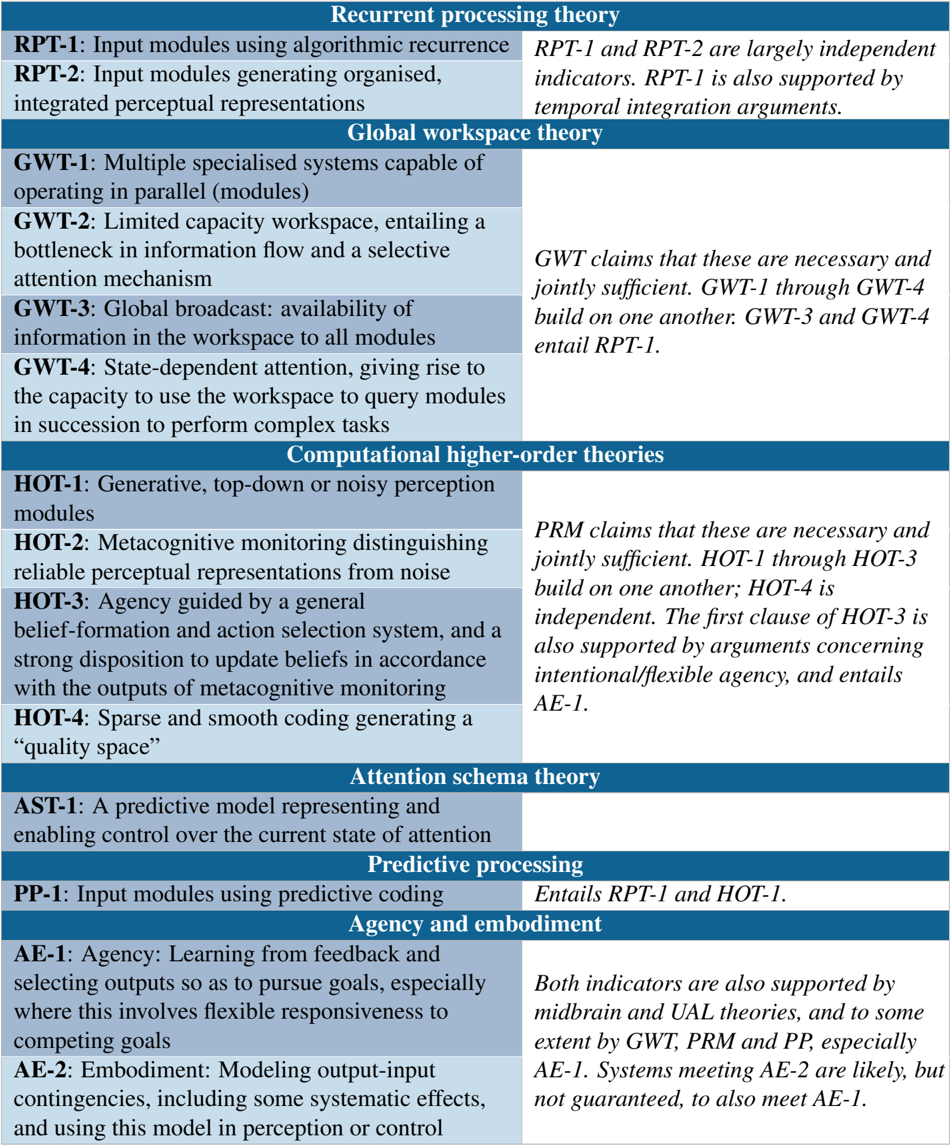
The image presents a summary of several cognitive theories, including Recurrent Processing Theory, Global Workspace Theory, Computational Higher-Order Theories, Attention Schema Theory, Predictive Processing, and Agency and Embodiment. Each theory is briefly described with key concepts and relationships to other theories.
### Components/Axes
The image is organized into sections, each dedicated to a specific cognitive theory. Each section includes:
* **Theory Title:** The name of the cognitive theory (e.g., "Recurrent processing theory").
* **Theory Components:** A list of numbered points (e.g., "RPT-1", "RPT-2") that describe specific aspects or modules within the theory.
* **Theory Relationships:** Textual descriptions of how the theory relates to other theories, including entailment and support.
### Detailed Analysis or ### Content Details
**1. Recurrent Processing Theory**
* **RPT-1:** Input modules using algorithmic recurrence.
* **RPT-2:** Input modules generating organized, integrated perceptual representations.
* **Relationships:** RPT-1 and RPT-2 are largely independent indicators. RPT-1 is also supported by temporal integration arguments.
**2. Global Workspace Theory**
* **GWT-1:** Multiple specialized systems capable of operating in parallel (modules).
* **GWT-2:** Limited capacity workspace, entailing a bottleneck in information flow and a selective attention mechanism.
* **GWT-3:** Global broadcast: availability of information in the workspace to all modules.
* **GWT-4:** State-dependent attention, giving rise to the capacity to use the workspace to query modules in succession to perform complex tasks.
* **Relationships:** GWT claims that these are necessary and jointly sufficient. GWT-1 through GWT-4 build on one another. GWT-3 and GWT-4 entail RPT-1.
**3. Computational Higher-Order Theories**
* **HOT-1:** Generative, top-down or noisy perception modules.
* **HOT-2:** Metacognitive monitoring distinguishing reliable perceptual representations from noise.
* **HOT-3:** Agency guided by a general belief-formation and action selection system, and a strong disposition to update beliefs in accordance with the outputs of metacognitive monitoring.
* **HOT-4:** Sparse and smooth coding generating a "quality space".
* **Relationships:** PRM claims that these are necessary and jointly sufficient. HOT-1 through HOT-3 build on one another; HOT-4 is independent. The first clause of HOT-3 is also supported by arguments concerning intentional/flexible agency, and entails AE-1.
**4. Attention Schema Theory**
* **AST-1:** A predictive model representing and enabling control over the current state of attention.
**5. Predictive Processing**
* **PP-1:** Input modules using predictive coding.
* **Relationships:** Entails RPT-1 and HOT-1.
**6. Agency and Embodiment**
* **AE-1:** Agency: Learning from feedback and selecting outputs so as to pursue goals, especially where this involves flexible responsiveness to competing goals.
* **AE-2:** Embodiment: Modeling output-input contingencies, including some systematic effects, and using this model in perception or control.
* **Relationships:** Both indicators are also supported by midbrain and UAL theories, and to some extent by GWT, PRM and PP, especially AE-1. Systems meeting AE-2 are likely, but not guaranteed, to also meet AE-1.
### Key Observations
* The theories are presented in a hierarchical or interconnected manner, with some theories building upon or entailing others.
* Recurrent Processing Theory (RPT) appears to be a foundational element, as it is entailed by Global Workspace Theory (GWT) and Predictive Processing (PP).
* Agency and Embodiment (AE) is supported by multiple other theories, suggesting its integrative nature.
* The descriptions are concise and focus on the core concepts of each theory.
### Interpretation
The image provides a high-level overview of several prominent cognitive theories and their interrelationships. The relationships between the theories suggest a complex and interconnected cognitive architecture. The entailment relationships indicate a dependency structure, where certain theories rely on the principles of others. The support relationships suggest that multiple theories contribute to the understanding of specific cognitive phenomena. The summary highlights the importance of considering multiple theoretical perspectives when studying cognition.