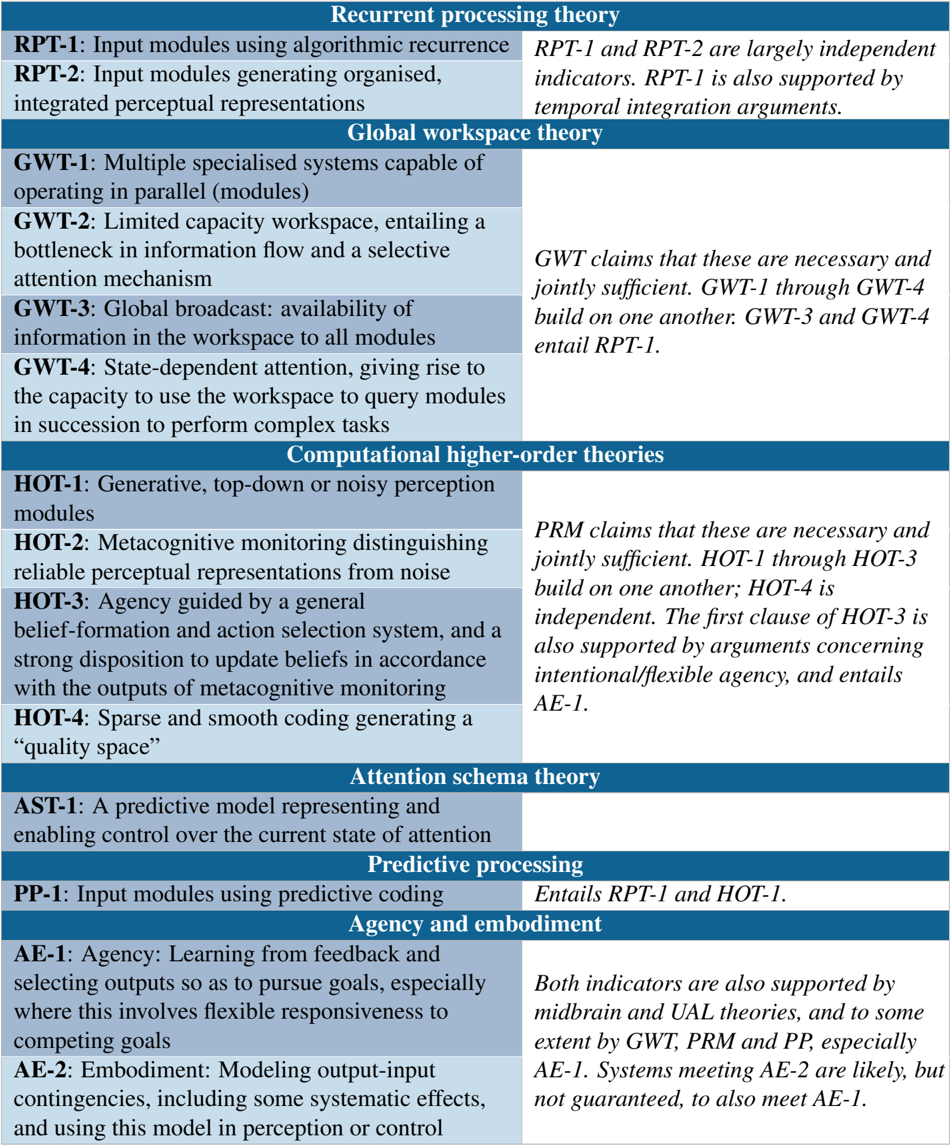
## Table: Theories of Consciousness and Cognition - Component Breakdown
| Theory | Components (Left Column) | Notes (Right Column) |
| :--- | :--- | :--- |
| **Recurrent processing theory** | **RPT-1:** Input modules using algorithmic recurrence.<br>**RPT-2:** Input modules generating organised, integrated perceptual representations. | *RPT-1 and RPT-2 are largely independent indicators. RPT-1 is also supported by temporal integration arguments.* |
| **Global workspace theory** | **GWT-1:** Multiple specialised systems capable of operating in parallel (modules).<br>**GWT-2:** Limited capacity workspace, entailing a bottleneck in information flow and a selective attention mechanism.<br>**GWT-3:** Global broadcast: availability of information in the workspace to all modules.<br>**GWT-4:** State-dependent attention, giving rise to the capacity to use the workspace to query modules in succession to perform complex tasks. | *GWT claims that these are necessary and jointly sufficient. GWT-1 through GWT-4 build on one another. GWT-3 and GWT-4 entail RPT-1.* |
| **Computational higher-order theories** | **HOT-1:** Generative, top-down or noisy perception modules.<br>**HOT-2:** Metacognitive monitoring distinguishing reliable perceptual representations from noise.<br>**HOT-3:** Agency guided by a general belief-formation and action selection system, and a strong disposition to update beliefs in accordance with the outputs of metacognitive monitoring.<br>**HOT-4:** Sparse and smooth coding generating a “quality space”. | *PRM claims that these are necessary and jointly sufficient. HOT-1 through HOT-3 build on one another; HOT-4 is independent. The first clause of HOT-3 is also supported by arguments concerning intentional/flexible agency, and entails AE-1.* |
| **Attention schema theory** | **AST-1:** A predictive model representing and enabling control over the current state of attention. | *(This cell is empty in the image).* |
| **Predictive processing** | **PP-1:** Input modules using predictive coding. | *Entails RPT-1 and HOT-1.* |
| **Agency and embodiment** | **AE-1:** Agency: Learning from feedback and selecting outputs so as to pursue goals, especially where this involves flexible responsiveness to competing goals.<br>**AE-2:** Embodiment: Modeling output-input contingencies, including some systematic effects, and using this model in perception or control. | *Both indicators are also supported by midbrain and UAL theories, and to some extent by GWT, PRM and PP, especially AE-1. Systems meeting AE-2 are likely, but not guaranteed, to also meet AE-1.* |
### Key Observations
* **Hierarchical Dependencies:** Several theories describe a build-up of components (e.g., GWT-1 to GWT-4, HOT-1 to HOT-3).
* **Cross-Theory Entailments:** Explicit logical connections are drawn between theories. For example:
* GWT-3 & GWT-4 entail RPT-1.
* PP-1 entails both RPT-1 and HOT-1.
* The first clause of HOT-3 entails AE-1.
* **Sufficiency Claims:** Both Global Workspace Theory and Computational Higher-Order Theories (referred to as PRM in the note) claim their listed components are "necessary and jointly sufficient."
* **Independent Elements:** Some components are noted as independent (RPT-1 & RPT-2 are "largely independent"; HOT-4 is independent from HOT-1 to HOT-3).
* **Supporting Evidence:** Notes reference support from other theoretical frameworks (e.g., AE-1 and AE-2 are supported by midbrain and UAL theories).
### Interpretation
This table serves as a comparative analytical tool for understanding the mechanistic postulates of prominent theories of consciousness. It moves beyond simple definitions to map the logical and supportive relationships *between* theories.
The data suggests a complex, interconnected theoretical landscape. Key insights include:
1. **Convergence on Core Mechanisms:** Theories like Predictive Processing (PP) and Global Workspace Theory (GWT) are shown to entail or support components of other theories (RPT, HOT), suggesting potential points of convergence or shared foundational ideas about information processing in the brain.
2. **Divergence on Sufficiency:** The table highlights a fundamental debate: GWT and HOT each claim a specific set of components is sufficient for consciousness, while other theories (like AST, PP) are presented with a single core component, leaving sufficiency implicit or unclaimed.
3. **The Role of Agency and Embodiment:** AE-1 and AE-2 are positioned as important, empirically supported indicators that are linked to, but not guaranteed by, other cognitive architectures. The note suggests a potential directional relationship where embodiment (AE-2) may lead to agency (AE-1).
4. **Modular vs. Integrated Views:** The components reflect a tension between modular, parallel processing (GWT-1, HOT-1) and integrated, recurrent, or global processes (RPT, GWT-3).
In essence, the table provides a "map of the debate," allowing a researcher to trace how a postulate in one theory (e.g., predictive coding in PP) logically implies or supports a postulate in another (e.g., algorithmic recurrence in RPT), revealing the underlying structure of the academic discourse on consciousness.