## Table: Cognitive Architecture Theories and Components
### Overview
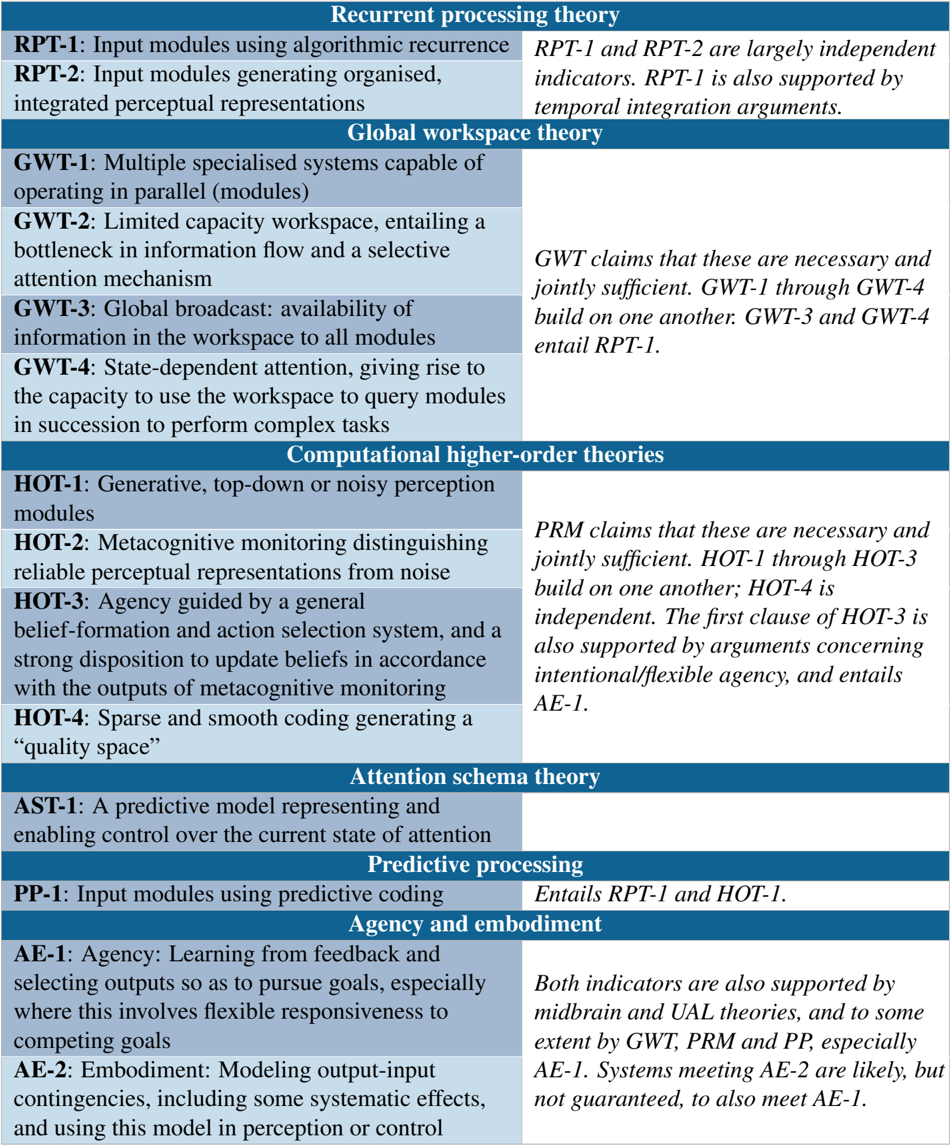
The image presents a structured table categorizing cognitive architecture theories into six main frameworks: Recurrent Processing Theory (RPT), Global Workspace Theory (GWT), Computational Higher-Order Theories (HOT), Attention Schema Theory (AST), Predictive Processing (PP), and Agency and Embodiment (AE). Each framework includes subcomponents (e.g., RPT-1, GWT-1) with descriptive labels and interdependencies noted in footnotes.
---
### Components/Axes
#### Recurrent Processing Theory (RPT)
- **RPT-1**: Input modules using algorithmic recurrence
*Note*: Largely independent indicators; supported by temporal integration arguments.
- **RPT-2**: Input modules generating organized, integrated perceptual representations
#### Global Workspace Theory (GWT)
- **GWT-1**: Multiple specialized systems operating in parallel (modules)
- **GWT-2**: Limited-capacity workspace with bottleneck and selective attention
- **GWT-3**: Global broadcast enabling information sharing across modules
- **GWT-4**: State-dependent attention for querying workspace
*Note*: GWT-1–GWT-4 are jointly sufficient; GWT-3/GWT-4 entail RPT-1.
#### Computational Higher-Order Theories (HOT)
- **HOT-1**: Generative, top-down modules for noisy perception
- **HOT-2**: Metacognitive monitoring to distinguish reliable representations from noise
- **HOT-3**: Agency guided by belief-formation and action selection
*Note*: First clause supported by intentional/flexible agency (AE-1).
- **HOT-4**: Sparse/smooth coding generating a "quality space"
*Note*: Independent of other HOT components.
*Note*: HOT-1–HOT-3 are jointly sufficient; HOT-4 is independent.
#### Attention Schema Theory (AST)
- **AST-1**: Predictive model representing and controlling attention state
#### Predictive Processing (PP)
- **PP-1**: Input modules using predictive coding
*Note*: Entails RPT-1 and HOT-1.
#### Agency and Embodiment (AE)
- **AE-1**: Agency: Learning from feedback to pursue goals with flexible responsiveness
- **AE-2**: Embodiment: Modeling output-input contingencies (including systematic effects) for perception/control
*Note*: AE-2 systems likely meet AE-1 but not guaranteed.
---
### Detailed Analysis
1. **Hierarchical Structure**:
- RPT and GWT form foundational layers, with GWT-3/GWT-4 explicitly entailing RPT-1.
- HOT builds on GWT, with HOT-1–HOT-3 jointly sufficient and HOT-4 independent.
- PP-1 directly depends on RPT-1 and HOT-1.
- AE integrates agency (AE-1) and embodiment (AE-2), with AE-2 systems likely but not guaranteed to meet AE-1.
2. **Interdependencies**:
- GWT-3/GWT-4 → RPT-1
- HOT-1–HOT-3 → PRM (Computational Higher-Order Theories)
- PP-1 → RPT-1 and HOT-1
- AE-2 → AE-1 (probabilistic, not guaranteed)
3. **Key Descriptions**:
- RPT emphasizes algorithmic recurrence and perceptual integration.
- GWT focuses on parallel modules, workspace bottlenecks, and global broadcasting.
- HOT introduces metacognition, agency, and quality space coding.
- AST centers on predictive attention modeling.
- PP highlights predictive coding as a unifying mechanism.
- AE combines goal-directed agency with embodied perception-action loops.
---
### Key Observations
- **Modularity vs. Integration**: RPT-1/RPT-2 and GWT-1/GWT-2 emphasize modular processing, while GWT-3/GWT-4 and HOT-3 emphasize integration.
- **Predictive Elements**: PP-1 and AST-1 explicitly incorporate predictive mechanisms.
- **Agency**: HOT-3 and AE-1 both address agency but differ in scope (metacognitive vs. goal-directed).
- **Independence**: HOT-4 and AE-2 are noted as independent components within their frameworks.
---
### Interpretation
The table illustrates a layered cognitive architecture where lower-level theories (RPT, GWT) provide foundational mechanisms for higher-order processes (HOT, AE). Predictive Processing (PP) acts as a unifying framework, integrating RPT and HOT. Notably, HOT-4 and AE-2 are positioned as independent innovations, suggesting alternative pathways for cognition. The emphasis on predictive coding (PP-1) and metacognition (HOT-2) aligns with contemporary neuroscience trends, while the distinction between AE-1 and AE-2 highlights unresolved questions about embodiment’s role in agency. The footnotes clarify that while some components are interdependent (e.g., GWT-3/GWT-4 → RPT-1), others (e.g., HOT-4) operate autonomously, reflecting debates about modularity vs. holistic integration in cognitive science.