## Diagram: Interdisciplinary Framework for Neuroscience, Synthetic Biology, and Neuromorphic Engineering
### Overview
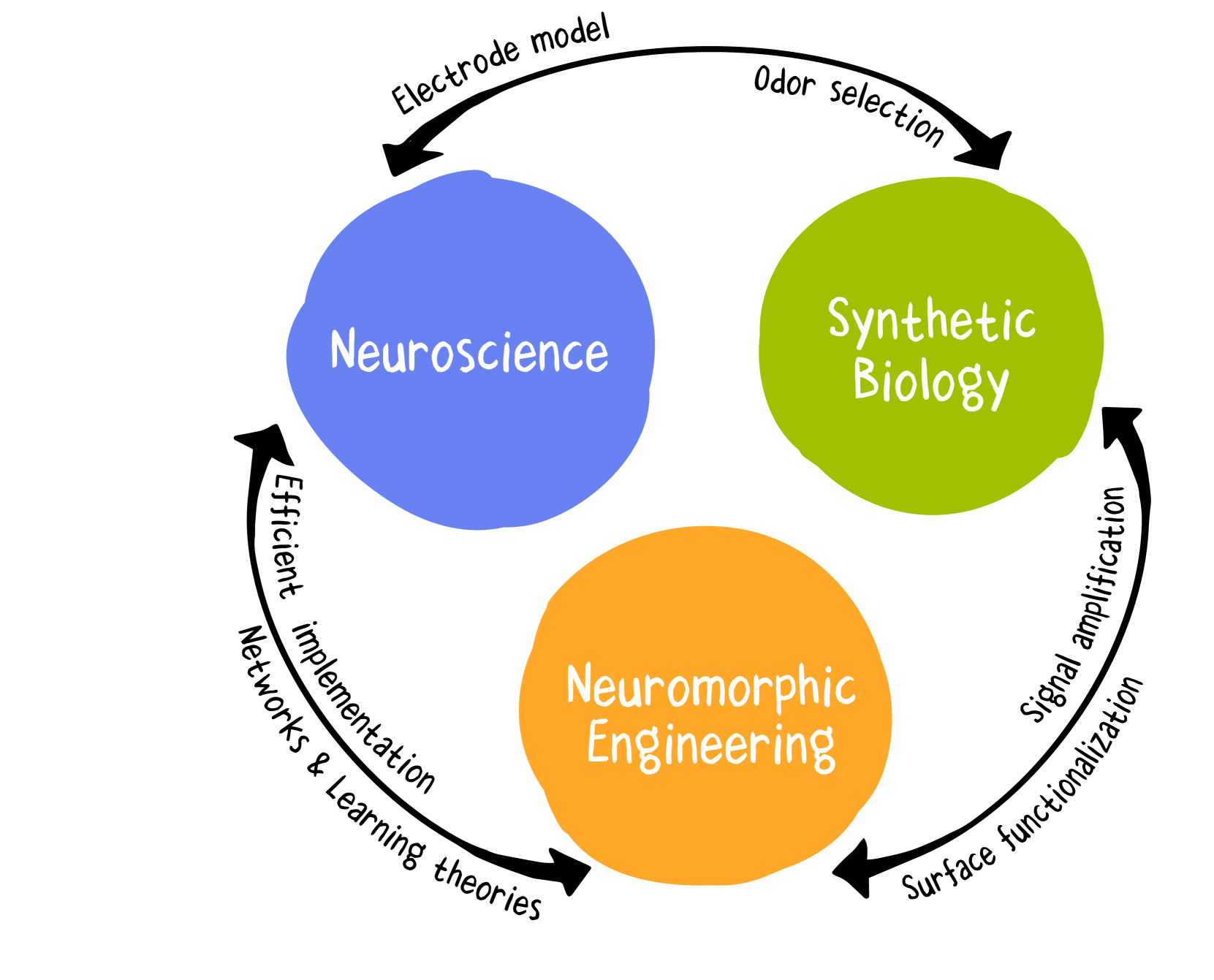
The diagram illustrates a cyclical, interconnected relationship between three scientific disciplines: Neuroscience, Synthetic Biology, and Neuromorphic Engineering. Arrows indicate directional processes linking these fields, emphasizing bidirectional knowledge transfer and collaborative innovation.
### Components/Axes
1. **Core Disciplines**:
- **Neuroscience** (Blue circle)
- **Synthetic Biology** (Green circle)
- **Neuromorphic Engineering** (Orange circle)
2. **Connecting Processes** (Arrows with labels):
- **Electrode model** (Neuroscience → Synthetic Biology)
- **Odor selection** (Synthetic Biology → Neuromorphic Engineering)
- **Efficient implementation** (Neuromorphic Engineering → Neuroscience)
- **Networks & Learning theories** (Neuroscience → Neuromorphic Engineering)
- **Signal amplification** (Synthetic Biology → Neuromorphic Engineering)
- **Surface functionalization** (Neuromorphic Engineering → Synthetic Biology)
### Detailed Analysis
- **Neuroscience** contributes to **Synthetic Biology** via "Electrode model" and "Odor selection," suggesting applications of neural principles in biological systems.
- **Synthetic Biology** feeds into **Neuromorphic Engineering** through "Signal amplification" and "Surface functionalization," indicating biological-inspired engineering solutions.
- **Neuromorphic Engineering** loops back to **Neuroscience** via "Efficient implementation" and "Networks & Learning theories," implying engineered systems inform neural research.
- **Cross-disciplinary processes** like "Odor selection" and "Surface functionalization" highlight specialized techniques bridging fields.
### Key Observations
- The diagram emphasizes **cyclical interdependence**, with no single field acting as a terminal endpoint.
- Processes like "Networks & Learning theories" and "Efficient implementation" suggest practical applications of theoretical knowledge.
- "Signal amplification" and "Surface functionalization" imply material science and biophysical innovations.
### Interpretation
This framework demonstrates a **closed-loop system** where advancements in one discipline directly enable progress in others. For example:
- Neuroscience-inspired "Electrode models" may improve synthetic biological systems, which in turn inform neuromorphic engineering designs.
- Neuromorphic engineering's "Efficient implementation" could refine neural network theories, creating feedback for further biological research.
The absence of linear hierarchy underscores the **equal importance** of each field in solving complex problems, such as brain-machine interfaces or bio-inspired AI. The diagram aligns with Peircean principles of abductive reasoning, where iterative cross-disciplinary inquiry drives innovation.