## Diagram: Process Flow with Input/Output Nodes
### Overview
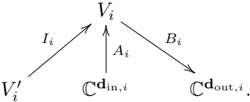
The diagram illustrates a flow or transformation process involving nodes and directional relationships. Key elements include labeled nodes (`Vi`, `Vi'`, `Ai`, `Bi`, `Ci`, `Cin,i`, `Cout,i`) and arrows indicating directional flow. The structure suggests a bifurcation or decision point within the system.
### Components/Axes
- **Nodes**:
- `Vi` (top center): Central input node.
- `Vi'` (bottom left): Output node connected to `Vi` via arrow labeled `Ii`.
- `Bi` (bottom right): Output node connected to `Vi` via arrow labeled `Bi`.
- `Ai` (vertical arrow from `Vi` to `Ci`): Intermediate transformation step.
- `Ci` (central bottom node): Splits into two sub-nodes.
- `Cin,i` (left sub-node of `Ci`): Labeled with `Cdin,i`.
- `Cout,i` (right sub-node of `Ci`): Labeled with `Cout,i`.
- **Arrows**:
- `Ii`: Connects `Vi` to `Vi'` (leftward).
- `Bi`: Connects `Vi` to `Bi` (rightward).
- `Ai`: Vertical arrow from `Vi` to `Ci`.
- `Cin,i` and `Cout,i`: Sub-nodes of `Ci` with directional labels.
### Detailed Analysis
- **Node Relationships**:
- `Vi` is the primary input, feeding into three paths:
1. Directly to `Vi'` via `Ii`.
2. Directly to `Bi` via `Bi`.
3. Through `Ai` to `Ci`, which bifurcates into `Cin,i` and `Cout,i`.
- `Ci` acts as a decision point, splitting the flow into two distinct outputs (`Cin,i` and `Cout,i`).
- **Label Placement**:
- All labels (`Ii`, `Bi`, `Ai`, `Cdin,i`, `Cout,i`) are positioned near their respective arrows or nodes.
- `Vi'` and `Bi` are terminal nodes, while `Ci` is an intermediate node with bifurcation.
### Key Observations
1. **Bifurcation at `Ci`**: The splitting of `Ci` into `Cin,i` and `Cout,i` suggests a critical decision or transformation step.
2. **Dual Output Paths**: `Vi` feeds into two direct outputs (`Vi'` and `Bi`) and one indirect path via `Ci`.
3. **Label Consistency**: Arrow labels (`Ii`, `Bi`, `Ai`) align with their directional flow, ensuring clarity in process steps.
### Interpretation
This diagram likely represents a system or process where an input (`Vi`) undergoes multiple transformations or decisions:
- **Direct Paths**: `Ii` and `Bi` may represent immediate outputs or side effects of `Vi`.
- **Indirect Path**: `Ai` and `Ci` suggest a more complex transformation, with `Ci` acting as a mediator that splits the flow into two specialized outputs (`Cin,i` and `Cout,i`).
- **Potential Applications**: Could model data flow in a computational system, decision trees in AI, or resource allocation in engineering.
The absence of numerical data or explicit units implies the diagram focuses on structural relationships rather than quantitative metrics. The labels (`Cdin,i`, `Cout,i`) hint at input/output data streams or conditions, but further context is needed for precise interpretation.