## Diagram: Grid-Based Creature Movement Puzzle
### Overview
The image depicts a grid-based puzzle with labeled sections (<image1> to <image7>). Key elements include:
- **<image1>**: Red ant with white flag (standing)
- **<image2>**: Simple house outline
- **<image3>**: Red ladybug
- **<image4>**: Red ant with white flag (walking)
- **<image5>**: Simple house outline
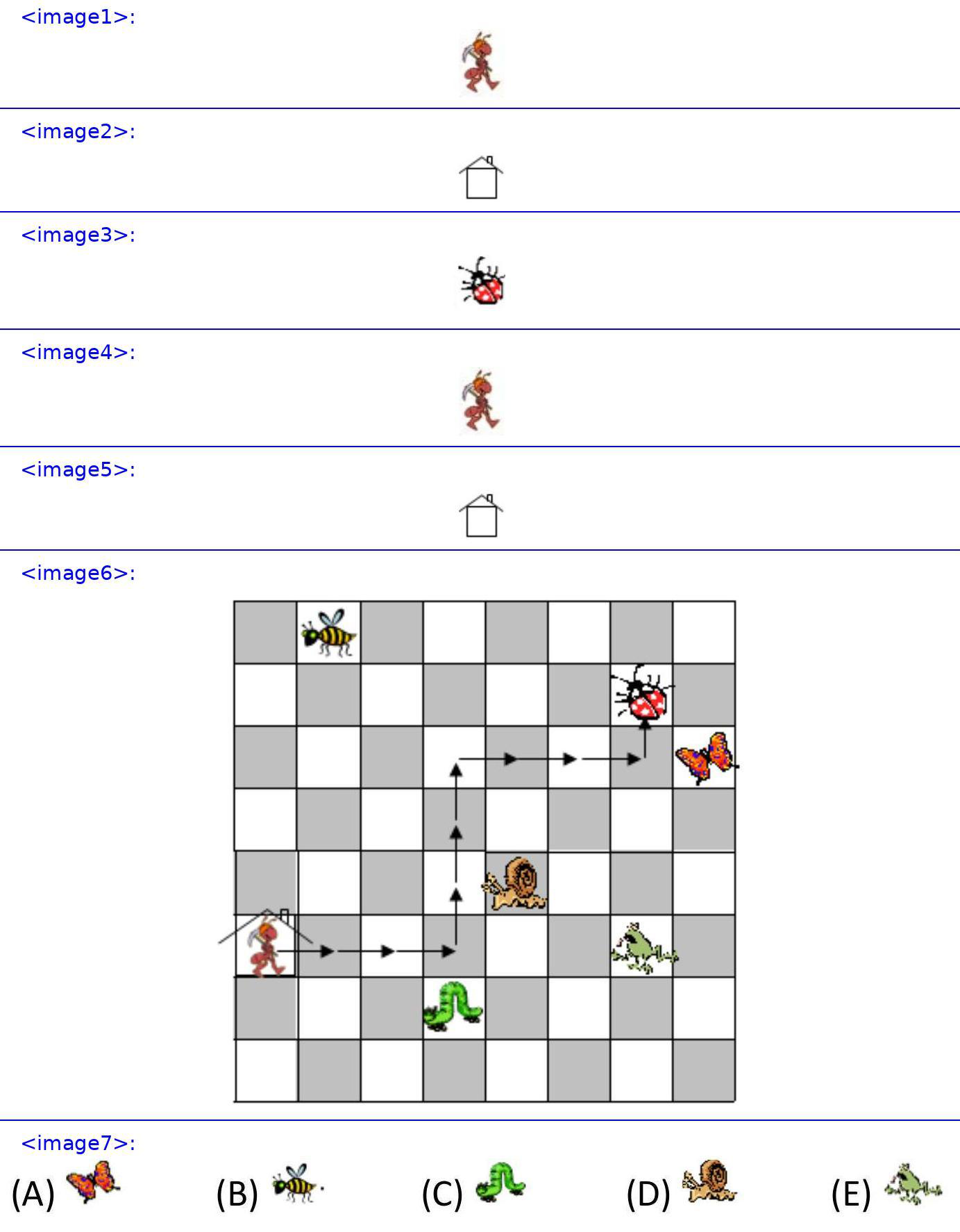
- **<image6>**: 5x5 grid with creatures and directional arrows
- **<image7>**: Multiple-choice options (A-E) with creature icons
### Components/Axes
1. **Grid Structure** (<image6>):
- 5x5 checkerboard pattern (alternating gray/white cells)
- No explicit axis labels, but cells are referenced by position
- Creatures occupy specific cells with directional arrows indicating movement paths
2. **Creature Labels**:
- Ant (red with white flag)
- Ladybug (red with black spots)
- Butterfly (orange/black wings)
- Snail (brown shell)
- Frog (green with red tongue)
- Worm (green segmented body)
3. **Directional Arrows**:
- Black arrows show movement between cells
- Arrows connect:
- Ant → Ladybug → Butterfly
- Ant → Snail → Worm
- Ant → Frog
4. **Multiple-Choice Options** (<image7>):
- (A) Butterfly
- (B) Bee (yellow/black stripes)
- (C) Worm
- (D) Snail
- (E) Frog
### Detailed Analysis
- **Grid Placement**:
- Ant: Top-left cell (row 1, column 1)
- Ladybug: Top-middle cell (row 1, column 3)
- Butterfly: Top-right cell (row 1, column 5)
- Snail: Middle row, middle column (row 3, column 3)
- Worm: Middle row, left column (row 3, column 1)
- Frog: Middle row, right column (row 3, column 5)
- **Arrow Connections**:
- Ant (1,1) → Ladybug (1,3) → Butterfly (1,5)
- Ant (1,1) → Snail (3,3) → Worm (3,1)
- Ant (1,1) → Frog (3,5)
- **Creature Repetition**:
- Ant appears in <image1> (standing) and <image4> (walking)
- House outline appears in <image2> and <image5>
### Key Observations
1. **Movement Constraints**:
- Arrows suggest sequential movement from ant to other creatures
- No direct path from ladybug/butterfly to other creatures
2. **Creature Distribution**:
- Ant is the only creature appearing in multiple images
- House outline is repeated but unlabeled
3. **Option Ambiguity**:
- Option (B) "Bee" does not appear in the grid
- All other options (A, C, D, E) correspond to grid creatures
### Interpretation
This appears to be a logic puzzle or game interface where:
1. The ant must navigate the grid to reach specific creatures
2. Arrows represent allowed movement paths
3. <image7> options likely represent choices for the next move
4. Repeated house outlines may indicate "home" positions or level markers
The puzzle emphasizes spatial reasoning and pathfinding, with the ant as the primary agent. The absence of a bee in the grid despite its inclusion in options suggests potential red herrings or incomplete information. The directional arrows create a dependency chain, requiring players to plan sequential moves carefully.