## Diagram: Collaborative LLM-Human System Architecture
### Overview
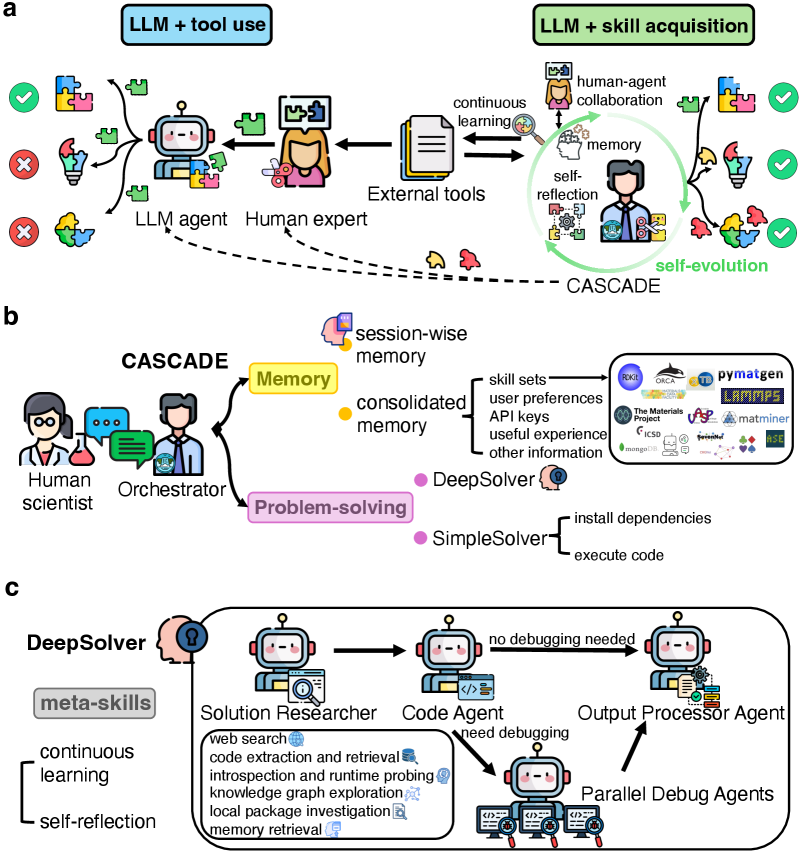
The image depicts a three-part technical architecture for a collaborative system integrating Large Language Models (LLMs), human expertise, and autonomous agents. It emphasizes skill acquisition, problem-solving, and continuous learning through human-agent collaboration.
### Components/Axes
#### Part a: LLM + Tool Use / LLM + Skill Acquisition
- **Key Elements**:
- **LLM Agent**: Interacts with external tools (e.g., puzzles, code snippets).
- **Human Expert**: Collaborates with the LLM agent, providing feedback (✓/✗ symbols).
- **External Tools**: Represented by puzzle pieces, code, and documents.
- **Memory**: Central to skill acquisition, with self-reflection and self-evolution loops.
- **Continuous Learning**: Arrows indicate iterative improvement.
- **Flow**:
- LLM agent uses tools → Human expert validates → Memory updates → Self-evolution.
#### Part b: CASCADE Framework
- **Key Elements**:
- **Human Scientist**: Oversees the system.
- **Orchestrator**: Manages workflow between agents.
- **Problem-Solving Agents**:
- **DeepSolver**: Handles complex tasks (e.g., code extraction, runtime probing).
- **SimpleSolver**: Executes basic tasks (e.g., code execution).
- **Memory**: Session-wise and consolidated memory.
- **User Preferences**: API keys, useful experiences.
- **Flow**:
- Human scientist → Orchestrator → Problem-solving agents → Memory integration.
#### Part c: DeepSolver Architecture
- **Key Elements**:
- **Meta-Skills**: Continuous learning, self-reflection.
- **Solution Researcher**: Performs web searches, code extraction, and runtime probing.
- **Code Agent**: Requires debugging (✗) or not (✓).
- **Output Processor Agent**: Finalizes results.
- **Parallel Debug Agents**: Handle debugging tasks.
- **Flow**:
- Solution Researcher → Code Agent → Output Processor Agent (with parallel debugging).
### Detailed Analysis
- **Part a**:
- The LLM agent’s tool use is validated by the human expert, with successful interactions (✓) and failures (✗).
- External tools (e.g., code, documents) feed into the LLM’s skill acquisition via memory and self-reflection.
- **Part b**:
- The CASCADE framework emphasizes memory consolidation and problem-solving hierarchies (DeepSolver for complex tasks, SimpleSolver for basic tasks).
- User preferences (API keys, experiences) guide the system’s behavior.
- **Part c**:
- DeepSolver integrates meta-skills (continuous learning, self-reflection) to autonomously resolve issues.
- The Solution Researcher handles knowledge graph exploration and local package investigation.
### Key Observations
1. **Human-AI Collaboration**: Human experts validate LLM outputs, ensuring accuracy and skill refinement.
2. **Memory-Centric Design**: Memory acts as a bridge between tool use, problem-solving, and skill acquisition.
3. **Autonomous Debugging**: Parallel Debug Agents in DeepSolver reduce reliance on human intervention.
4. **Hierarchical Problem-Solving**: Tasks are delegated to agents based on complexity (DeepSolver vs. SimpleSolver).
### Interpretation
This architecture demonstrates a symbiotic system where LLMs and humans co-evolve skills through iterative collaboration. The CASCADE framework ensures efficient problem-solving by leveraging memory and agent specialization, while DeepSolver’s meta-skills enable self-sufficiency in complex tasks. The emphasis on memory and self-reflection suggests a focus on long-term adaptability, positioning the system as a dynamic tool for technical workflows requiring both human insight and autonomous execution.