# Technical Analysis of Radar Charts
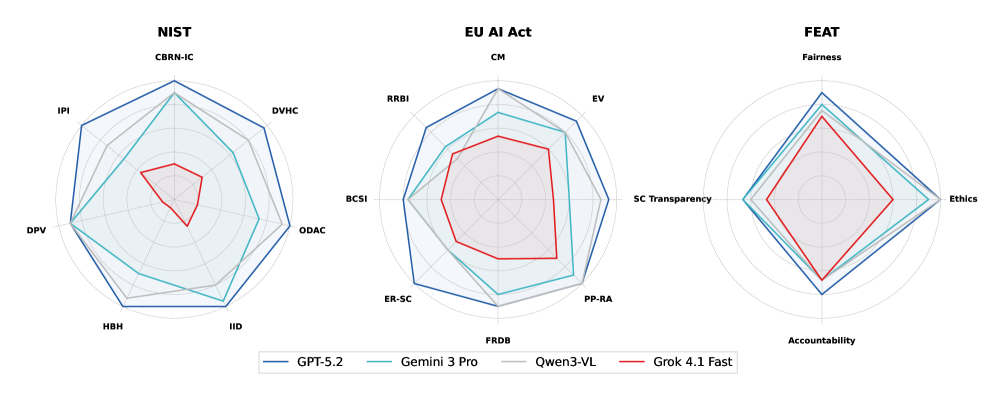
## Legend
- **Position**: Bottom center of the composite image
- **Labels & Colors**:
- `GPT-5.2` (Blue)
- `Gemini 3 Pro` (Teal)
- `Qwen3-VL` (Gray)
- `Grok 4.1 Fast` (Red)
---
## Chart 1: NIST
### Axes (Clockwise from Top):
1. `CBRN-IC`
2. `IPI`
3. `DPV`
4. `HBH`
5. `IID`
6. `ODAC`
7. `DVHC`
### Data Series Trends:
- **GPT-5.2 (Blue)**: Largest polygon, consistently highest values across all axes.
- **Gemini 3 Pro (Teal)**: Medium-sized polygon, values ~50-70% of GPT-5.2.
- **Qwen3-VL (Gray)**: Smaller polygon, values ~30-50% of GPT-5.2.
- **Grok 4.1 Fast (Red)**: Smallest polygon, values ~20-40% of GPT-5.2.
### Key Observations:
- GPT-5.2 dominates all axes, with `CBRN-IC` and `DVHC` showing the largest radial spread.
- Grok 4.1 Fast underperforms significantly, particularly on `HBH` and `IID`.
---
## Chart 2: EU AI Act
### Axes (Clockwise from Top):
1. `CM`
2. `RBI`
3. `BCSI`
4. `ER-SC`
5. `FRDB`
6. `PP-RA`
7. `EV`
### Data Series Trends:
- **GPT-5.2 (Blue)**: Largest polygon, highest values on `CM` and `EV`.
- **Gemini 3 Pro (Teal)**: Medium polygon, values ~60-80% of GPT-5.2.
- **Qwen3-VL (Gray)**: Smaller polygon, values ~40-60% of GPT-5.2.
- **Grok 4.1 Fast (Red)**: Smallest polygon, values ~30-50% of GPT-5.2.
### Key Observations:
- GPT-5.2 excels on `CM` and `EV`, while Grok 4.1 Fast struggles on `BCSI` and `FRDB`.
- Gemini 3 Pro shows balanced performance across most axes.
---
## Chart 3: FEAT
### Axes (Clockwise from Top):
1. `Fairness`
2. `SC Transparency`
3. `Ethics`
4. `Accountability`
### Data Series Trends:
- **GPT-5.2 (Blue)**: Largest polygon, highest values on `Ethics` and `Accountability`.
- **Gemini 3 Pro (Teal)**: Medium polygon, values ~70-90% of GPT-5.2.
- **Qwen3-VL (Gray)**: Smaller polygon, values ~50-70% of GPT-5.2.
- **Grok 4.1 Fast (Red)**: Smallest polygon, values ~40-60% of GPT-5.2.
### Key Observations:
- GPT-5.2 leads in `Ethics` and `Accountability`, while Grok 4.1 Fast lags on `Fairness` and `SC Transparency`.
- Gemini 3 Pro maintains strong performance across all axes.
---
## Spatial Grounding & Validation
- **Legend Position**: Bottom center (coordinates: [x_center, y_bottom]).
- **Color Consistency**: All lines match legend colors (e.g., GPT-5.2 = Blue in all charts).
- **Trend Verification**:
- GPT-5.2 consistently forms the outermost polygon in all charts.
- Grok 4.1 Fast forms the innermost polygon, confirming its lower performance.
---
## Summary
- **Dominant Model**: GPT-5.2 outperforms all others across all frameworks (NIST, EU AI Act, FEAT).
- **Weakest Model**: Grok 4.1 Fast shows the smallest radial spread, indicating poor alignment with evaluation criteria.
- **Framework-Specific Insights**:
- **NIST**: Focus on `CBRN-IC` and `DVHC` for GPT-5.2 strengths.
- **EU AI Act**: `CM` and `EV` highlight GPT-5.2's regulatory compliance.
- **FEAT**: `Ethics` and `Accountability` emphasize GPT-5.2's ethical AI alignment.