## Line Graph: Correctness vs. Number of Retries
### Overview
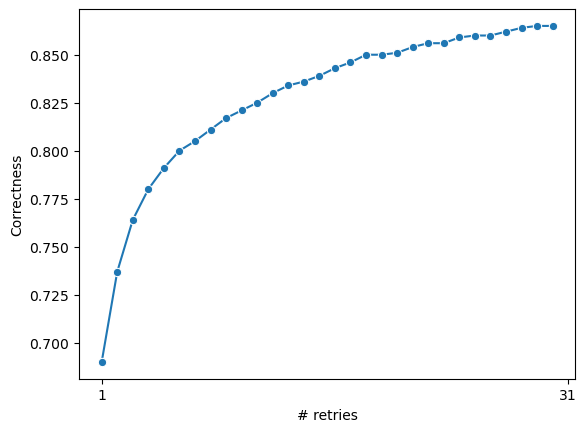
The image depicts a line graph illustrating the relationship between the number of retries (x-axis) and correctness (y-axis). The blue line shows a clear upward trend, starting at a correctness of 0.700 with 1 retry and reaching approximately 0.860 with 31 retries. The graph includes a legend in the top-right corner, confirming the blue line represents "Correctness."
### Components/Axes
- **X-axis**: Labeled "# retries," with values ranging from 1 to 31 in increments of 1.
- **Y-axis**: Labeled "Correctness," with values ranging from 0.700 to 0.850 in increments of 0.025.
- **Legend**: Positioned in the top-right corner, featuring a blue circle labeled "Correctness."
### Detailed Analysis
- **Data Points**:
- At 1 retry: Correctness = 0.700
- At 31 retries: Correctness ≈ 0.860
- **Trend**: The line exhibits a steep initial increase (from 1 to ~10 retries) followed by a gradual, linear rise. The slope decreases as retries increase, indicating diminishing returns.
- **Color Consistency**: The blue line matches the legend's blue circle, confirming accurate representation.
### Key Observations
1. **Initial Growth**: Correctness rises sharply from 0.700 to ~0.780 between 1 and 10 retries.
2. **Plateau Phase**: Between 10 and 31 retries, correctness increases more gradually, reaching ~0.860.
3. **Final Value**: The maximum correctness (0.860) is achieved at 31 retries, slightly exceeding the y-axis upper bound of 0.850.
### Interpretation
The graph demonstrates a positive correlation between the number of retries and correctness, suggesting that repeated attempts improve performance. The steep initial increase implies significant gains from early retries, while the plateau indicates diminishing marginal returns. The final value (~0.860) suggests a practical upper limit for correctness, even with extensive retries. This could reflect a system where initial errors are quickly corrected, but residual inaccuracies persist despite further attempts. The data underscores the importance of balancing retry efforts with resource constraints.