\n
## Diagram: Light Path Illustration
### Overview
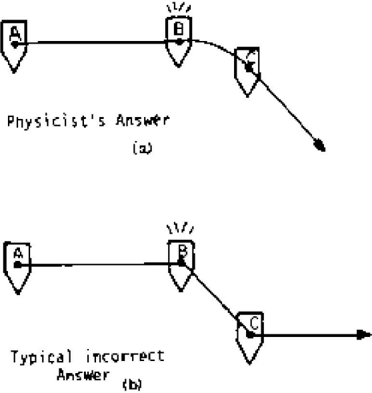
The image presents two diagrams illustrating different proposed paths of light. The diagrams are labeled "(a)" and "(b)", and are accompanied by descriptive text. The diagrams depict a light source (B) emitting light towards a surface, and the resulting path of the light.
### Components/Axes
The diagrams consist of the following components:
* **A**: A point representing the initial position or source of a line.
* **B**: A point representing a light source, depicted with radiating lines indicating light emission.
* **C**: A point representing a position on a reflected light path.
* Lines: Representing the path of light.
* Labels: "Physicist's Answer (a)" and "Typical Incorrect Answer (b)".
### Detailed Analysis or Content Details
**Diagram (a): "Physicist's Answer"**
* A straight line connects point A to point B.
* From point B, light radiates outwards.
* A curved line originates from point B, representing the path of light after interaction with a surface.
* The curved line intersects with a rectangular shape, which is likely representing a reflective surface.
* The light then continues in a straight line away from the reflective surface.
**Diagram (b): "Typical Incorrect Answer"**
* A straight line connects point A to point B.
* From point B, light radiates outwards.
* A straight line continues from point B to point C.
* A straight line continues from point C, representing the path of light.
### Key Observations
* Diagram (a) illustrates a curved path of light, likely representing refraction or reflection.
* Diagram (b) illustrates a straight path of light, which is presented as an incorrect answer.
* The diagrams are intended to demonstrate the correct and incorrect understanding of light propagation.
### Interpretation
The diagrams illustrate a common misconception about light propagation. The "Physicist's Answer" (a) correctly depicts the bending of light due to reflection or refraction, while the "Typical Incorrect Answer" (b) incorrectly assumes light travels in a straight line even after interacting with a surface. This suggests the diagrams are used to teach or explain the principles of optics, specifically the behavior of light when it encounters different media or surfaces. The diagrams are not providing quantitative data, but rather a qualitative illustration of a physical phenomenon. The use of "Physicist's Answer" vs. "Typical Incorrect Answer" suggests a pedagogical approach, highlighting the difference between a scientifically accurate understanding and a common intuitive error.