## Distribution Plot: Router Stability vs. MoE Layer
### Overview
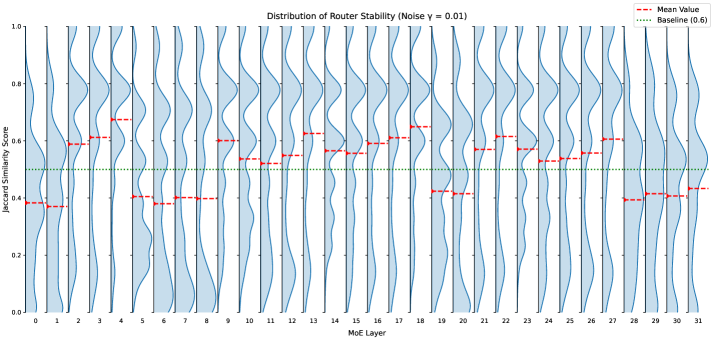
The image is a distribution plot showing the stability of routers across different MoE (Mixture of Experts) layers. The plot displays the Jaccard Similarity Score on the y-axis and the MoE Layer on the x-axis. Each layer has a distribution of Jaccard Similarity Scores represented by a filled blue shape. A red dashed line indicates the mean value for each layer, and a green dotted line represents a baseline value of 0.6. The title indicates that the noise level (gamma) is 0.01.
### Components/Axes
* **Title:** Distribution of Router Stability (Noise γ = 0.01)
* **X-axis:** MoE Layer, with integer values from 0 to 31.
* **Y-axis:** Jaccard Similarity Score, ranging from 0.0 to 1.0.
* **Distributions:** Blue filled shapes representing the distribution of Jaccard Similarity Scores for each MoE layer.
* **Mean Value:** Red dashed line indicating the mean Jaccard Similarity Score for each layer.
* **Baseline:** Green dotted line at a Jaccard Similarity Score of 0.6.
* **Legend (Top-Right):**
* Red dashed line: Mean Value
* Green dotted line: Baseline (0.6)
### Detailed Analysis
The plot consists of 32 distributions, one for each MoE layer from 0 to 31. Each distribution shows the range and density of Jaccard Similarity Scores for that layer. The red dashed line connects the mean values for each layer, showing how the average similarity score changes across the layers. The green dotted line provides a constant baseline for comparison.
Here's a breakdown of the mean values (red dashed line) for selected layers:
* **Layer 0:** Mean value is approximately 0.38.
* **Layer 1:** Mean value is approximately 0.38.
* **Layer 2:** Mean value is approximately 0.59.
* **Layer 3:** Mean value is approximately 0.62.
* **Layer 4:** Mean value is approximately 0.68.
* **Layer 5:** Mean value is approximately 0.41.
* **Layer 6:** Mean value is approximately 0.39.
* **Layer 7:** Mean value is approximately 0.40.
* **Layer 8:** Mean value is approximately 0.55.
* **Layer 9:** Mean value is approximately 0.60.
* **Layer 10:** Mean value is approximately 0.63.
* **Layer 11:** Mean value is approximately 0.57.
* **Layer 12:** Mean value is approximately 0.55.
* **Layer 13:** Mean value is approximately 0.57.
* **Layer 14:** Mean value is approximately 0.58.
* **Layer 15:** Mean value is approximately 0.58.
* **Layer 16:** Mean value is approximately 0.60.
* **Layer 17:** Mean value is approximately 0.68.
* **Layer 18:** Mean value is approximately 0.68.
* **Layer 19:** Mean value is approximately 0.42.
* **Layer 20:** Mean value is approximately 0.42.
* **Layer 21:** Mean value is approximately 0.58.
* **Layer 22:** Mean value is approximately 0.60.
* **Layer 23:** Mean value is approximately 0.63.
* **Layer 24:** Mean value is approximately 0.58.
* **Layer 25:** Mean value is approximately 0.58.
* **Layer 26:** Mean value is approximately 0.58.
* **Layer 27:** Mean value is approximately 0.42.
* **Layer 28:** Mean value is approximately 0.42.
* **Layer 29:** Mean value is approximately 0.42.
* **Layer 30:** Mean value is approximately 0.42.
* **Layer 31:** Mean value is approximately 0.45.
### Key Observations
* The mean Jaccard Similarity Score varies significantly across different MoE layers.
* Some layers (e.g., 4, 10, 17, 18, 23) have relatively high mean similarity scores, approaching or exceeding the baseline of 0.6.
* Other layers (e.g., 0, 1, 5, 6, 7, 19, 20, 27, 28, 29, 30) have lower mean similarity scores, indicating less stability or consistency in router behavior.
* The distributions themselves vary in shape and spread, suggesting different levels of variability in router stability within each layer.
### Interpretation
The plot provides insights into the stability of routers within a Mixture of Experts model across different layers. The Jaccard Similarity Score is used as a metric to quantify this stability. The variation in mean similarity scores and distribution shapes across layers suggests that some layers exhibit more consistent and stable router behavior than others.
The baseline of 0.6 serves as a benchmark for acceptable stability. Layers with mean values consistently above this baseline may be considered more reliable or effective in routing decisions. Conversely, layers with mean values below the baseline may require further investigation or optimization to improve their stability.
The distributions provide additional information about the variability within each layer. A narrow, peaked distribution indicates high consistency, while a wider, flatter distribution suggests greater variability in router behavior.
The "Noise γ = 0.01" in the title indicates that the model was trained or evaluated with a specific level of noise. This noise could affect the router stability and contribute to the observed variations across layers. Further analysis with different noise levels could provide additional insights into the robustness of the model.