## Diagram: Tree Transformation
### Overview
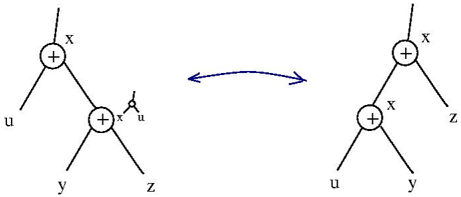
The image depicts a transformation of a tree structure, likely representing an algebraic expression. The transformation involves rearranging the nodes and branches of the tree while preserving the underlying mathematical meaning. The diagram shows two trees connected by a double-headed arrow, indicating a reversible transformation.
### Components/Axes
* **Nodes:** Each node is represented by a circle containing a "+" symbol, indicating an addition operation.
* **Branches:** Lines connecting the nodes represent the relationships between the operations and operands.
* **Leaves:** The terminal nodes of the tree are labeled with variables: u, x, y, and z.
* **Arrow:** A blue double-headed arrow indicates the transformation direction.
* **Labels:** The variables x, y, z, and u are used as labels.
### Detailed Analysis
**Left Tree:**
* The root node (top) is a "+" node labeled with "x".
* The left child of the root is labeled "u".
* The right child of the root is another "+" node labeled with "x".
* The left child of the second "+" node is labeled "y".
* The right child of the second "+" node is labeled "z".
* There is a small dangling node with a circle, labeled "x" and "u".
**Right Tree:**
* The root node (top) is a "+" node labeled with "x".
* The left child of the root is another "+" node labeled with "x".
* The right child of the root is labeled "z".
* The left child of the second "+" node is labeled "u".
* The right child of the second "+" node is labeled "y".
**Transformation:**
* The double-headed arrow indicates that the transformation can occur in either direction.
* The transformation essentially rearranges the order of addition, grouping "u" and "y" together before adding "z".
### Key Observations
* The transformation appears to be an application of the associative property of addition.
* The dangling node on the left tree is not present on the right tree, suggesting it might be an intermediate step or a simplification.
### Interpretation
The diagram illustrates the associative property of addition, which states that the grouping of operands in an addition operation does not affect the result. The transformation shows how the tree structure can be rearranged to reflect different groupings of the same operands. The dangling node on the left tree might represent a temporary variable or an intermediate calculation that is simplified in the final expression. The diagram demonstrates the flexibility in representing mathematical expressions and how they can be manipulated while preserving their meaning.