## Diagram: Node Transformation Relationship
### Overview
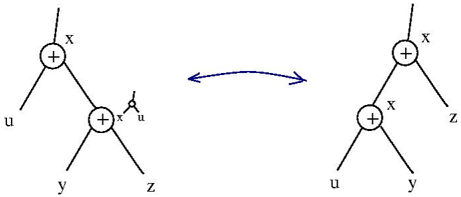
The image depicts two interconnected diagrams via a bidirectional arrow, illustrating a transformation or equivalence relationship between two node-based structures. Both diagrams use labeled nodes (+, x, u, y, z) with directional edges.
### Components/Axes
- **Nodes**:
- Left Diagram:
- Top node: `+` (root)
- Left child of `+`: `u`
- Right child of `+`: `x` (with a smaller `+x` node branching to `u`)
- Children of `x`: `y` and `z`
- Right Diagram:
- Top node: `+` (root)
- Left child of `+`: `x` (connected to `u`)
- Right child of `+`: `x` (connected to `z`)
- Children of `x` (right branch): `y`
- **Edges**:
- Solid lines represent parent-child relationships.
- Bidirectional arrow (`↔`) connects the two diagrams, indicating a reversible transformation.
### Detailed Analysis
- **Left Diagram**:
- The root `+` splits into `u` (left) and `x` (right).
- The `x` node has a sub-node `+x` (smaller circle) branching to `u`, suggesting a recursive or nested structure.
- `x` also connects to `y` and `z` as terminal nodes.
- **Right Diagram**:
- The root `+` splits into two `x` nodes:
- Left `x` connects to `u`.
- Right `x` connects to `z` and `y`.
- No nested `+x` sub-node is present.
### Key Observations
1. **Structural Symmetry**: Both diagrams share the same set of labels (`u, x, y, z`) but differ in node connections.
2. **Bidirectional Relationship**: The arrow implies the transformation between the diagrams is reversible (e.g., a mathematical isomorphism or algorithmic operation).
3. **Nested Node**: The left diagram’s `+x` sub-node introduces a hierarchical layer absent in the right diagram.
### Interpretation
The diagrams likely represent a computational or mathematical transformation, such as:
- **Tree Rotation**: Rearranging nodes while preserving relationships (e.g., balancing a binary tree).
- **Graph Isomorphism**: Demonstrating equivalence between two structures under specific operations.
- **Algorithmic Step**: Illustrating a before/after state in a process (e.g., data restructuring).
The absence of numerical values suggests the focus is on topological or logical relationships rather than quantitative data. The bidirectional arrow emphasizes reversibility, critical in contexts like reversible computing or reversible logic circuits.