## Network Graph: Bimodal Node-Link Diagram
### Overview
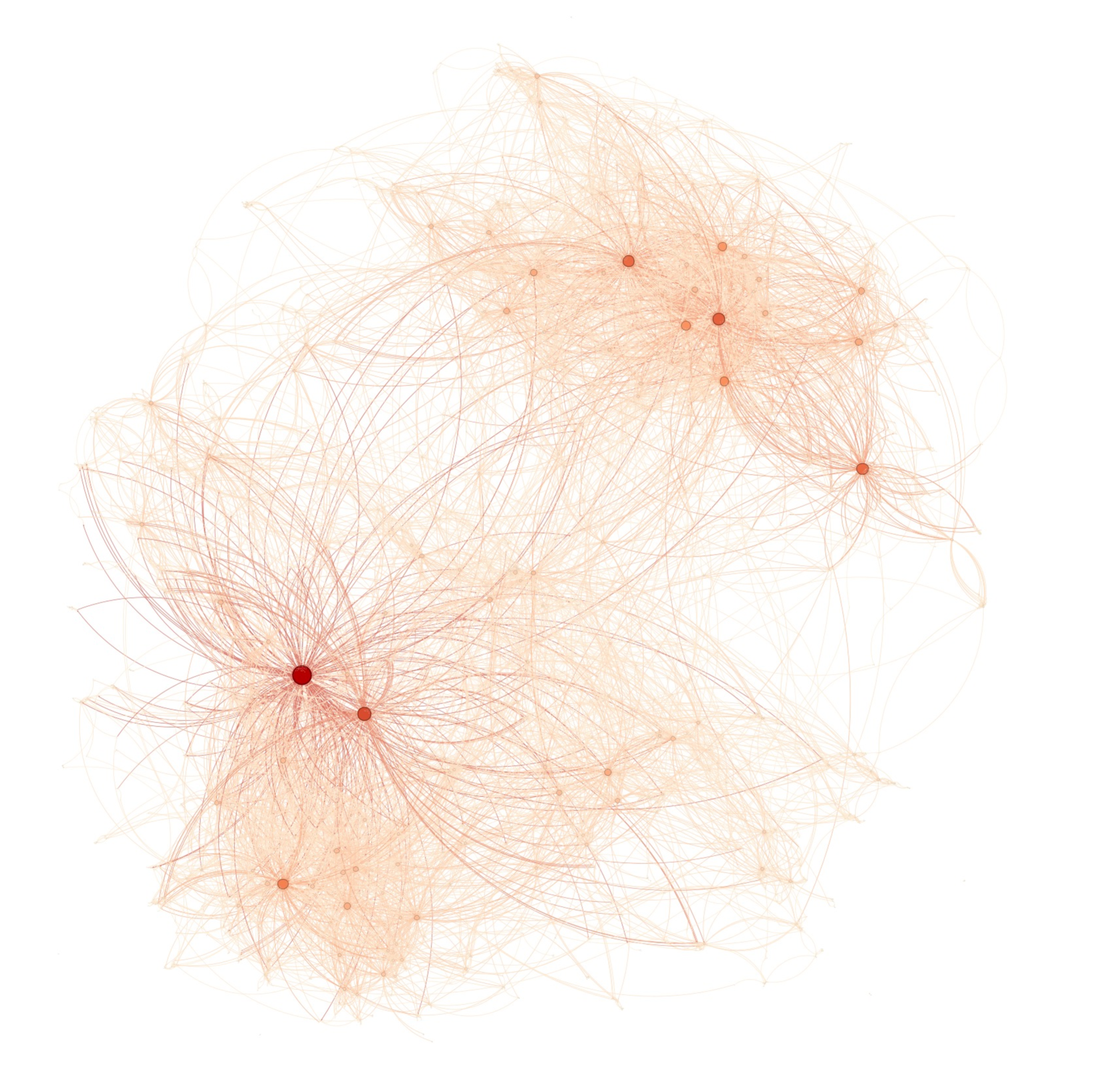
This image displays a complex network graph (specifically a node-link diagram) rendered against a solid white background. The visualization maps the relationships and interconnectivity between hundreds to thousands of individual entities.
**CRITICAL NOTE:** This image contains absolutely no text, labels, axes, legends, or explicit numerical data. Therefore, specific factual data points (e.g., exact values, categories, or metrics) cannot be extracted. The following analysis is derived entirely from the visual topology, clustering patterns, and the visual encoding (size, color, density) of the network elements.
### Components/Axes
In the absence of explicit legends or axes, the data is encoded through the following visual components:
* **Nodes (Vertices):** Represented by circular points.
* *Size:* Varies significantly. Larger size correlates with a higher number of connections (degree centrality).
* *Color:* Ranges from pale, translucent peach/orange (small, peripheral nodes) to deep, opaque crimson red (large, highly connected hub nodes).
* **Edges (Links):** Represented by curved lines connecting the nodes.
* *Color/Opacity:* Ranges from very faint, translucent peach to darker reddish-brown. Darker lines appear to indicate either higher edge weight (stronger connections) or the visual accumulation of multiple overlapping edges in dense areas.
* **Layout:** The spatial distribution appears to be generated by a force-directed layout algorithm. This type of algorithm simulates physical forces, pulling highly connected nodes closer together into clusters while pushing disconnected nodes apart, revealing the underlying structure of the network.
### Detailed Analysis (Spatial Grounding & Component Isolation)
To accurately describe the topology, the image can be segmented into distinct spatial regions:
**1. Bottom-Left Primary Cluster (The Major Hub)**
* *Position:* Centered in the lower-left quadrant of the graph.
* *Description:* This is the densest and most visually dominant region of the network.
* *Key Features:* It contains the single largest and darkest red node in the entire graph. This node acts as a massive central hub. Immediately to its right (approx. 4 o'clock position relative to the main hub) is a secondary, slightly smaller dark red node. Hundreds of distinct, curved edges radiate outward from these central points in a dense "starburst" or hub-and-spoke pattern, connecting to a vast cloud of smaller, lighter-colored peripheral nodes.
**2. Top-Right Secondary Cluster**
* *Position:* Located in the upper-right quadrant.
* *Description:* A distinct, secondary center of gravity within the network. It is less dense than the bottom-left cluster but highly structured.
* *Key Features:* It features one prominent dark red hub node. Unlike the primary cluster, this hub is closely surrounded by a constellation of 4 to 5 medium-sized, moderately red nodes. The connections here form a complex, interconnected web among these medium hubs, rather than a single massive starburst.
**3. Far-Right Peripheral Hub**
* *Position:* Located on the far right edge, slightly below the horizontal midline.
* *Description:* A smaller, isolated sub-cluster.
* *Key Features:* It contains one medium-dark red node with a localized, distinct starburst of connections radiating outward, primarily connecting back toward the Top-Right Secondary Cluster.
**4. The Interstitial Web (Connecting Tissue)**
* *Position:* The space between the major clusters (running diagonally from top-left to bottom-right).
* *Description:* This area is characterized by long, sweeping, curved edges that bridge the distinct clusters.
* *Key Features:* While the clusters are spatially separated, the dense webbing of faint lines between them indicates that the sub-networks are highly integrated. There are very few isolated nodes; almost everything eventually connects back to the main hubs.
### Key Observations
* **Bimodal Distribution:** The network is fundamentally bimodal, dominated by two massive super-clusters (bottom-left and top-right) that dictate the overall shape of the graph.
* **Scale-Free Topology:** The visual evidence strongly suggests a "scale-free" network topology. The vast majority of nodes are small and have very few connections, while a tiny minority of nodes (the dark red circles) possess a massive number of connections.
* **Curved Edge Bundling:** The edges are drawn as sweeping curves (splines) rather than straight lines. This is a common data visualization technique used to reduce visual clutter in highly dense graphs, allowing the viewer to see the flow of connections without the center becoming a solid, unreadable block of color.
### Interpretation
Because we lack the specific data labels, we must interpret the *structural meaning* of this graph.
* **System Dynamics:** This topology is typical of systems like social networks (where the red nodes are massive influencers or central figures), biological networks (like protein-protein interactions where central nodes are vital genes), or transportation/routing networks (like major airline hubs).
* **Efficiency vs. Vulnerability:** The network is highly efficient for transferring information/resources. Because of the massive central hubs, it likely takes very few "hops" to get from any one node to any other node in the network. However, this structure represents a significant vulnerability. If the single largest node in the bottom-left were removed or failed, that entire half of the network would likely fragment into disconnected pieces. The system relies heavily on a few critical points of failure.
* **Community Structure:** The distinct separation between the bottom-left and top-right clusters suggests two distinct "communities" or sub-groups within the broader dataset. While they interact (evidenced by the interstitial web), their internal connections are much stronger than their external connections to each other.