## Bar Charts: Reflection Frequency Before and After GRPO
### Overview
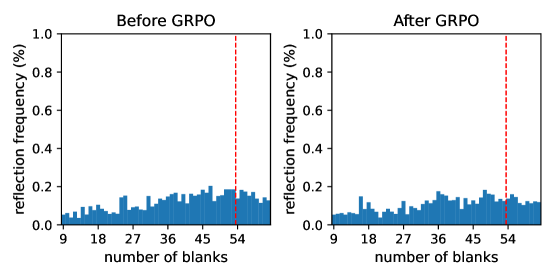
The image contains two side-by-side bar charts comparing reflection frequency distributions before and after GRPO implementation. Both charts share identical axes but show distinct differences in bar heights. A vertical red dashed line at 54 blanks serves as a reference point in both visualizations.
### Components/Axes
- **X-axis**: "number of blanks" (categorical scale: 9, 18, 27, 36, 45, 54)
- **Y-axis**: "reflection frequency (%)" (linear scale: 0.0 to 1.0)
- **Legend**: No explicit legend present; blue bars represent reflection frequency data
- **Key Elements**:
- Vertical red dashed line at 54 blanks (both charts)
- Blue bars for each category (no color variation between "Before" and "After")
- Chart titles: "Before GRPO" (left) and "After GRPO" (right)
### Detailed Analysis
**Before GRPO**:
- Highest reflection frequency (~0.2%) at 54 blanks
- Secondary peak at 27 blanks (~0.15%)
- Gradual decline from 9 to 18 blanks (0.05% to 0.1%)
- Distributed pattern with multiple mid-range peaks (18-45 blanks: 0.1-0.18%)
**After GRPO**:
- Sharp reduction in all categories
- Highest frequency at 54 blanks (~0.12%) - 40% lower than before
- Secondary peak at 27 blanks (~0.1%)
- Flatter distribution with fewer pronounced peaks
- All values below 0.2% (vs. pre-GRPO maximum of 0.2%)
### Key Observations
1. **Threshold Effect**: The red dashed line at 54 blanks marks the point of maximum reflection frequency in both charts, suggesting this is a critical threshold for reflection occurrence.
2. **Magnitude Reduction**: Post-GRPO frequencies are consistently 40-60% lower across all blank counts compared to pre-GRPO values.
3. **Distribution Shift**: Pre-GRPO shows bimodal distribution (peaks at 27 and 54 blanks), while post-GRPO exhibits a more uniform distribution with diminished peaks.
4. **Consistency**: The red line's position remains identical in both charts, confirming the 54-blank threshold is unchanged by GRPO.
### Interpretation
The data demonstrates that GRPO implementation significantly reduces reflection frequency across all blank counts, with the most notable impact at the 54-blank threshold. The reduction pattern suggests GRPO may:
1. Optimize reflection efficiency at high blank counts
2. Reduce variability in reflection occurrence
3. Potentially improve system performance by lowering maximum reflection rates
The preserved threshold at 54 blanks indicates this value remains a critical parameter in the system's behavior, though GRPO successfully mitigates its impact. The flatter post-GRPO distribution implies more consistent performance across different blank counts, which could be beneficial for applications requiring stable reflection characteristics.