## Line Graphs: Comparative Performance of Face Recognition Models on CMC and ROC Metrics
### Overview
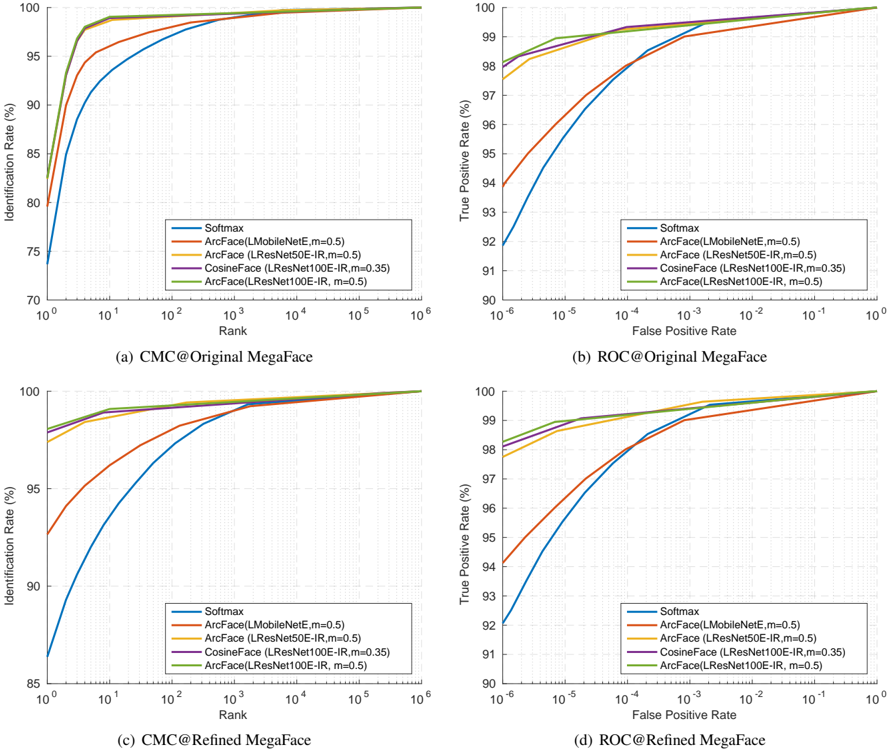
The image contains four line graphs comparing the performance of face recognition models across two datasets (Original MegaFace and Refined MegaFace) using two evaluation metrics: CMC (Cumulative Match Characteristic) and ROC (Receiver Operating Characteristic). Each graph evaluates five models: Softmax, ArcFace with different backbones (LMobileNetE, LResNet50E-IR, LResNet100E-IR) and parameters (m=0.5 or m=0.35). The graphs are arranged in a 2x2 grid, with CMC metrics on the top row and ROC metrics on the bottom row.
---
### Components/Axes
#### Graph (a): CMC@Original MegaFace
- **X-axis**: Rank (logarithmic scale: 10⁰ to 10⁶)
- **Y-axis**: Identification Rate (%) (linear scale: 70% to 100%)
- **Legend**: Bottom-right corner, labels include:
- Softmax (blue)
- ArcFace(LMobileNetE, m=0.5) (orange)
- ArcFace(LResNet50E-IR, m=0.5) (purple)
- CosineFace(LResNet100E-IR, m=0.35) (green)
- ArcFace(LResNet100E-IR, m=0.5) (red)
#### Graph (b): ROC@Original MegaFace
- **X-axis**: False Positive Rate (logarithmic scale: 10⁻⁶ to 10⁰)
- **Y-axis**: True Positive Rate (%) (linear scale: 90% to 100%)
- **Legend**: Bottom-right corner, same labels as (a).
#### Graph (c): CMC@Refined MegaFace
- **X-axis**: Rank (logarithmic scale: 10⁰ to 10⁶)
- **Y-axis**: Identification Rate (%) (linear scale: 85% to 100%)
- **Legend**: Bottom-right corner, same labels as (a).
#### Graph (d): ROC@Refined MegaFace
- **X-axis**: False Positive Rate (logarithmic scale: 10⁻⁶ to 10⁰)
- **Y-axis**: True Positive Rate (%) (linear scale: 90% to 100%)
- **Legend**: Bottom-right corner, same labels as (a).
---
### Detailed Analysis
#### Graph (a): CMC@Original MegaFace
- **Trends**:
- All models show increasing Identification Rate with lower Rank.
- **ArcFace(LResNet100E-IR, m=0.5)** (red) achieves the highest Identification Rate (~99% at Rank 10³).
- **Softmax** (blue) lags significantly, reaching ~95% at Rank 10⁴.
- **ArcFace(LMobileNetE, m=0.5)** (orange) and **CosineFace(LResNet100E-IR, m=0.35)** (green) perform similarly, with ~97% at Rank 10³.
#### Graph (b): ROC@Original MegaFace
- **Trends**:
- All models achieve high True Positive Rates (>97%) at low False Positive Rates (<10⁻³).
- **ArcFace(LResNet100E-IR, m=0.5)** (red) and **CosineFace(LResNet100E-IR, m=0.35)** (green) dominate, maintaining ~99% TPR at FPR <10⁻⁴.
- **Softmax** (blue) underperforms, with TPR ~93% at FPR 10⁻².
#### Graph (c): CMC@Refined MegaFace
- **Trends**:
- Similar to (a), but all models show slightly improved performance.
- **ArcFace(LResNet100E-IR, m=0.5)** (red) reaches ~99.5% at Rank 10³.
- **Softmax** (blue) improves marginally to ~96% at Rank 10⁴.
#### Graph (d): ROC@Refined MegaFace
- **Trends**:
- All models achieve near-perfect TPR (>98%) at low FPR (<10⁻³).
- **ArcFace(LResNet100E-IR, m=0.5)** (red) and **CosineFace(LResNet100E-IR, m=0.35)** (green) maintain ~99.5% TPR at FPR <10⁻⁴.
- **Softmax** (blue) improves to ~94% at FPR 10⁻².
---
### Key Observations
1. **ArcFace superiority**: ArcFace variants consistently outperform Softmax across all metrics and datasets.
2. **Backbone impact**: LResNet100E-IR backbones (e.g., ArcFace and CosineFace) achieve the highest accuracy, suggesting deeper networks improve performance.
3. **Parameter sensitivity**: The `m` parameter in ArcFace (e.g., m=0.5 vs. m=0.35) has minimal impact on performance in this dataset.
4. **Refinement effect**: Refined MegaFace datasets show marginally better results than Original MegaFace, but differences are small (~1-2% improvement).
---
### Interpretation
The data demonstrates that **ArcFace with LResNet100E-IR backbones** is the most effective model for face recognition, achieving near-perfect Identification Rates and True Positive Rates. Softmax, a traditional baseline, underperforms significantly, highlighting the advantages of modern deep learning approaches. The slight improvements in Refined MegaFace suggest dataset quality impacts model performance, but architectural choices (e.g., ArcFace) remain the dominant factor. The `m` parameter in ArcFace appears less critical in this context, indicating robustness across parameter settings. These results align with prior research emphasizing the importance of deep feature extraction in face recognition tasks.