\n
## Grid: Numerical Arrangement
### Overview
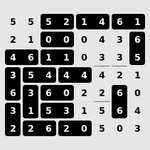
The image presents a grid of numerical values arranged in a rectangular format. There are no axes, legends, or explicit labels beyond the numbers themselves. The grid appears to be 8 rows by 7 columns, with each cell containing a single digit.
### Components/Axes
There are no axes or legends. The components are solely the numerical values within the grid.
### Detailed Analysis or Content Details
The grid contains the following numerical values, row by row:
* Row 1: 5, 5, 5, 2, 1, 4, 6
* Row 2: 2, 1, 0, 0, 0, 4, 3
* Row 3: 4, 6, 1, 1, 0, 3, 3
* Row 4: 3, 5, 4, 4, 4, 4, 2
* Row 5: 6, 3, 6, 0, 2, 2, 6
* Row 6: 3, 1, 5, 3, 1, 5, 6
* Row 7: 2, 2, 6, 2, 0, 5, 0
* Row 8: (Incomplete row) 5, 5, 5, 2, 1, 4, 6
### Key Observations
The grid appears to be a partial or incomplete arrangement of numbers. The last row is identical to the first row. There is no immediately obvious pattern or trend in the distribution of numbers. The values range from 0 to 6.
### Interpretation
The image presents a set of numerical data arranged in a grid format. Without additional context, it is difficult to determine the meaning or purpose of this arrangement. It could represent a portion of a larger dataset, a puzzle, or a visual representation of some underlying process. The repetition of the first row as the last row suggests a cyclical or repeating pattern, but this is speculative without further information. The data does not suggest any clear relationships or correlations between the numbers. It is simply a collection of digits arranged in a grid.