## Flowchart: System Architecture for Adaptive Task Management
### Overview
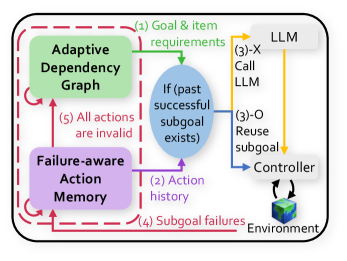
The diagram illustrates a dynamic system where an LLM (Large Language Model) interacts with a Controller and Environment to manage tasks. Key components include an **Adaptive Dependency Graph**, **Failure-aware Action Memory**, and feedback loops for handling subgoal failures. The flow emphasizes adaptability, memory of past actions, and conditional logic for reusing or calling new subgoals.
---
### Components/Axes
1. **Adaptive Dependency Graph** (green): Represents task dependencies and constraints.
2. **Failure-aware Action Memory** (purple): Stores historical action data and failures.
3. **LLM** (yellow): Interacts with the Controller to call or reuse subgoals.
4. **Controller** (black): Mediates between LLM, Environment, and Memory.
5. **Environment** (blue cube): External system interacting with the Controller.
6. **Legend Colors**:
- Green: Goal & item requirements
- Blue: Action history
- Yellow: LLM interactions
- Red: Subgoal failures/invalid actions
- Purple: Memory updates
- Black: Controller
---
### Detailed Analysis
1. **Goal & Item Requirements** (green arrow):
- Input to the Adaptive Dependency Graph.
- Triggers the system workflow.
2. **Action History** (blue arrow):
- Feeds into the Failure-aware Action Memory.
- Used to determine if a past successful subgoal exists.
3. **LLM Interactions** (yellow arrows):
- **(3)-X Call LLM**: Invokes the LLM when no past subgoal exists.
- **(3)-O Reuse Subgoal**: Reuses a past subgoal if available.
4. **Subgoal Failures** (red arrow):
- Loops back to the Failure-aware Action Memory for analysis.
5. **Invalid Actions** (red dashed loop):
- All actions marked invalid trigger a memory update.
6. **Controller-Environment Loop** (black arrows):
- The Controller sends outputs to the Environment and receives feedback.
---
### Key Observations
- **Feedback Loops**: The system prioritizes learning from failures (red) and past successes (blue).
- **Conditional Logic**: The LLM’s role shifts between calling new subgoals (3-X) and reusing existing ones (3-O) based on memory.
- **Central Role of Memory**: The Failure-aware Action Memory acts as a hub for storing and retrieving action history.
- **Adaptive Graph**: The green graph dynamically adjusts based on task requirements and memory updates.
---
### Interpretation
This system is designed for **adaptive task management**, where the LLM and Controller collaborate to optimize workflows. The **Failure-aware Action Memory** ensures robustness by learning from past errors, while the **Adaptive Dependency Graph** maintains task constraints. The Controller’s dual role in mediating LLM-Environment interactions and memory updates highlights its critical function in balancing efficiency and adaptability. The emphasis on reusing past subgoals (3-O) suggests a focus on reducing computational overhead, while the red failure loops indicate a proactive approach to error handling. Overall, the diagram reflects a **closed-loop system** where feedback drives continuous improvement.