## Flowchart: ENERGY-AWARE OPTIMIZATION ENGINE
### Overview
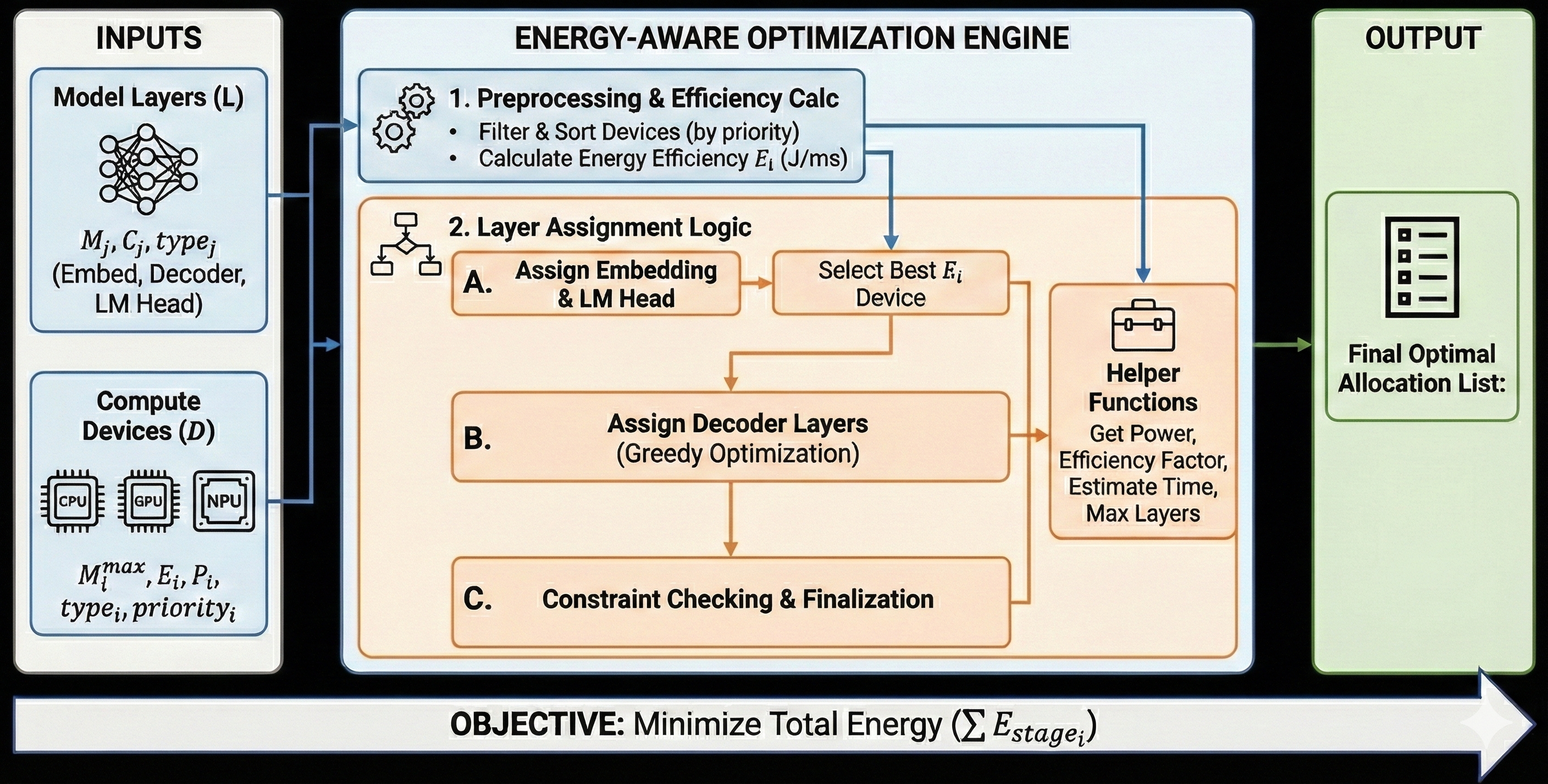
The diagram illustrates a multi-stage optimization engine designed to minimize total energy consumption (ΣE_stage_i) for deploying machine learning models. It processes inputs (model layers and compute devices), applies energy-aware layer assignment logic, and outputs an optimal allocation list.
### Components/Axes
#### INPUTS
1. **Model Layers (L)**
- Parameters: `M_j`, `C_j`, `type_j` (Embed, Decoder, LM Head)
- Visualized as interconnected nodes.
2. **Compute Devices (D)**
- Types: CPU, GPU, NPU
- Attributes: `M_i^max` (max memory), `E_i` (energy), `P_i` (power), `type_i`, `priority_i`
- Visualized as hardware icons.
#### ENGINE
1. **Preprocessing & Efficiency Calc**
- Tasks:
- Filter & Sort Devices (by priority)
- Calculate Energy Efficiency `E_i` (J/ms)
2. **Layer Assignment Logic**
- **A. Assign Embedding & LM Head**
- **B. Assign Decoder Layers** (Greedy Optimization)
- **C. Constraint Checking & Finalization**
3. **Helper Functions**
- Tasks:
- Get Power
- Efficiency Factor
- Estimate Time
- Max Layers
#### OUTPUT
- **Final Optimal Allocation List** (checklist icon)
### Detailed Analysis
- **Flow Direction**:
- Inputs → Preprocessing → Layer Assignment → Helper Functions → Output.
- **Key Relationships**:
- Energy efficiency (`E_i`) directly influences device selection.
- Greedy optimization is applied to decoder layers, prioritizing immediate energy savings.
- Constraints ensure feasibility (e.g., memory, power limits).
### Key Observations
- **Energy-Centric Design**: All stages prioritize minimizing `ΣE_stage_i`.
- **Hierarchical Optimization**:
- Preprocessing filters devices by priority before efficiency calculations.
- Layer assignment balances greedy optimization (decoder layers) with constraint adherence.
- **Modularity**: Helper functions abstract power, efficiency, and time estimation.
### Interpretation
The engine demonstrates a systematic approach to energy-aware resource allocation:
1. **Priority Filtering**: Ensures high-priority devices are considered first, potentially overriding raw efficiency metrics.
2. **Greedy Optimization**: Focuses on immediate energy savings for decoder layers, which may be computationally intensive.
3. **Constraint Enforcement**: Prevents over-allocation (e.g., exceeding device memory).
4. **Final Allocation**: Balances energy efficiency with operational constraints, producing a practical deployment plan.
The absence of numerical values suggests the diagram emphasizes workflow logic over quantitative results. The use of greedy optimization implies a trade-off between optimality and computational simplicity.