\n
## Scatter Plot with Regression: High School Statistics Confidence vs. Target Length
### Overview
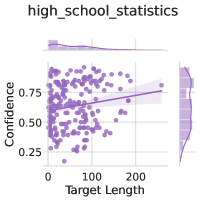
The image is a statistical visualization, specifically a scatter plot with an overlaid linear regression line and marginal distribution plots. It explores the relationship between "Target Length" and "Confidence" within a context labeled "high_school_statistics". The plot suggests a positive correlation between the two variables.
### Components/Axes
* **Title:** `high_school_statistics` (centered at the top).
* **X-Axis:**
* **Label:** `Target Length` (centered below the axis).
* **Scale:** Linear scale ranging from 0 to approximately 250.
* **Major Tick Marks:** 0, 100, 200.
* **Y-Axis:**
* **Label:** `Confidence` (rotated 90 degrees, centered to the left of the axis).
* **Scale:** Linear scale ranging from approximately 0.25 to 0.75.
* **Major Tick Marks:** 0.25, 0.50, 0.75.
* **Data Series:**
* **Scatter Points:** Numerous purple circular markers representing individual data points.
* **Regression Line:** A solid, darker purple line showing the best linear fit through the data.
* **Confidence Interval:** A semi-transparent purple shaded band surrounding the regression line, indicating the uncertainty of the fit.
* **Marginal Distributions:**
* **Top Marginal Plot:** A horizontal density plot or histogram showing the distribution of the `Target Length` variable. It is positioned directly above the main plot area.
* **Right Marginal Plot:** A vertical density plot or histogram showing the distribution of the `Confidence` variable. It is positioned directly to the right of the main plot area.
### Detailed Analysis
* **Data Distribution & Trend:**
* The scatter points are densely clustered in the lower-left quadrant of the plot, specifically where `Target Length` is between 0-100 and `Confidence` is between 0.50-0.75.
* The data becomes sparser as `Target Length` increases beyond 100.
* The regression line has a clear **positive slope**, rising from left to right. This indicates a positive correlation: as `Target Length` increases, `Confidence` tends to increase.
* The shaded confidence interval around the regression line is narrower in the region with dense data (low Target Length) and widens slightly as Target Length increases, reflecting greater uncertainty where data is sparse.
* **Marginal Distributions:**
* The **top marginal plot** shows a right-skewed distribution for `Target Length`. The highest density is near 0, with a long tail extending towards 250.
* The **right marginal plot** shows a roughly symmetric, unimodal distribution for `Confidence`, centered around 0.60-0.65.
### Key Observations
1. **Positive Correlation:** The primary observation is the positive linear relationship between Target Length and Confidence.
2. **Data Concentration:** The majority of observations have a short Target Length (<100) and a moderate to high Confidence (>0.50).
3. **Outliers/Sparse Data:** There are relatively few data points with a Target Length greater than 150, making the trend in that region less certain.
4. **Variable Ranges:** Confidence values are bounded between approximately 0.25 and 0.80, while Target Length spans a wider relative range from 0 to over 200.
### Interpretation
This chart suggests that in the context of "high school statistics," tasks or items with a longer "Target Length" (which could refer to the length of a problem, answer, or study material) are associated with higher reported or measured "Confidence." The positive slope of the regression line quantifies this relationship.
The concentration of data at lower Target Lengths implies that most items in this dataset are relatively short. The widening confidence interval for longer targets indicates that predictions become less reliable for these less common cases. The marginal distributions confirm that while Confidence is normally distributed around a moderate value, Target Length is heavily skewed towards shorter items.
From a Peircean investigative perspective, this correlation could be interpreted in several ways without additional context: longer targets might provide more information, leading to higher confidence; they might be associated with more advanced topics where confidence is naturally higher; or there could be a methodological bias where confidence is overestimated for longer tasks. The chart establishes a relationship but does not reveal causation.