\n
## Diagram: Pre-Training - Adaptation Interface
### Overview
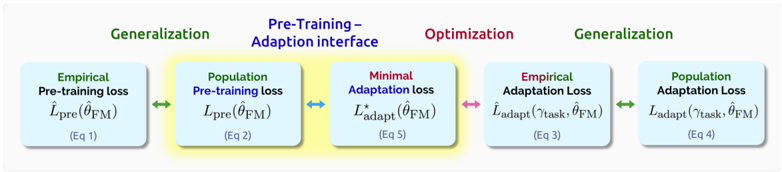
The image is a diagram illustrating a process flow related to pre-training and adaptation in a machine learning context. It depicts a sequence of loss calculations and their relationship to generalization and optimization. The diagram uses colored arrows to indicate the direction of information flow and labels each step with a specific loss function and equation number.
### Components/Axes
The diagram consists of six rectangular blocks arranged horizontally. Each block represents a loss function. The blocks are labeled as follows:
1. **Empirical Pre-training loss:** `L_pre(θFM)` (Eq 1)
2. **Population Pre-training loss:** `L_pre(θFM)` (Eq 2)
3. **Minimal Adaptation loss:** `L_adapt(θFM)` (Eq 5)
4. **Empirical Adaptation Loss:** `L_adapt(γtask, θFM)` (Eq 3)
5. **Population Adaptation Loss:** `L_adapt(γtask, θFM)` (Eq 4)
Above the blocks are labels indicating the stages of the process: "Generalization", "Pre-Training – Adaptation interface", and "Optimization", "Generalization".
Arrows connect the blocks, indicating the flow of information. A yellow, dashed arrow connects blocks 1 and 2, and blocks 3 and 4. A blue arrow connects blocks 2 and 3. A green arrow connects blocks 4 and 5.
### Detailed Analysis or Content Details
The diagram shows a cyclical process.
* **Block 1 (Empirical Pre-training loss):** Labeled with `L_pre(θFM)` and equation number (Eq 1).
* **Block 2 (Population Pre-training loss):** Labeled with `L_pre(θFM)` and equation number (Eq 2).
* **Block 3 (Minimal Adaptation loss):** Labeled with `L_adapt(θFM)` and equation number (Eq 5).
* **Block 4 (Empirical Adaptation Loss):** Labeled with `L_adapt(γtask, θFM)` and equation number (Eq 3).
* **Block 5 (Population Adaptation Loss):** Labeled with `L_adapt(γtask, θFM)` and equation number (Eq 4).
The yellow dashed arrow indicates a relationship between the empirical and population pre-training losses, and between the minimal adaptation loss and the empirical adaptation loss. The blue arrow indicates a flow from population pre-training loss to minimal adaptation loss. The green arrow indicates a flow from empirical adaptation loss to population adaptation loss.
The labels "Generalization" appear above blocks 1 and 5, "Pre-Training – Adaptation interface" above blocks 2 and 3, and "Optimization" above block 4.
### Key Observations
The diagram highlights the interplay between pre-training and adaptation losses, emphasizing the concepts of empirical and population losses. The cyclical nature suggests an iterative process of refinement. The use of different colors for the arrows may indicate different types of relationships or information flow.
### Interpretation
This diagram illustrates a framework for adapting a pre-trained model to a new task. The pre-training phase (blocks 1 & 2) establishes a general representation, while the adaptation phase (blocks 3, 4 & 5) fine-tunes the model for the specific task. The distinction between empirical and population losses suggests a focus on both fitting the training data and generalizing to unseen data. The "Pre-Training – Adaptation interface" highlights the critical point where the pre-trained knowledge is leveraged for the new task. The cyclical flow suggests an iterative optimization process where the adaptation loss is used to refine the model parameters. The diagram suggests a method to minimize adaptation while maximizing generalization. The equations (Eq 1-5) likely represent the mathematical formulations of these loss functions, but their specific details are not visible in the image. The parameters `θFM` and `γtask` likely represent the model parameters and task-specific parameters, respectively.