\n
## Text Block: Economic Impacts of Bottled Water
### Overview
The image presents a block of text discussing the economic impacts of the bottled water industry. It details the industry's global worth, consumption trends, and potential consequences of banning bottled water, including impacts on jobs, revenue, and environmental innovation.
### Content Details
The text can be transcribed as follows:
"Economic Impacts
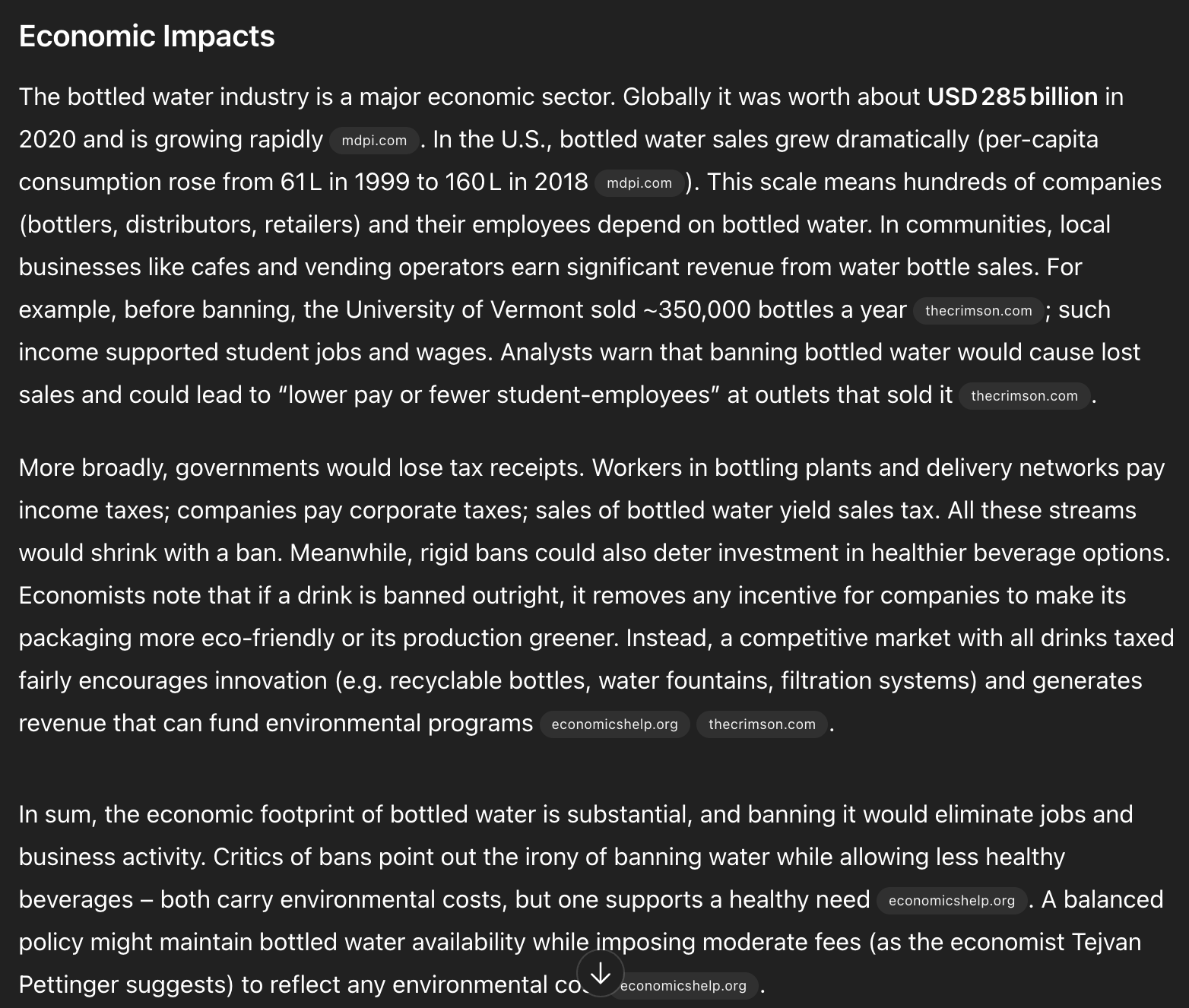
The bottled water industry is a major economic sector. Globally it was worth of **USD 285 billion** in 2020 and is growing rapidly [mdpi.com]. In the U.S., bottled water sales grew dramatically (per-capita consumption rose from **61L** in **1999** to **160L** in **2018** [mdpi.com]). This scale means hundreds of companies (bottlers, distributors, retailers) and their employees depend on bottled water. In communities, local businesses like cafes and vending operators earn significant revenue from water bottle sales. For example, before banning, the University of Vermont sold ~**350,000 bottles a year** [thecrimson.com]; such income supported student jobs and wages. Analysts warn that banning bottled water would cause lost sales and could lead to “lower pay or fewer student-employees” at outlets that sold it [thecrimson.com].
More broadly, governments would lose tax receipts. Workers in bottling plants and delivery networks pay income taxes; companies pay corporate taxes; sales of bottled water yield sales tax. All these streams would shrink with a ban. Meanwhile, rigid bans could also deter investment in healthier beverage options. Economists note that if a drink is banned outright, it removes any incentive for companies to make its packaging more eco-friendly or its production greener. Instead, a competitive market with all drinks taxed fairly encourages innovation (e.g. recyclable bottles, water fountains, filtration systems) and generates revenue that can fund environmental programs [economicshelp.org] [thecrimson.com].
In sum, the economic footprint of bottled water is substantial, and banning it would eliminate jobs and business activity. Critics of bans point out the irony of banning water while allowing less healthy beverages – both carry environmental costs, but one supports a healthy need [economicshelp.org]. A balanced policy might maintain bottled water availability while imposing moderate fees (as the economist Tevjan Pettinger suggests) to reflect any environmental co[economicshelp.org]."
### Key Observations
* **Financial Value:** The global bottled water industry was valued at USD 285 billion in 2020.
* **Consumption Increase:** Per-capita consumption in the U.S. increased significantly from 61L in 1999 to 160L in 2018.
* **University Example:** The University of Vermont sold approximately 350,000 bottles of water per year before a ban.
* **Tax Revenue:** Banning bottled water would result in lost tax revenue for governments.
* **Innovation Incentive:** A ban removes incentives for eco-friendly packaging and production.
* **Website References:** The text cites three websites: mdpi.com, thecrimson.com, and economicshelp.org.
### Interpretation
The text argues that the bottled water industry is a significant economic force and that banning it would have substantial negative consequences. It highlights the industry's contribution to jobs, revenue, and innovation. The author suggests that a more balanced approach, such as taxation, might be preferable to an outright ban, as it could address environmental concerns while preserving the economic benefits of bottled water. The text presents a pro-industry perspective, emphasizing the economic downsides of prohibition while acknowledging the environmental costs associated with both bottled water and other beverages. The inclusion of specific data points (USD 285 billion, 61L/160L, 350,000 bottles) lends credibility to the argument. The references to economists and specific examples (University of Vermont) further strengthen the case.