## Text Block: Economic Impacts of the Bottled Water Industry
### Overview
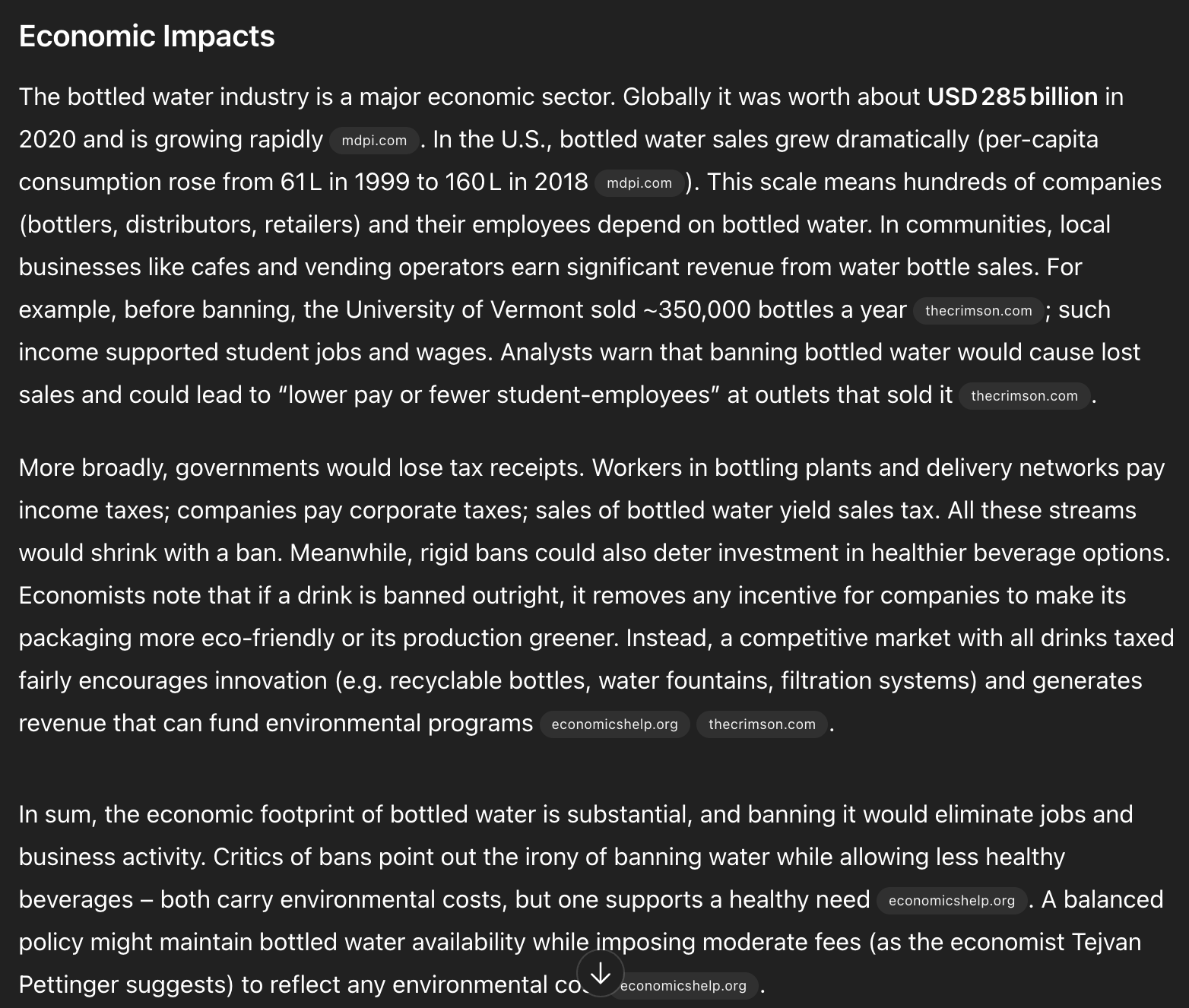
The image is a screenshot of a text document titled "Economic Impacts." It presents a detailed argument about the significant economic footprint of the global bottled water industry and the potential negative consequences of implementing bans on the product. The text is structured into three paragraphs, each containing embedded source citations.
### Components/Axes
* **Title:** "Economic Impacts" (displayed in bold, larger font at the top).
* **Main Body Text:** Three paragraphs of prose text.
* **Citations:** Inline source references formatted as small, grey-background tags (e.g., `mdpi.com`, `thecrimson.com`, `economicshelp.org`). These are embedded within the sentences they support.
* **Layout:** The text is left-aligned on a dark grey background. A downward-pointing arrow icon is partially visible at the very bottom, suggesting this is part of a scrollable interface.
### Detailed Analysis / Content Details
**Paragraph 1:**
* **Global Industry Value:** The bottled water industry was worth approximately **USD 285 billion** in 2020 and is described as "growing rapidly." (Source: `mdpi.com`)
* **U.S. Consumption Growth:** Per-capita consumption in the U.S. rose from **61 L in 1999** to **160 L in 2018**. (Source: `mdpi.com`)
* **Employment & Local Revenue:** The industry supports hundreds of companies and their employees. Local businesses (cafes, vending operators) earn significant revenue from sales.
* **Specific Example:** Before a ban, the University of Vermont sold approximately **350,000 bottles a year**. (Source: `thecrimson.com`)
* **Impact of Bans:** Analysts warn bans would cause lost sales, potentially leading to "lower pay or fewer student-employees" at affected outlets. (Source: `thecrimson.com`)
**Paragraph 2:**
* **Government Revenue Loss:** Governments would lose tax receipts from:
* Income taxes paid by workers in bottling plants and delivery networks.
* Corporate taxes paid by companies.
* Sales tax from bottled water sales.
* **Investment Deterrence:** Rigid bans could deter investment in healthier beverage options.
* **Economic Argument Against Bans:** Economists argue that an outright ban removes incentives for companies to make packaging more eco-friendly or production greener.
* **Proposed Alternative:** A competitive market with fair taxation on all drinks is suggested to encourage innovation (e.g., recyclable bottles, water fountains, filtration systems) and generate revenue for environmental programs. (Sources: `economicshelp.org`, `thecrimson.com`)
**Paragraph 3 (Conclusion):**
* **Summary of Economic Footprint:** The economic footprint is "substantial," and banning would eliminate jobs and business activity.
* **Critics' Irony:** Critics point out the irony of banning water (a healthy need) while allowing less healthy beverages, noting both have environmental costs. (Source: `economicshelp.org`)
* **Balanced Policy Suggestion:** A balanced policy might maintain availability while imposing moderate fees to reflect environmental costs, as suggested by economist Tejvan Pettinger. (Source: `economicshelp.org`)
* **Final Line (Partially Cut Off):** The text ends mid-sentence: "...to reflect any environmental co..." The visible citation is `economicshelp.org`.
### Key Observations
1. **Data-Driven Argument:** The text relies on specific, cited data points (market value, consumption volumes, sales figures) to ground its economic argument.
2. **Multi-Stakeholder Impact:** It details impacts across various stakeholders: global corporations, local businesses, employees (including students), and government tax bases.
3. **Policy Nuance:** The argument moves beyond a simple "ban vs. no ban" dichotomy, proposing a market-based, fee-oriented solution as a middle path.
4. **Rhetorical Framing:** The conclusion uses the concept of "irony" to frame the debate, contrasting bottled water with less healthy but permitted beverages.
### Interpretation
The text presents a **Peircean investigative** analysis of the bottled water debate, focusing on the **pragmatic consequences** (the "pragmatic maxim") of a potential ban. It argues that the **sign** of a ban (the policy action) would lead to a chain of **interpretants** (lost jobs, reduced tax revenue, stifled innovation) that are economically detrimental. The underlying **ground** for this argument is the industry's deep integration into local and global economic systems.
The text suggests that the debate is not merely environmental but deeply economic. It positions bottled water not as a luxury good but as a commodity with a vast, embedded supply chain. The proposed solution—moderate fees—aims to internalize environmental externalities without dismantling the economic structure, reflecting a **market-environmentalist** perspective. The most significant anomaly highlighted is the potential for a ban to paradoxically reduce incentives for environmental innovation within the industry, a counterintuitive outcome that challenges simplistic regulatory approaches.