## Text Block: Economic Impacts of the Bottled Water Industry
### Overview
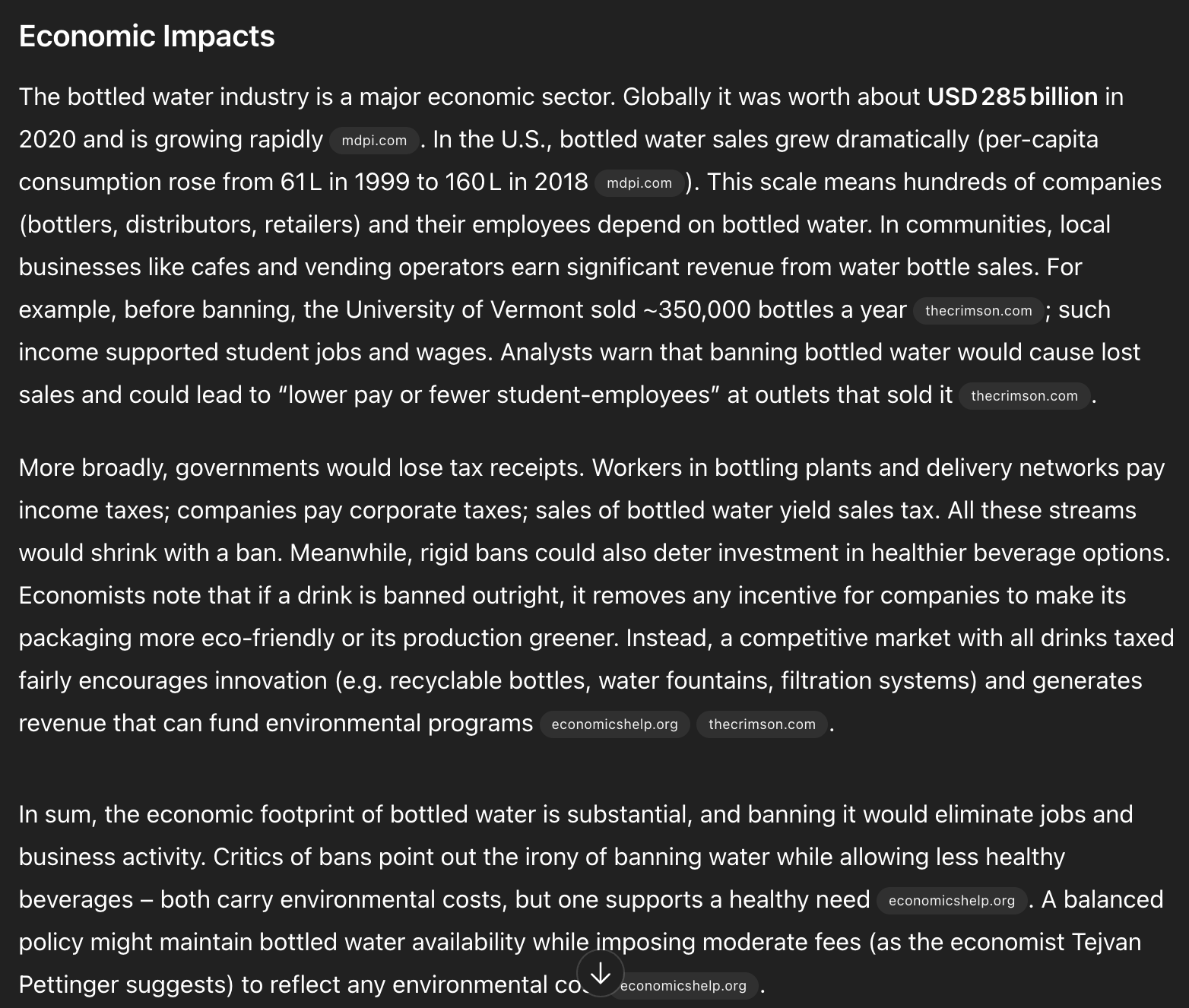
The image contains a block of text discussing the economic significance of the bottled water industry, its growth trends, employment dependencies, tax implications, and debates around bans versus eco-friendly alternatives.
### Components/Axes
- **Headings**:
- "Economic Impacts" (bold, top-left).
- Subheadings: "More broadly," "In sum."
- **Text Structure**:
- Paragraphs with inline references (e.g., `mdpi.com`, `thecrimson.com`, `economicshelp.org`).
- Bolded terms: "USD 285 billion," "per-capita consumption rose," "lower pay," "eco-friendly."
### Detailed Analysis
1. **Industry Scale**:
- Global bottled water market valued at **USD 285 billion** in 2020.
- U.S. per-capita consumption increased from **61L (1999)** to **160L (2018)**.
- Growth driven by bottlers, distributors, retailers, and their employees.
2. **Economic Dependencies**:
- Local businesses (cafes, vending operators) earn significant revenue from water sales.
- Example: University of Vermont sold ~350,000 bottles/year pre-ban, supporting student jobs.
3. **Tax and Revenue Impacts**:
- Governments lose tax receipts from bottling plants, delivery networks, and sales taxes.
- Bans could reduce corporate tax revenue and deter investment in healthier alternatives.
4. **Environmental and Policy Debates**:
- Bans may eliminate jobs but could incentivize eco-friendly innovations (e.g., recyclable bottles, water fountains).
- Economists suggest **moderate fees** (à la Tejvan Pettinger) to balance environmental costs and revenue generation.
### Key Observations
- **Growth Trends**: Rapid industry expansion (61L → 160L per capita) highlights economic reliance.
- **Job and Tax Risks**: Bans threaten employment and tax streams critical to public funding.
- **Irony of Bans**: Critics argue banning water while allowing less healthy beverages is contradictory.
### Interpretation
The text underscores the bottled water industry’s substantial economic footprint, emphasizing job creation, tax contributions, and community revenue. Critics of bans highlight the paradox of prioritizing environmental concerns over economic stability, while economists propose fee-based policies to align profitability with sustainability. The debate centers on balancing ecological responsibility with economic pragmatism, suggesting that outright bans may harm more than they help without compensatory measures.
**References**:
- `mdpi.com` (industry growth data).
- `thecrimson.com` (University of Vermont example).
- `economicshelp.org` (policy recommendations).