## Diagram: State Transition Diagram with AND Logic
### Overview
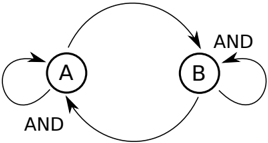
The image is a state transition diagram illustrating the interaction between two states, A and B, governed by AND logic. The diagram shows transitions between the states and self-loops within each state.
### Components/Axes
* **States:**
* State A: Represented by a circle labeled "A".
* State B: Represented by a circle labeled "B".
* **Transitions:** Arrows indicate the direction of state transitions.
* **Logic:** "AND" labels indicate the conditions required for certain transitions.
### Detailed Analysis
* **State A:**
* Self-loop: An arrow loops from State A back to itself, labeled "AND". This indicates that State A can remain in State A under certain conditions.
* Transition to State B: An arrow goes from State A to State B.
* Transition from State B: An arrow goes from State B to State A, labeled "AND".
* **State B:**
* Self-loop: An arrow loops from State B back to itself, labeled "AND". This indicates that State B can remain in State B under certain conditions.
* Transition to State A: An arrow goes from State B to State A, labeled "AND".
* Transition from State A: An arrow goes from State A to State B.
### Key Observations
* Both states have self-loops governed by "AND" logic, suggesting that they can maintain their current state based on specific conditions.
* The transitions between State A and State B are bidirectional.
* The transition from State B to State A, and State A to State A, and State B to State B are all governed by "AND" logic.
### Interpretation
The diagram represents a system with two states, A and B, where transitions between them and maintenance of their current state depend on specific conditions represented by "AND" logic. The bidirectional transitions suggest a dynamic interaction between the states, where each state can influence the other. The "AND" logic implies that multiple conditions must be met for a state transition or maintenance to occur. This type of diagram is commonly used in control systems, automata theory, and software engineering to model stateful behavior.