## Diagram: Data Processing Node Network
### Overview
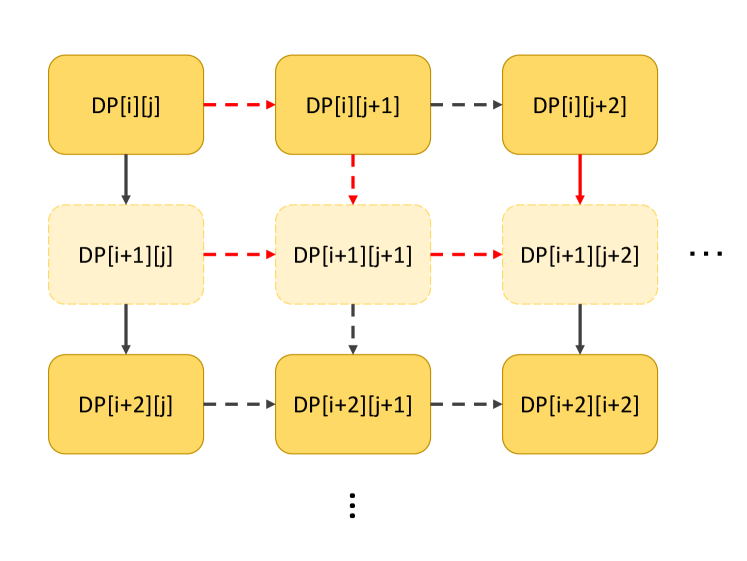
The diagram illustrates a structured network of data processing nodes arranged in a grid pattern. Nodes are labeled with DP[i][j] notation, where "i" and "j" represent row and column indices. Arrows indicate directional relationships between nodes, with distinct styling for horizontal vs vertical connections. The middle row of nodes is visually emphasized through background highlighting.
### Components/Axes
- **Nodes**:
- Labeled using DP[i][j] syntax (e.g., DP[1][1], DP[2][3])
- Organized in a 3x3 grid structure (visible portion)
- Color-coded:
- Top/bottom rows: Yellow background
- Middle row: Light yellow background
- **Arrows**:
- Horizontal connections: Dashed red arrows (left-to-right flow)
- Vertical connections: Solid black arrows (top-to-bottom flow)
- **Special Elements**:
- Middle row nodes highlighted with light yellow background
- Ellipsis (...) indicates continuation beyond visible grid
### Detailed Analysis
1. **Node Relationships**:
- Horizontal flow: DP[i][j] → DP[i][j+1] → DP[i][j+2] (dashed red)
- Vertical flow: DP[i][j] → DP[i+1][j] → DP[i+2][j] (solid black)
- Diagonal relationships implied through combined flows
2. **Indexing Pattern**:
- Row index "i" increments downward (top=1, middle=2, bottom=3)
- Column index "j" increments rightward (left=1, center=2, right=3)
3. **Highlighted Middle Row**:
- DP[2][j] nodes emphasized through background color
- Suggests special processing layer or priority status
### Key Observations
1. Structured grid organization enables systematic data flow
2. Dual-directional connectivity allows both row-wise and column-wise processing
3. Middle row emphasis implies potential bottleneck or critical processing stage
4. Consistent labeling convention supports scalable network expansion
### Interpretation
This diagram represents a multi-stage data processing pipeline where:
1. **Horizontal Flow** (dashed red): Represents sequential processing within the same row (e.g., feature extraction stages)
2. **Vertical Flow** (solid black): Indicates data aggregation or transformation between processing layers
3. **Middle Row Emphasis**: Suggests this layer might contain:
- Core processing logic
- Data validation checkpoint
- Resource-intensive operations
4. The grid structure enables:
- Parallel processing capabilities
- Modular system design
- Scalable architecture through index-based addressing
The network's design implies a balance between horizontal data propagation and vertical transformation, with the middle row serving as a critical integration point. The consistent labeling convention and directional arrows create a self-documenting system that could be extended to larger dimensions while maintaining operational clarity.