\n
## Diagram: Early Electrical Experiment Setup
### Overview
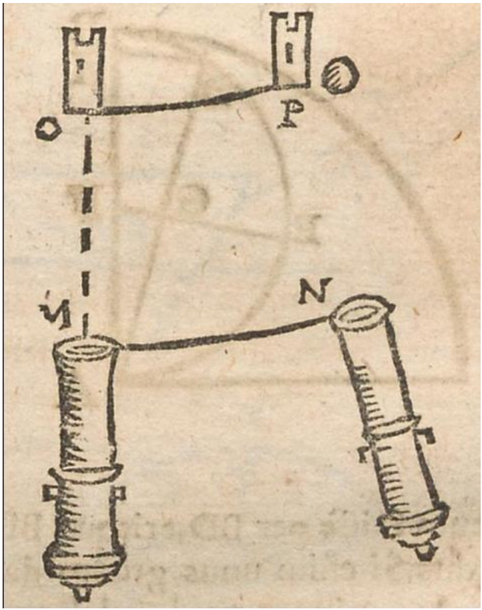
The image depicts a hand-drawn diagram of an early electrical experiment setup, likely from the 17th or 18th century. It shows a Leyden jar connected to two cylindrical objects, possibly intended to demonstrate static electricity. The drawing is in a faded, aged style, suggesting it's a reproduction of an older illustration.
### Components/Axes
The diagram features the following labeled components:
* **Leyden Jar:** Represented by a rectangular shape with two vertical protrusions at the top, labeled "P". A small circle is positioned to the right of the jar.
* **Vertical Cylinders:** Two cylindrical shapes are present. The left cylinder is labeled "S" and the right cylinder is labeled "N".
* **Connecting Lines:** Solid and dashed lines connect the components. A dashed line connects the top of the Leyden jar to the top of the left cylinder ("S"). A solid line connects the right side of the Leyden jar to the right cylinder ("N").
* **Small Circles:** Two small circles are present, one near the Leyden jar and one near the top of the Leyden jar.
There are no axes or scales present in this diagram. It is a schematic representation rather than a quantitative chart.
### Detailed Analysis or Content Details
The diagram illustrates a basic electrical circuit. The Leyden jar, an early form of capacitor, is connected to two cylindrical objects. The dashed line suggests a potential connection or discharge path, while the solid line indicates a more direct connection. The cylinders may be intended to accumulate or discharge electrical charge.
The Leyden jar ("P") is positioned at the top-center of the image. The cylinder labeled "S" is located on the left, and the cylinder labeled "N" is on the right. The dashed line connecting "P" to "S" is vertical, while the solid line connecting "P" to "N" is angled downwards.
### Key Observations
The diagram is a qualitative representation of an electrical experiment. It does not provide any numerical data or measurements. The use of dashed and solid lines suggests different types of connections or electrical pathways. The overall arrangement suggests an attempt to store and discharge static electricity.
### Interpretation
This diagram likely represents an early attempt to understand and demonstrate the principles of static electricity. The Leyden jar was a groundbreaking invention that allowed for the storage of electrical charge, and this diagram shows how it might have been used in conjunction with other components to explore electrical phenomena. The cylinders ("S" and "N") could represent conductors or insulators, and the experiment may have been designed to observe the effects of electrical discharge. The diagram's simplicity and hand-drawn nature suggest it was created for instructional or exploratory purposes, rather than for precise scientific documentation. The "S" and "N" labels could potentially relate to the poles of a magnet, suggesting an early investigation into the relationship between electricity and magnetism, though this is speculative without further context. The diagram is a valuable historical artifact that provides insight into the early stages of electrical research.