## Diagram: Spatial Reasoning Puzzle
### Overview
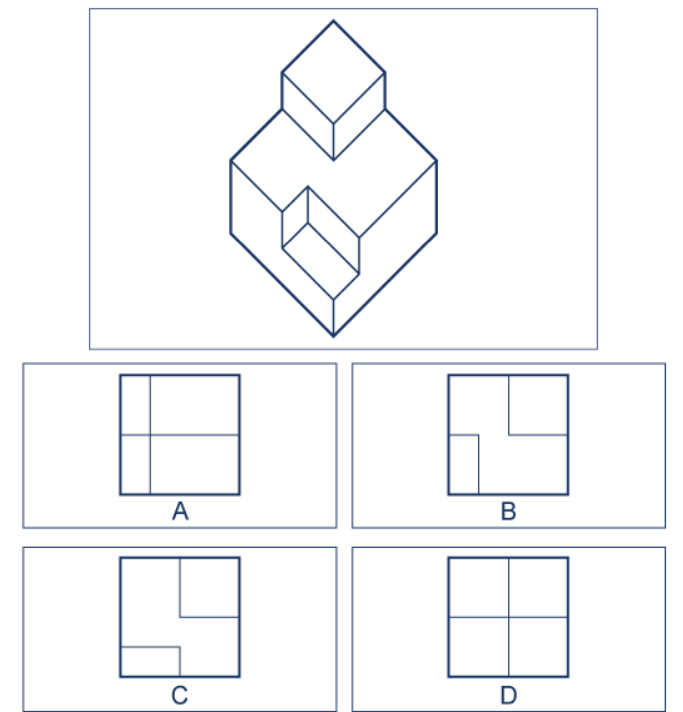
The image presents a spatial reasoning puzzle. It consists of a 3D isometric projection of a complex shape at the top, and four 2D orthographic projections (top views) labeled A, B, C, and D at the bottom. The puzzle requires identifying which of the 2D views correctly represents the top view of the 3D shape. All elements are drawn with blue lines.
### Components/Axes
* **Top Section:** 3D Isometric Projection
* A complex shape composed of stacked cubes with a cut-out section.
* **Bottom Section:** 2D Orthographic Projections (Top Views)
* Four square diagrams labeled A, B, C, and D. Each diagram contains different arrangements of lines representing the top view of a possible 3D shape.
### Detailed Analysis
* **3D Isometric Projection:** The 3D shape consists of a larger cube with a smaller cube stacked on top, offset to one side. A rectangular section is cut out from the larger cube.
* **2D Orthographic Projections:**
* **A:** A square divided into four regions. The left half is further divided vertically into two equal rectangles.
* **B:** A square divided into four regions. The top-left region is further divided into a smaller square. A small rectangle is present in the bottom-left region.
* **C:** A square divided into four regions. A rectangle is present in the bottom-left region, and a smaller square in the top-left region.
* **D:** A square divided into four equal regions.
### Key Observations
* The 3D shape has a distinct cut-out section and an offset smaller cube on top.
* The correct 2D projection must accurately represent the top view of these features.
### Interpretation
The puzzle aims to test spatial reasoning skills. The task is to mentally rotate the 3D shape and determine which of the 2D views accurately depicts its top-down appearance. By comparing the features of the 3D shape (cut-out, offset cube) with the line arrangements in the 2D views, one can identify the correct answer. Based on the 3D shape, option B appears to be the correct answer. The small square in the top-left represents the smaller cube, and the rectangle in the bottom-left represents the cut-out section.