\n
## Diagram: 3D Block Structure and 2D Projections
### Overview
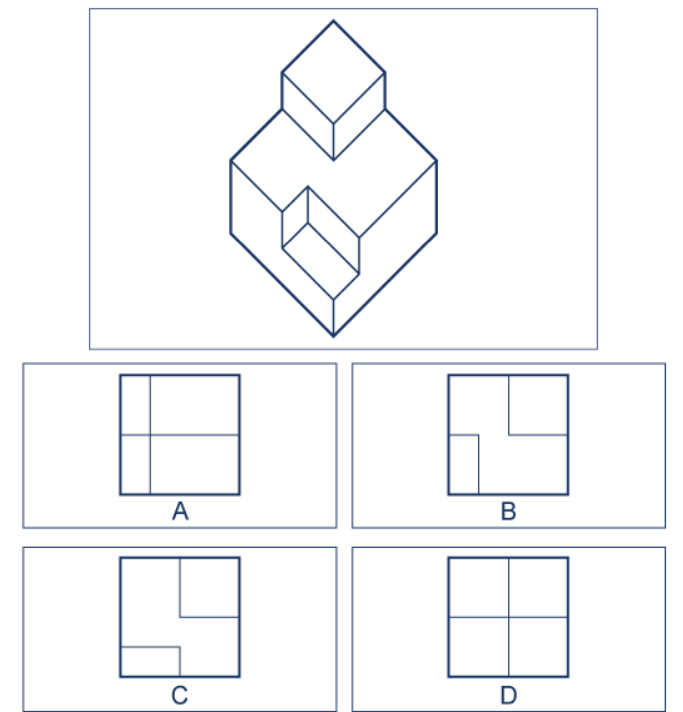
The image presents a 3D block structure composed of multiple smaller cubes arranged in a stacked configuration. Below the 3D structure are four 2D projections (A, B, C, and D) represented as square grids with line segments. The task appears to be identifying which of the 2D projections accurately represents a view of the 3D structure.
### Components/Axes
The image consists of:
* **Main Diagram:** A 3D isometric projection of a structure built from cubes.
* **Projection A:** A 2D square grid with internal line segments.
* **Projection B:** A 2D square grid with internal line segments.
* **Projection C:** A 2D square grid with internal line segments.
* **Projection D:** A 2D square grid with internal line segments.
* **Labels:** "A", "B", "C", and "D" identifying each projection.
There are no axes or scales present in this image.
### Detailed Analysis or Content Details
The 3D structure is composed of four cubes. The largest cube forms the base. A smaller cube is recessed into the top-front of the base cube. A medium-sized cube is placed on top of the base cube, slightly offset towards the back. Finally, a smaller cube is placed on top of the medium-sized cube, aligned with the front edge.
**Projection A:** Shows a square grid divided into four equal squares. Two vertical lines divide the left side into two columns, and two horizontal lines divide the top half into two rows.
**Projection B:** Shows a square grid divided into four equal squares. A "L" shaped line segment is present in the top-right corner, and a vertical line segment is present in the bottom-left corner.
**Projection C:** Shows a square grid divided into four equal squares. An inverted "L" shaped line segment is present in the bottom-left corner, and a horizontal line segment is present in the top-right corner.
**Projection D:** Shows a square grid divided into four equal squares, with all squares separated by lines.
### Key Observations
The key challenge is to mentally rotate and project the 3D structure onto a 2D plane to determine which projection accurately represents a possible view. Projection B appears to be the most likely candidate, as the "L" shape could represent the recessed cube and the top cube.
### Interpretation
This image is a spatial reasoning puzzle. It tests the ability to visualize 3D objects and their 2D projections. The correct answer would be the projection that accurately represents the arrangement of the cubes as seen from a specific viewpoint. Without further context or instructions, it's difficult to definitively determine the intended viewpoint. However, based on the visual arrangement, Projection B is the most plausible representation of a view of the 3D structure. The image demonstrates the principles of orthographic projection and the challenges of translating 3D information into 2D representations.