## Diagram: 3D Cube Structure with 2D Partitioned Views
### Overview
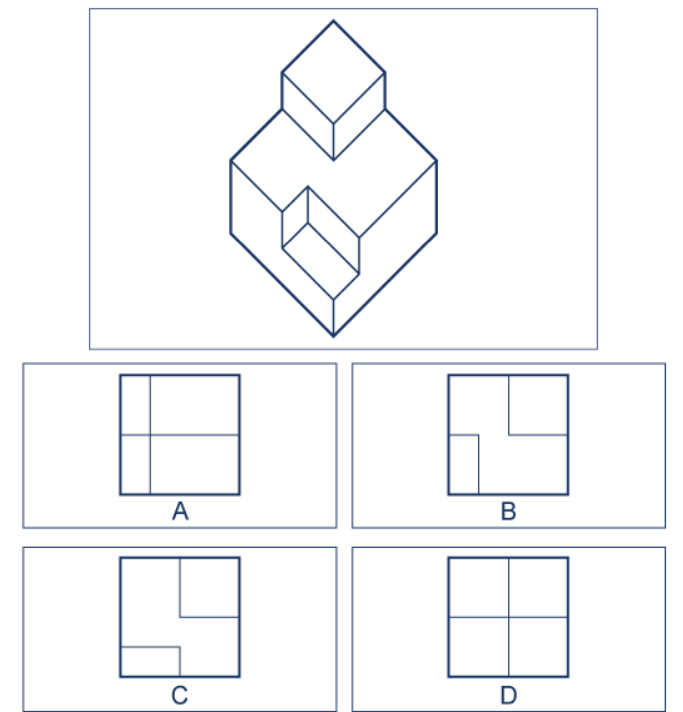
The image depicts a 3D geometric structure resembling a cube with a smaller cube attached to its top face and a cutout section on one side. Below the 3D structure, four 2D diagrams (labeled A, B, C, D) are arranged in a 2x2 grid. Each diagram shows a square partitioned into irregular regions with varying configurations.
### Components/Axes
- **3D Structure**:
- A cube with a smaller cube stacked on its top face.
- A rectangular cutout on the front face, creating an open cavity.
- No explicit labels, axes, or legends are present in the 3D structure.
- **2D Diagrams (A, B, C, D)**:
- **Diagram A**: A square divided into three regions: a small square in the top-left, a horizontal rectangle spanning the bottom half, and a vertical rectangle on the right.
- **Diagram B**: A square partitioned into four regions: a small square in the top-left, a horizontal rectangle in the top-right, a vertical rectangle in the bottom-left, and a larger square in the bottom-right.
- **Diagram C**: A square divided into four regions: a small square in the bottom-left, a horizontal rectangle spanning the top half, a vertical rectangle on the right, and a larger square in the bottom-right.
- **Diagram D**: A square divided into four equal smaller squares (2x2 grid).
### Detailed Analysis
- **3D Structure**:
- The cube’s orientation suggests a perspective view, with the cutout revealing internal depth.
- The smaller cube on top creates a stepped effect, emphasizing vertical layering.
- **2D Diagrams**:
- **Diagram A**: Asymmetrical partitioning with uneven regions.
- **Diagram B**: Balanced but irregular partitioning, with one large square dominating the bottom-right.
- **Diagram C**: Similar to B but with the small square shifted to the bottom-left.
- **Diagram D**: Uniform partitioning into equal quadrants.
### Key Observations
1. The 3D cube’s complexity contrasts with the simplicity of the 2D diagrams.
2. Diagrams A, B, and C share a recurring pattern of a small square and a large square, while D is uniform.
3. No numerical values, legends, or axis markers are present in any diagram.
### Interpretation
The image likely illustrates a conceptual relationship between 3D spatial reasoning and 2D representation. The 3D cube’s cutout and layered structure may symbolize fragmentation or modularity, while the 2D diagrams could represent different ways to partition or analyze a system. Diagram D’s uniformity might signify standardization, whereas A, B, and C highlight variability in segmentation. The absence of labels suggests the focus is on visual patterns rather than quantitative data.
## No textual data, numerical values, or legends are present in the image. The analysis is based solely on geometric and spatial relationships.