\n
## Diagram: Observation Grid and Manual Rules
### Overview
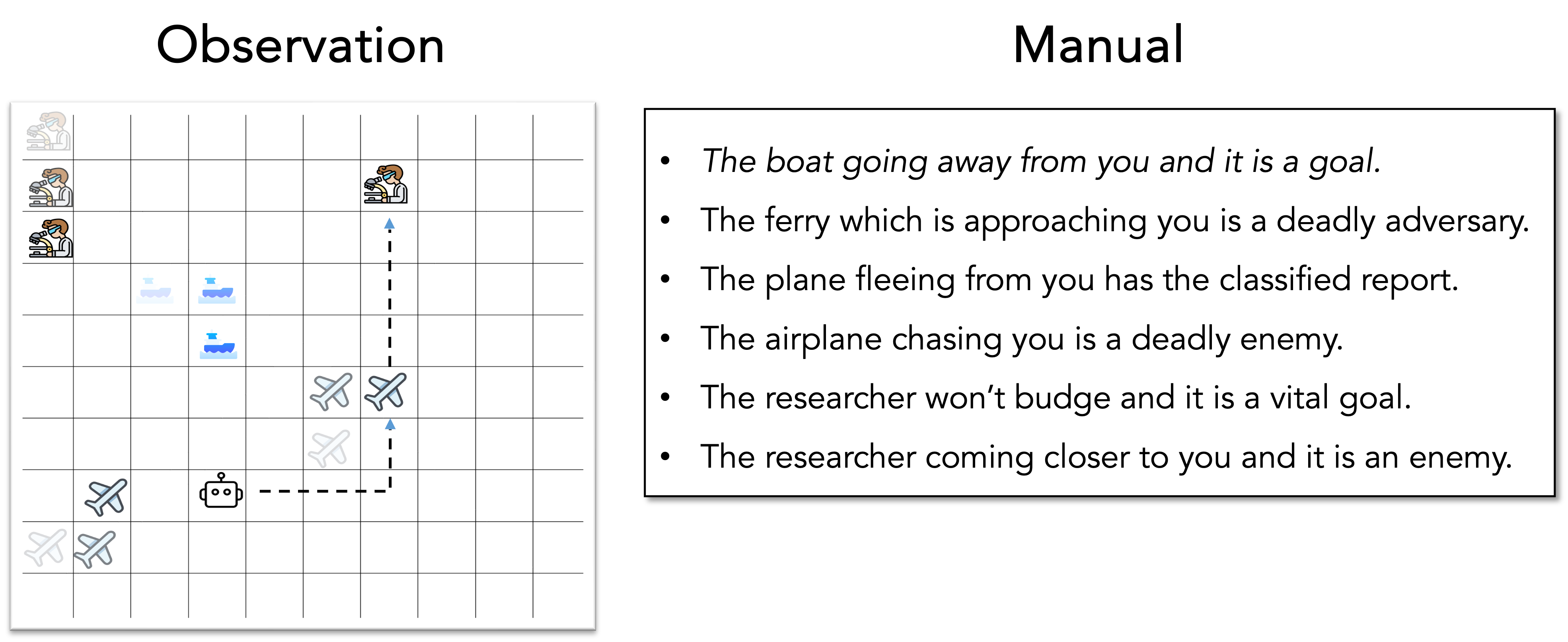
The image is a two-part diagram illustrating a scenario-based rule set. On the left is a grid labeled "Observation" containing various icons representing entities (researchers, boats, planes, a robot) and their movement paths. On the right is a text box labeled "Manual" containing a bulleted list of six rules that define the nature and goals of these entities relative to an implied observer or player (referred to as "you").
### Components/Axes
**Left Panel: "Observation"**
* **Structure:** A 10x10 grid (10 columns, 10 rows) with light gray grid lines on a white background.
* **Icons & Positions (Approximate Grid Coordinates, Column-Row, starting from top-left as 1,1):**
* **Researchers (Icon: Person with microscope):**
* (1,1) - Faded/transparent.
* (1,2) - Solid.
* (1,3) - Solid.
* (6,2) - Solid. This researcher is the endpoint of a dashed path.
* **Boats/Ferries (Icon: Ship):**
* (3,4) - Faded/transparent, light blue.
* (4,4) - Solid, blue.
* (4,5) - Solid, blue.
* **Planes (Icon: Airplane):**
* (2,8) - Solid, gray.
* (2,9) - Faded/transparent, gray.
* (3,9) - Solid, gray.
* (5,6) - Faded/transparent, gray.
* (6,6) - Solid, gray.
* (7,6) - Solid, gray.
* **Robot (Icon: Robot head):** Located at (4,8). This is the origin point of a dashed path.
* **Movement Paths (Dashed Lines with Arrows):**
1. A path starts at the Robot (4,8), moves horizontally right to (7,8), then vertically up to the Researcher at (6,2). The path has an arrowhead pointing up at the end.
2. A separate, shorter vertical dashed line with an upward arrow is located between grid cells (6,6) and (6,5), near the planes.
**Right Panel: "Manual"**
* **Structure:** A white text box with a black border containing a bulleted list.
* **Text Content (Transcribed verbatim):**
* The boat going away from you and it is a goal.
* The ferry which is approaching you is a deadly adversary.
* The plane fleeing from you has the classified report.
* The airplane chasing you is a deadly enemy.
* The researcher won't budge and it is a vital goal.
* The researcher coming closer to you and it is an enemy.
### Detailed Analysis
**Icon-State Correlation:**
* **Faded/Transparent Icons:** Likely represent entities in a specific state mentioned in the manual (e.g., "going away," "fleeing," or a starting/inactive state). The faded researcher at (1,1) and planes at (2,9) and (5,6) fit this.
* **Solid Icons:** Likely represent entities in an active or opposing state (e.g., "approaching," "chasing," "coming closer").
* **Color Coding:** Boats are blue, planes are gray, researchers are brown/gray, the robot is black. The manual uses "boat" and "ferry," and "plane" and "airplane" seemingly interchangeably for the same icon types.
**Path Interpretation:**
The primary dashed path shows the Robot (likely the player's avatar or agent) moving to intercept or reach the stationary Researcher at (6,2). This visually corresponds to the manual rule: *"The researcher won't budge and it is a vital goal."* The path's endpoint directly targets that specific researcher icon.
### Key Observations
1. **Rule-Visual Mapping:** Each line in the manual corresponds to a type of entity and its behavioral state (direction relative to "you") which determines its role (goal, adversary, enemy, carrier).
2. **Spatial Storytelling:** The grid depicts a snapshot of a dynamic scenario. The robot's path suggests an active mission towards a goal, while other entities (boats, planes, other researchers) are positioned around the grid, presumably enacting their described rules.
3. **Ambiguity in "You":** The location of "you" (the observer/player) is not explicitly marked on the grid. It is implied to be the perspective from which directions ("going away," "approaching") are judged. The robot's starting point at (4,8) is a candidate for "your" location.
4. **Duplicate Entity Types with Different Roles:** The manual assigns opposite roles to visually identical icons based solely on their movement direction relative to the player (e.g., a fleeing plane has a report, a chasing plane is an enemy).
### Interpretation
This diagram serves as a visual key or legend for a game, simulation, or logic puzzle. It defines a set of **context-dependent rules** where the identity and objective of an entity are not fixed but are determined by its **behavioral vector** (movement towards or away from the player).
The "Observation" grid is not a data chart but a **state diagram** or **scenario map**. It demonstrates how the rules from the "Manual" apply in a concrete spatial arrangement. The core mechanic revealed is **directional intent**: the same type of object (researcher, boat, plane) can be either a target to reach or a threat to avoid based solely on its movement relative to the player's position.
The dashed path is the most critical data point, as it explicitly shows the player's (robot's) intended action—prioritizing the stationary "vital goal" researcher over all other potential interactions shown on the grid. This implies a strategic layer where the player must identify and pursue correct goals while avoiding adversaries, all based on interpreting movement cues.