## Diagram: AI Interpretability Bridge
### Overview
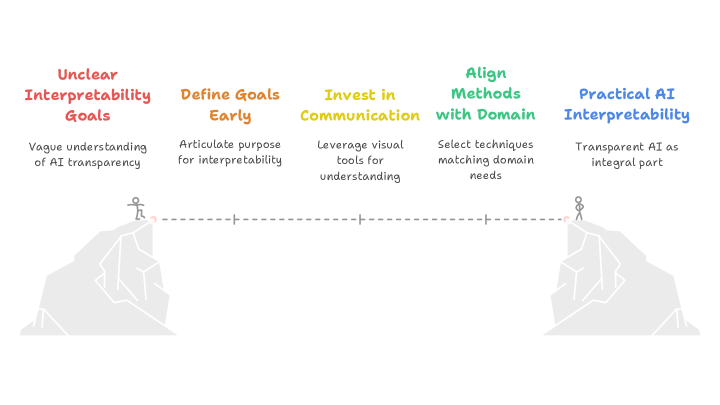
The image is a diagram illustrating the steps to achieve practical AI interpretability, represented as a bridge spanning from "Unclear Interpretability Goals" to "Practical AI Interpretability." The diagram uses visual metaphors of mountains and a bridge to represent the journey.
### Components/Axes
* **Titles (Top, Left to Right):**
* Unclear Interpretability Goals (Red)
* Define Goals Early (Orange)
* Invest in Communication (Yellow)
* Align Methods with Domain (Green)
* Practical AI Interpretability (Blue)
* **Descriptions (Below Titles):**
* Vague understanding of AI transparency (Below "Unclear Interpretability Goals")
* Articulate purpose for interpretability (Below "Define Goals Early")
* Leverage visual tools for understanding (Below "Invest in Communication")
* Select techniques matching domain needs (Below "Align Methods with Domain")
* Transparent AI as integral part (Below "Practical AI Interpretability")
* **Visual Elements:**
* Two mountains on either side of the diagram.
* Stick figures on top of each mountain.
* A dashed line connecting the two mountains, representing a bridge.
### Detailed Analysis
The diagram presents a linear progression from a state of unclear AI interpretability goals to a state of practical AI interpretability. The steps are:
1. **Unclear Interpretability Goals:** Characterized by a "vague understanding of AI transparency." This is the starting point, represented by a mountain on the left.
2. **Define Goals Early:** Emphasizes the need to "articulate purpose for interpretability."
3. **Invest in Communication:** Highlights the importance of "leveraging visual tools for understanding."
4. **Align Methods with Domain:** Focuses on "selecting techniques matching domain needs."
5. **Practical AI Interpretability:** The desired outcome, where "transparent AI [is] an integral part." This is represented by a mountain on the right.
The dashed line connecting the mountains symbolizes the path or steps needed to transition from unclear goals to practical interpretability. The stick figures on each mountain represent individuals or teams at different stages of this process.
### Key Observations
* The diagram uses color-coding to distinguish each step in the process.
* The dashed line bridge visually represents the connection and progression between the steps.
* The mountain metaphor suggests that achieving practical AI interpretability requires effort and overcoming obstacles.
### Interpretation
The diagram illustrates a structured approach to achieving practical AI interpretability. It emphasizes the importance of defining clear goals, investing in communication, and aligning methods with the specific domain. The visual representation of a bridge suggests that this is a journey that requires effort and a clear path to follow. The diagram implies that by following these steps, one can move from a state of uncertainty to a state where AI is transparent and integral to the process.