\n
## Diagram: Code Generation Comparison
### Overview
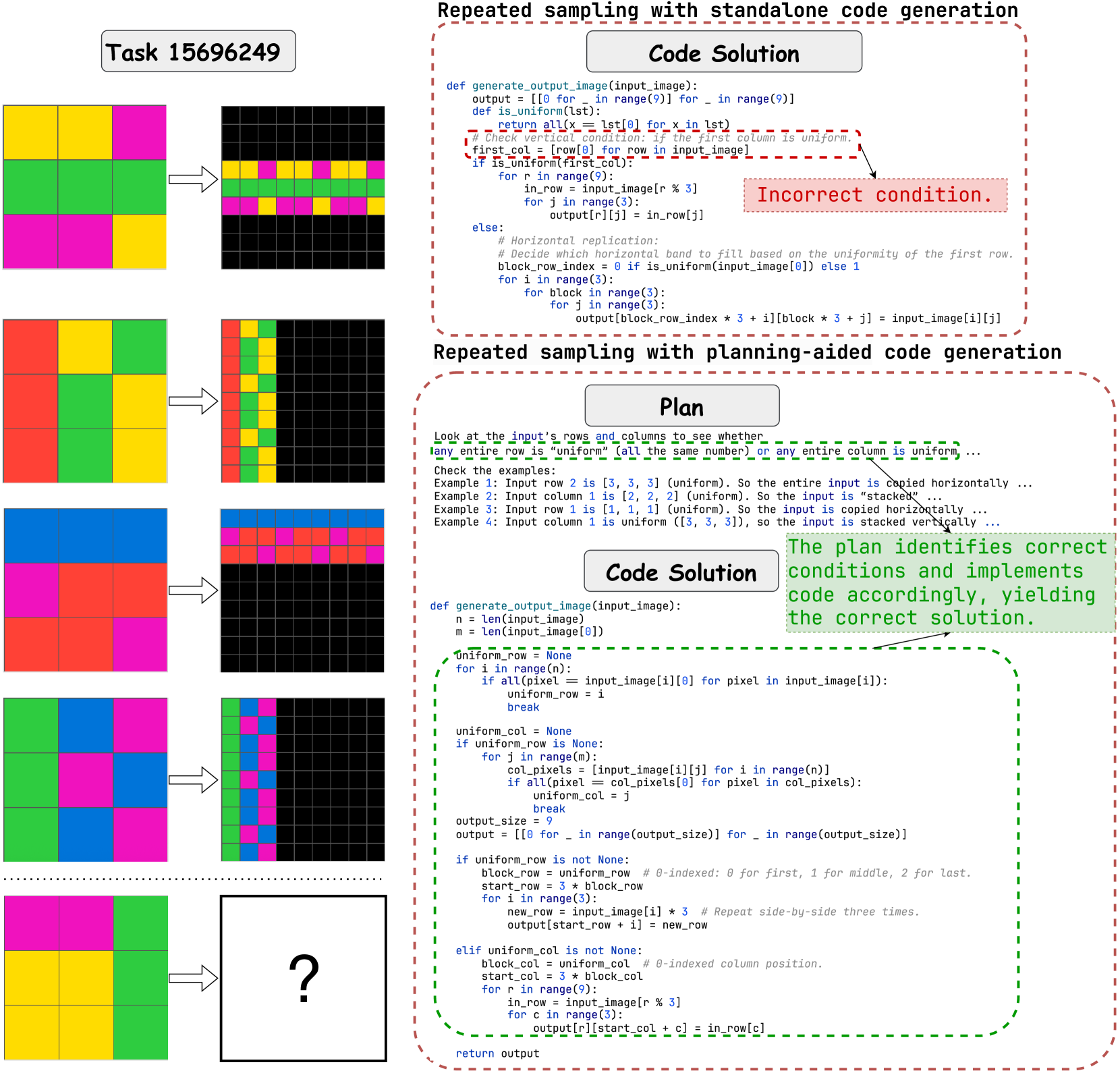
The image presents a comparison between two approaches to code generation: "Repeated sampling with standalone code generation" and "Repeated sampling with planning-aided code generation." It visually contrasts the code solutions produced by each method, highlighting a correction made in the planning-aided approach. The diagram uses flow arrows and text annotations to explain the process and identify an "Incorrect condition" in the standalone method.
### Components/Axes
The diagram is divided into two main sections, one for each code generation approach. Each section contains:
* **Task ID:** "15696249" (top-left)
* **Method Title:** "Repeated sampling with standalone code generation" or "Repeated sampling with planning-aided code generation"
* **Code Solution:** A block of Python code.
* **Plan:** A textual description of the planning process.
* **Arrows:** Green arrows indicating the flow of execution or reasoning.
* **Annotations:** Text labels like "Incorrect condition." and a question mark.
### Detailed Analysis or Content Details
**Section 1: Repeated sampling with standalone code generation**
* **Code Solution:**
```python
def generate_output_image(input_image):
output = [[0 for _ in range(9)] for _ in range(9)]
for i in range(9):
for j in range(9):
if input_image[i][j] == 1:
output[i][j] = input_image[i][j]
return output
```
* **Annotation:** "Incorrect condition." (positioned near the `if` statement)
**Section 2: Repeated sampling with planning-aided code generation**
* **Plan:**
```
Look at the input's rows and columns to see whether
any entire row is "uniform" (all the same number) or any entire column is uniform...
Example 1: Input row 2 is [3, 3, 3] (uniform). So the entire input is copied horizontally ...
Example 2: Input column 1 is [2, 2, 2] (uniform). So the input is "stacked" vertically ...
Example 3: Input row 1 is [1, 1, 1] (uniform). So the input is copied horizontally ...
Example 4: Input column 1 is uniform (3, 3, 3), so the input is stacked vertically ...
```
* **Code Solution:**
```python
def generate_output_image(input_image):
n = len(input_image)
m = len(input_image[0])
uniform_row = None
for i in range(n):
if all(input_image[i][j] == input_image[i][0] for j in range(m)):
uniform_row = i
break
uniform_col = None
for j in range(m):
if all(input_image[i][j] == input_image[0][j] for i in range(n)):
uniform_col = j
break
if uniform_row is not None:
output = [input_image[uniform_row] for _ in range(n)]
elif uniform_col is not None:
output = [[input_image[i][uniform_col] for i in range(n)] for _ in range(m)]
else:
output = [[0 for _ in range(m)] for _ in range(n)]
for i in range(n):
for j in range(m):
if input_image[i][j] == 1:
output[i][j] = input_image[i][j]
return output
```
* **Annotation:** "The plan identifies correct conditions and implements the correct solution." (positioned near the code solution)
* **Annotation:** A question mark ("?") is placed near the final `else` block in the code.
### Key Observations
* The standalone code generation approach produces a simple, but incorrect, solution. The annotation highlights a flaw in the conditional logic.
* The planning-aided approach first analyzes the input to identify uniform rows or columns. This allows it to implement more efficient and correct copying or stacking logic.
* The planning-aided code includes a fallback to the standalone approach if no uniform rows or columns are found.
* The question mark suggests a potential area for further refinement or consideration in the planning-aided approach.
### Interpretation
The diagram demonstrates the benefit of incorporating planning into code generation. The standalone approach, lacking a high-level understanding of the input data, resorts to a brute-force solution that is flagged as incorrect. The planning-aided approach, by first analyzing the input for patterns (uniform rows/columns), can generate more optimized and accurate code. The question mark indicates that even with planning, there may be edge cases or areas for improvement.
The diagram illustrates a key principle in AI: providing context and reasoning capabilities (through planning) can significantly improve the quality and efficiency of generated code. The comparison highlights the importance of not just generating code, but *understanding* the problem before attempting a solution. The use of examples in the "Plan" section is crucial for guiding the code generation process.