## Chart Type: Line Chart of Average Incorrect Flips per Iteration
### Overview
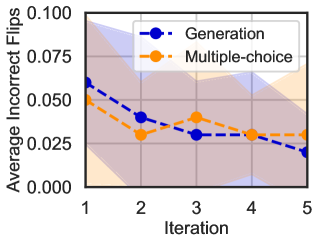
This image displays a 2D line chart comparing the "Average Incorrect Flips" over "Iteration" for two different conditions: "Generation" and "Multiple-choice". Each line represents the mean value, and a shaded region around each line indicates variability, likely a confidence interval or standard error. The chart shows a general downward trend for both conditions, suggesting an improvement (fewer incorrect flips) over iterations.
### Components/Axes
The chart is structured with a primary plotting area, an X-axis at the bottom, a Y-axis on the left, and a legend in the top-right.
* **X-axis:**
* **Title:** "Iteration"
* **Range:** From 1 to 5.
* **Markers:** 1, 2, 3, 4, 5.
* **Y-axis:**
* **Title:** "Average Incorrect Flips"
* **Range:** From 0.000 to 0.100.
* **Markers:** 0.000, 0.025, 0.050, 0.075, 0.100.
* **Legend:**
* **Position:** Located in the top-right quadrant of the plot area.
* **Entries:**
* **Generation:** Represented by a dark blue dashed line with solid blue circular markers. The associated shaded region is light blue.
* **Multiple-choice:** Represented by an orange dashed line with solid orange circular markers. The associated shaded region is light orange.
### Detailed Analysis
The chart presents two data series, each with a central line indicating the average and a surrounding shaded area indicating variability.
1. **Generation (Blue Line and Shaded Area):**
* **Visual Trend:** The "Generation" line generally slopes downwards from Iteration 1 to Iteration 5, indicating a decrease in average incorrect flips over time. The rate of decrease appears steeper between Iteration 1 and 2, then slows down.
* **Data Points (Approximate):**
* Iteration 1: Approximately 0.060
* Iteration 2: Approximately 0.040
* Iteration 3: Approximately 0.030
* Iteration 4: Approximately 0.028
* Iteration 5: Approximately 0.020
* **Shaded Area:** The light blue shaded region around the "Generation" line shows the variability. It is widest around Iteration 1 and 2, and narrows slightly towards Iteration 5, suggesting a potential reduction in variability as performance improves.
2. **Multiple-choice (Orange Line and Shaded Area):**
* **Visual Trend:** The "Multiple-choice" line also shows a general downward trend, but with a slight increase between Iteration 2 and 3. It starts lower than "Generation" at Iteration 1, crosses above it, then crosses back below, and finally levels off.
* **Data Points (Approximate):**
* Iteration 1: Approximately 0.050
* Iteration 2: Approximately 0.030
* Iteration 3: Approximately 0.040
* Iteration 4: Approximately 0.030
* Iteration 5: Approximately 0.030
* **Shaded Area:** The light orange shaded region around the "Multiple-choice" line indicates its variability. This region also appears to narrow slightly over iterations, though it remains relatively wide.
### Key Observations
* Both conditions show a reduction in "Average Incorrect Flips" over the 5 iterations, indicating learning or improvement.
* At Iteration 1, "Multiple-choice" starts with a lower average incorrect flips (~0.050) compared to "Generation" (~0.060).
* At Iteration 2, "Multiple-choice" drops significantly to ~0.030, while "Generation" drops to ~0.040.
* At Iteration 3, "Multiple-choice" experiences a slight increase to ~0.040, while "Generation" continues to decrease to ~0.030. This is the point where "Generation" performs better (lower incorrect flips) than "Multiple-choice".
* From Iteration 3 onwards, "Generation" consistently has a lower or similar average incorrect flips compared to "Multiple-choice".
* By Iteration 5, "Generation" reaches the lowest point at ~0.020, while "Multiple-choice" levels off at ~0.030.
* The shaded regions (variability) for both conditions overlap significantly across all iterations, suggesting that the differences between the two conditions might not always be statistically significant, especially in the middle iterations.
### Interpretation
The data suggests that both "Generation" and "Multiple-choice" methods lead to a reduction in "Average Incorrect Flips" over successive iterations, implying a learning effect or improved performance with practice.
Initially, the "Multiple-choice" condition appears to have a slight advantage, starting with fewer incorrect flips and showing a sharper initial decrease. However, this advantage is short-lived. The "Generation" condition, despite starting higher, demonstrates a more consistent and sustained reduction in incorrect flips, eventually outperforming "Multiple-choice" from Iteration 3 onwards. By Iteration 5, "Generation" achieves the lowest average incorrect flips, indicating it might be a more effective method for long-term reduction in errors or for reaching a higher level of accuracy.
The temporary increase in "Average Incorrect Flips" for "Multiple-choice" at Iteration 3 is a notable anomaly that warrants further investigation. It could indicate a temporary dip in performance, a change in task difficulty, or an artifact of the measurement.
The substantial overlap of the confidence intervals (shaded regions) throughout the chart is crucial. While the lines show a trend, the overlap implies that, at many points, the observed differences between "Generation" and "Multiple-choice" might not be statistically significant. For instance, at Iteration 4, both lines are very close, and their confidence intervals largely encompass each other, making it difficult to definitively state one method is superior at that specific point without further statistical testing. However, the consistent lower value of "Generation" in later iterations, particularly at Iteration 5 where its mean is clearly below the "Multiple-choice" mean, suggests a potential long-term benefit for the "Generation" approach.