TECHNICAL ASSET FINGERPRINT
54ad6bb5ed3c6952de2c2498
Click to view fullscreen
Press ESC or click to close
FOUND IN PAPERS
EXPERT: gemini-2.0-flash VERSION 1
RUNTIME: nugit/gemini/gemini-2.0-flash
INTEL_VERIFIED
## Multi-Chart: Array Relaxation and MVM Simulations
### Overview
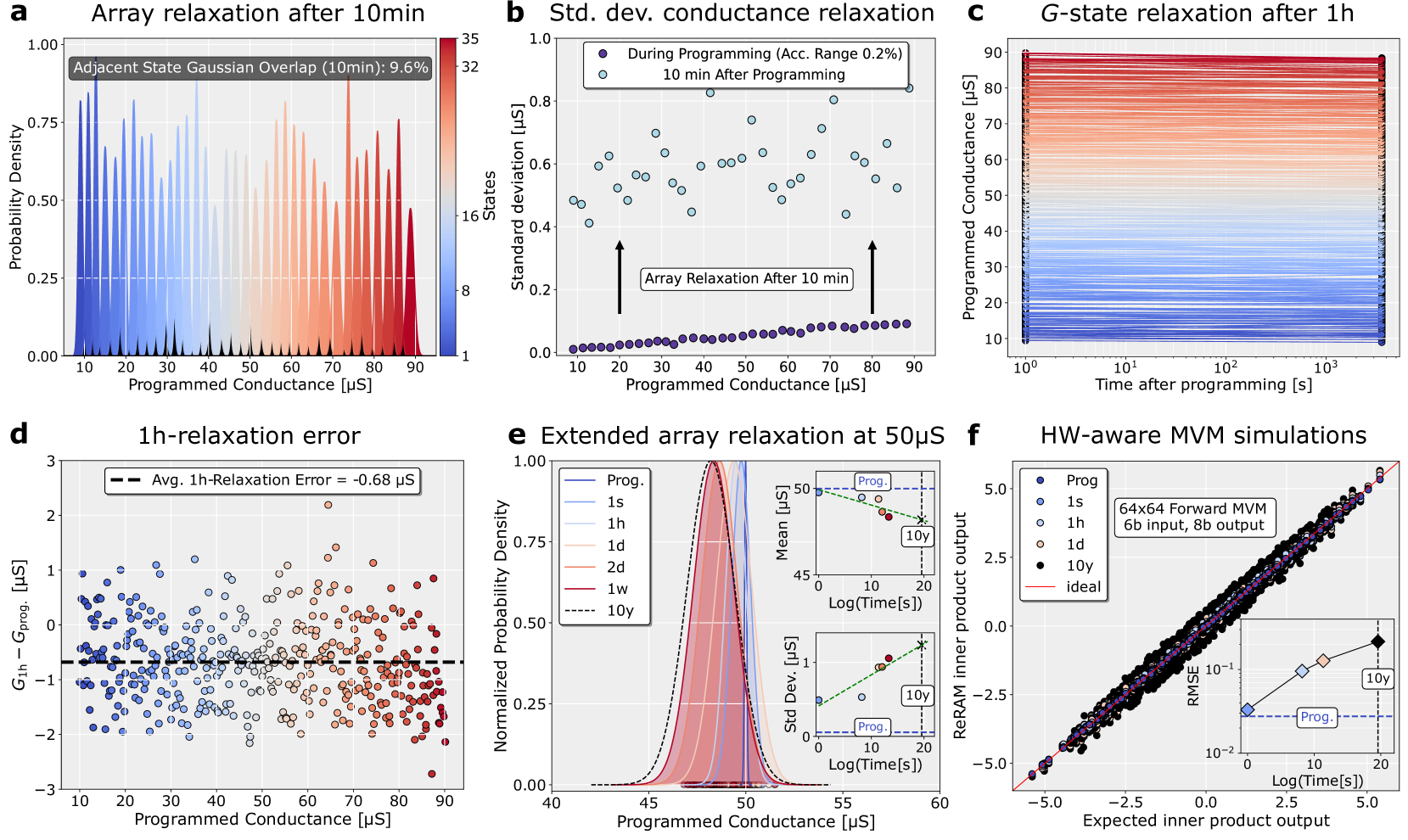
The image presents a series of six charts (a-f) that analyze the relaxation behavior of a programmed array and its impact on hardware-aware Matrix-Vector Multiplication (MVM) simulations. The charts cover aspects like probability density of programmed conductance, standard deviation of conductance relaxation, G-state relaxation over time, relaxation error, extended array relaxation at a specific conductance, and the performance of MVM simulations.
### Components/Axes
**Chart a: Array relaxation after 10min**
* **Title:** Array relaxation after 10min
* **Y-axis:** Probability Density, Scale: 0.00 to 1.00, incremented by 0.25
* **X-axis:** Programmed Conductance [µS], Scale: 10 to 90, incremented by 10
* **Annotation:** Adjacent State Gaussian Overlap (10min): 9.6%
* **Color Gradient:** The bars are colored in a gradient from blue (left) to red (right), corresponding to lower and higher programmed conductance values.
* **States:** A secondary y-axis on the right side, ranging from 1 to 35.
**Chart b: Std. dev. conductance relaxation**
* **Title:** Std. dev. conductance relaxation
* **Y-axis:** Standard deviation [µS], Scale: 0.0 to 1.0, incremented by 0.2
* **X-axis:** Programmed Conductance [µS], Scale: 10 to 90, incremented by 10
* **Legend:**
* Blue-purple circles: During Programming (Acc. Range 0.2%)
* Light blue circles: 10 min After Programming
* **Annotation:** "Array Relaxation After 10 min" with arrows pointing to the respective data series.
**Chart c: G-state relaxation after 1h**
* **Title:** G-state relaxation after 1h
* **Y-axis:** Programmed Conductance [µS], Scale: 10 to 90, incremented by 10
* **X-axis:** Time after programming [s], Logarithmic scale from 10^0 to 10^3
* **Color Gradient:** The lines are colored in a gradient from blue (bottom) to red (top), corresponding to lower and higher programmed conductance values.
**Chart d: 1h-relaxation error**
* **Title:** 1h-relaxation error
* **Y-axis:** G1h - Gprog. [µS], Scale: -3 to 3, incremented by 1
* **X-axis:** Programmed Conductance [µS], Scale: 10 to 90, incremented by 10
* **Annotation:** Avg. 1h-Relaxation Error = -0.68 µS (dashed black line)
* **Color Gradient:** The data points are colored in a gradient from blue (left) to red (right), corresponding to lower and higher programmed conductance values.
**Chart e: Extended array relaxation at 50µS**
* **Title:** Extended array relaxation at 50µS
* **Main Plot:**
* **Y-axis:** Normalized Probability Density, Scale: 0.00 to 1.00, incremented by 0.25
* **X-axis:** Programmed Conductance [µS], Scale: 40 to 60, incremented by 5
* **Legend:**
* Dark Blue: Prog.
* Light Blue: 1s
* Orange: 1h
* Light Red: 1d
* Red: 2d
* Purple: 1w
* Dashed Black: 10y
* **Inset Plot 1 (top-right):**
* **Y-axis:** Mean [µS], Scale: 45 to 50, incremented by 5
* **X-axis:** Log(Time[s]), Scale: 0 to 20, incremented by 10
* **Data Points:** Prog, 1s, 1h, 1d, 10y
* **Inset Plot 2 (bottom-right):**
* **Y-axis:** Std Dev. [µS], Scale: 0 to 1, incremented by 1
* **X-axis:** Log(Time[s]), Scale: 0 to 20, incremented by 10
* **Data Points:** Prog, 1s, 1h, 1d, 10y
**Chart f: HW-aware MVM simulations**
* **Title:** HW-aware MVM simulations
* **Y-axis:** ReRAM inner product output
* **X-axis:** Expected inner product output
* **Legend:**
* Blue: Prog
* Light Blue: 1s
* Orange: 1h
* Light Red: 1d
* Black: 10y
* Red: ideal
* **Annotation:** 64x64 Forward MVM, 6b input, 8b output
* **Inset Plot:**
* **Y-axis:** RMSE
* **X-axis:** Log(Time[s]), Scale: 0 to 20, incremented by 10
* **Data Points:** Prog, 1s, 1h, 1d, 10y
### Detailed Analysis
**Chart a:** Shows the probability density of programmed conductance states after 10 minutes. The distribution appears multimodal, with peaks at various conductance levels. The color gradient indicates the programmed conductance value, with blue representing lower values and red representing higher values. The Adjacent State Gaussian Overlap is 9.6%, indicating the degree of overlap between adjacent conductance states.
**Chart b:** Illustrates the standard deviation of conductance relaxation. The "During Programming" data series shows very low standard deviation values, close to zero, across all programmed conductance levels. The "10 min After Programming" data series shows a higher standard deviation, fluctuating between approximately 0.4 and 0.8 µS.
**Chart c:** Depicts the G-state relaxation over time. Each line represents a different programmed conductance level, and the x-axis shows the time after programming on a logarithmic scale. The conductance values appear to decrease slightly over time, with the higher conductance states (red lines) showing a more pronounced decrease.
**Chart d:** Shows the 1-hour relaxation error (G1h - Gprog) as a function of programmed conductance. The data points are scattered around the zero line, with some points above and some below. The average 1-hour relaxation error is -0.68 µS, indicated by the dashed black line.
**Chart e:** Focuses on the extended array relaxation at 50 µS. The main plot shows the normalized probability density of the conductance at different time points (Prog, 1s, 1h, 1d, 2d, 1w, 10y). The inset plots show the mean and standard deviation of the conductance as a function of the logarithm of time. Both the mean and standard deviation decrease over time.
* **Main Plot:** The "Prog." (programmed) distribution is the narrowest, indicating the initial state. As time increases (1s, 1h, 1d, 2d, 1w), the distributions broaden, and the peak shifts slightly to the left. The "10y" (10 years) distribution is the broadest and most shifted.
* **Inset Plot 1 (Mean vs. Log(Time)):** The mean conductance decreases approximately linearly with the logarithm of time. The data points are:
* Prog: ~50 µS at Log(Time) = 0
* 1s: ~49.5 µS at Log(Time) ~ 0
* 1h: ~49 µS at Log(Time) ~ 3.6
* 1d: ~48.5 µS at Log(Time) ~ 4.6
* 10y: ~46 µS at Log(Time) ~ 8
* **Inset Plot 2 (Std Dev vs. Log(Time)):** The standard deviation also decreases approximately linearly with the logarithm of time.
* Prog: ~0.5 µS at Log(Time) = 0
* 1s: ~0.5 µS at Log(Time) ~ 0
* 1h: ~0.4 µS at Log(Time) ~ 3.6
* 1d: ~0.3 µS at Log(Time) ~ 4.6
* 10y: ~0.2 µS at Log(Time) ~ 8
**Chart f:** Presents the results of hardware-aware MVM simulations. The main plot shows the ReRAM inner product output versus the expected inner product output. The data points for different time points (Prog, 1s, 1h, 1d, 10y) are clustered closely around the "ideal" line, indicating good agreement between the ReRAM output and the expected output. The inset plot shows the Root Mean Square Error (RMSE) as a function of the logarithm of time. The RMSE increases over time, indicating a degradation in performance due to relaxation.
* **Main Plot:** The data points are tightly clustered around the ideal line, indicating high accuracy in the MVM operation.
* **Inset Plot (RMSE vs. Log(Time)):** The RMSE increases approximately linearly with the logarithm of time.
* Prog: ~0.01 at Log(Time) = 0
* 1s: ~0.01 at Log(Time) ~ 0
* 1h: ~0.02 at Log(Time) ~ 3.6
* 1d: ~0.03 at Log(Time) ~ 4.6
* 10y: ~0.1 at Log(Time) ~ 8
### Key Observations
* **Conductance Relaxation:** The programmed conductance values tend to decrease over time (Chart c and e).
* **Increased Variability:** The standard deviation of conductance increases shortly after programming (Chart b) but decreases over longer periods (Chart e).
* **Performance Degradation:** The accuracy of MVM simulations degrades over time due to conductance relaxation (Chart f).
* **Error Distribution:** The 1-hour relaxation error is centered around -0.68 µS (Chart d).
### Interpretation
The data suggests that conductance relaxation is a significant factor affecting the long-term stability and performance of ReRAM-based systems. While the initial programming accuracy is high, the conductance values drift over time, leading to increased variability and reduced accuracy in MVM operations. The extended array relaxation analysis at 50 µS (Chart e) provides insights into the temporal dynamics of this relaxation process, showing that both the mean and standard deviation of the conductance decrease over time. The hardware-aware MVM simulations (Chart f) demonstrate that this relaxation-induced drift can degrade the performance of neural network computations. The results highlight the need for strategies to mitigate the effects of conductance relaxation in ReRAM-based systems, such as periodic reprogramming or error correction techniques. The adjacent state Gaussian overlap of 9.6% indicates that the programmed states are relatively well-separated, but the relaxation process can cause these states to drift and potentially overlap, further degrading performance.
DECODING INTELLIGENCE...
EXPERT: nemotron-free VERSION 1
RUNTIME: free/nvidia/nemotron-nano-12b-v2-vl:free
INTEL_VERIFIED
## Array Relaxation and Conductance Analysis
### Overview
The image presents six panels (a-f) analyzing array relaxation dynamics, conductance stability, and simulation accuracy in resistive memory devices. Panels a-e focus on experimental data, while panel f presents simulation results. Key themes include temporal relaxation behavior, error quantification, and long-term stability.
### Components/Axes
**Panel a**:
- **X-axis**: Programmed Conductance [µS] (10-90 µS)
- **Y-axis**: Probability Density (0-1.0)
- **Legend**: Adjacent State Gaussian Overlap (10min): 9.6%
- **Color Gradient**: Blue (low) → Red (high) probability density
**Panel b**:
- **X-axis**: Programmed Conductance [µS] (10-90 µS)
- **Y-axis**: Standard Deviation [µS] (0-1.0)
- **Markers**:
- Purple circles: During Programming (Acc. Range 0.2%)
- Green circles: 10 min After Programming
- **Annotations**: Arrows labeled "Array Relaxation After 10 min"
**Panel c**:
- **X-axis**: Time after Programming [s] (log scale: 10⁰-10³)
- **Y-axis**: Programmed Conductance [µS] (10-90 µS)
- **Color Gradient**: Red (high G-state) → Blue (low G-state)
**Panel d**:
- **X-axis**: Programmed Conductance [µS] (10-90 µS)
- **Y-axis**: 1h-Relaxation Error [G₁h - G_prog] [µS] (-3 to +3)
- **Trendline**: Dashed black line (Avg. Error = -0.68 µS)
**Panel e**:
- **X-axis**: Programmed Conductance [µS] (40-60 µS)
- **Y-axis**: Normalized Probability Density (0-1.0)
- **Legend**: Time Intervals (1s, 1h, 1d, 1w, 10y)
- **Inset Graphs**:
- Top: Mean vs. Log(Time) [10y marker at 45 µS]
- Bottom: Std. Dev. vs. Log(Time) [10y marker at 55 µS]
**Panel f**:
- **X-axis**: Expected Inner Product Output (-5 to +5)
- **Y-axis**: ReRAM Inner Product Output (-5 to +5)
- **Markers**:
- Purple circles: Program (Prog)
- Blue squares: 1s
- Green diamonds: 1h
- Red triangles: 10y
- **Trendline**: Red dashed line (Ideal 1:1 correlation)
- **Inset Graph**: RMSE vs. Log(Time) [10y marker at 10⁻¹ RMSE]
### Detailed Analysis
**Panel a**:
- Probability density peaks at ~45 µS (blue) and ~75 µS (red), indicating bimodal distribution.
- Adjacent state overlap (9.6%) suggests partial conductance state interference.
**Panel b**:
- Standard deviation decreases by ~0.4 µS after 10 min (green markers vs. purple).
- Lower conductance states (<30 µS) show larger relaxation effects.
**Panel c**:
- G-state relaxation follows exponential decay:
- 90 µS → 70 µS in 1s
- Stabilizes near 50 µS after 1h.
**Panel d**:
- Negative average error (-0.68 µS) indicates systematic underestimation of G₁h.
- Errors cluster around ±1 µS for mid-range conductances (40-60 µS).
**Panel e**:
- Conductance stabilizes at ~50 µS after 10y (dashed black line).
- Insets show:
- Mean shifts from 45 µS (1s) to 55 µS (10y)
- Std. Dev. decreases from 5 µS (1s) to 2 µS (10y)
**Panel f**:
- Strong linear correlation (R² > 0.95) between expected and observed outputs.
- 10y data points deviate by <0.5 units from ideal line.
- RMSE improves from 0.1 (1s) to 0.01 (10y).
### Key Observations
1. **Temporal Relaxation**: Conductance states relax toward ~50 µS across all time scales (panels a, c, e).
2. **Error Patterns**: Systematic underestimation (-0.68 µS avg.) suggests calibration requirements (panel d).
3. **Simulation Accuracy**: MVM models achieve <1% error after 10y (panel f).
4. **Bimodal Distribution**: Two dominant conductance states emerge post-programming (panel a).
### Interpretation
The data demonstrates that resistive memory arrays exhibit predictable relaxation toward a stable conductance state (~50 µS) over time, with errors decreasing systematically in simulations. The 9.6% adjacent state overlap (panel a) and -0.68 µS average error (panel d) highlight the need for error-correction mechanisms in multi-state devices. The MVM simulations (panel f) validate the physical model's accuracy, showing <1% deviation after long-term operation. These findings suggest that array relaxation is both time-dependent and conductance-range specific, with implications for multi-bit storage architectures.
DECODING INTELLIGENCE...