# Technical Document Extraction: Multi-Agent Cognitive Framework
## 1. Document Overview
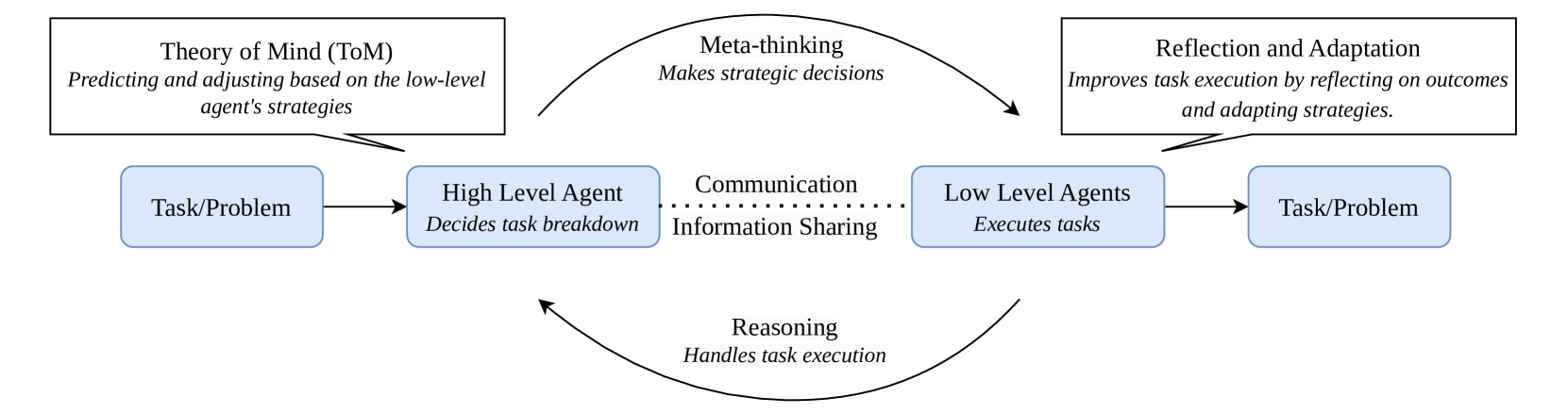
This image is a technical flow diagram illustrating a hierarchical multi-agent system architecture. It details the cognitive processes and communication loops between a "High Level Agent" and "Low Level Agents" as they process a "Task/Problem."
---
## 2. Component Isolation and Transcription
### Region A: Input and High-Level Processing (Left)
* **Input Node:** A light blue rounded rectangle labeled **"Task/Problem"**.
* **Primary Agent Node:** A light blue rounded rectangle labeled **"High Level Agent"** with the sub-text: *"Decides task breakdown"*.
* **Cognitive Callout (Top Left):** A rectangular speech bubble pointing to the High Level Agent containing:
* **Title:** Theory of Mind (ToM)
* **Description:** *"Predicting and adjusting based on the low-level agent's strategies"*
### Region B: Execution and Output (Right)
* **Secondary Agent Node:** A light blue rounded rectangle labeled **"Low Level Agents"** with the sub-text: *"Executes tasks"*.
* **Output Node:** A light blue rounded rectangle labeled **"Task/Problem"** (representing the completed or processed state).
* **Cognitive Callout (Top Right):** A rectangular speech bubble pointing to the Low Level Agents containing:
* **Title:** Reflection and Adaptation
* **Description:** *"Improves task execution by reflecting on outcomes and adapting strategies."*
### Region C: Interaction and Feedback Loops (Center/Top/Bottom)
* **Direct Horizontal Connection:** A dotted line connects the High Level Agent and Low Level Agents, labeled:
* **Communication**
* **Information Sharing**
* **Top Feedback Loop (Clockwise):** A curved arrow originating from the High Level Agent area and pointing toward the Low Level Agents, labeled:
* **Meta-thinking**
* **Description:** *"Makes strategic decisions"*
* **Bottom Feedback Loop (Counter-Clockwise):** A curved arrow originating from the Low Level Agents area and pointing back toward the High Level Agent, labeled:
* **Reasoning**
* **Description:** *"Handles task execution"*
---
## 3. System Flow and Logic Analysis
The diagram describes a continuous, iterative cycle of task management:
1. **Initialization:** A **Task/Problem** is fed into the **High Level Agent**.
2. **Decomposition:** The High Level Agent utilizes **Theory of Mind (ToM)** to predict how subordinates will perform and breaks the task down accordingly.
3. **Strategic Oversight:** Through **Meta-thinking**, the High Level Agent makes strategic decisions that flow down to the **Low Level Agents**.
4. **Execution & Communication:** The agents maintain a bidirectional link for **Communication** and **Information Sharing**. The Low Level Agents perform the actual work (**Executes tasks**).
5. **Feedback & Reasoning:** Data from the execution phase flows back to the High Level Agent via **Reasoning**, allowing the system to handle the complexities of task execution.
6. **Optimization:** The Low Level Agents engage in **Reflection and Adaptation** to improve future performance based on outcomes.
7. **Completion:** The process results in the resolved **Task/Problem**.
---
## 4. Visual Specifications
* **Language:** English (100%).
* **Color Palette:** Light blue fill for process nodes; white fill for cognitive callouts; black text and line art.
* **Connectors:**
* Solid arrows indicate linear flow.
* Dotted lines indicate ongoing communication.
* Curved arrows indicate high-level cognitive feedback loops.