# Technical Document: Flowchart Analysis
## Overview
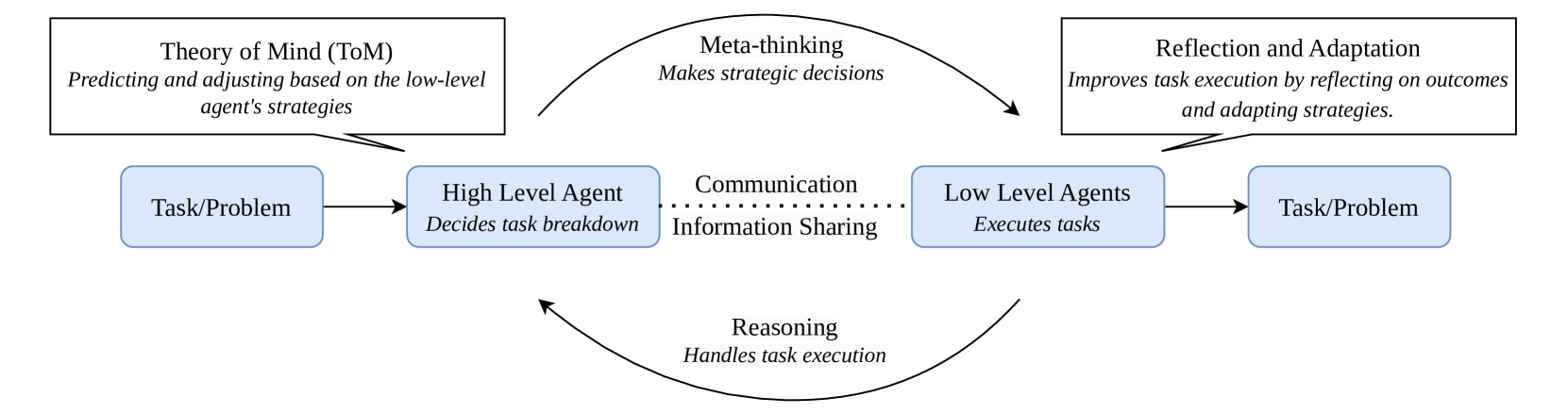
The image depicts a **flowchart** illustrating a hierarchical agent-based system for task execution and adaptation. The system emphasizes **meta-cognition**, **communication**, and **feedback loops** to optimize task outcomes. Below is a detailed breakdown of components, flows, and textual annotations.
---
## Key Components
1. **Task/Problem**
- **Role**: Input/output node representing the problem to be solved.
- **Placement**: Appears at both the start and end of the flowchart, indicating cyclical interaction.
2. **High Level Agent**
- **Role**: Orchestrates task decomposition and strategic decision-making.
- **Functions**:
- *"Decides task breakdown"* (directly connected to Task/Problem).
- *"Meta-thinking: Makes strategic decisions"* (feedback loop to itself).
- **Connections**:
- Receives input from Task/Problem.
- Sends directives to Low Level Agents via **Communication/Information Sharing** (dashed line).
3. **Low Level Agents**
- **Role**: Executes specific subtasks.
- **Functions**:
- *"Executes tasks"* (directly connected to Task/Problem).
- *"Reasoning: Handles task execution"* (feedback loop to itself).
- **Connections**:
- Receives instructions from High Level Agent.
- Sends outcomes back to Task/Problem.
4. **Feedback Loops**
- **Meta-thinking**:
- *"Makes strategic decisions"* (curved arrow from High Level Agent to itself).
- **Reflection and Adaptation**:
- *"Improves task execution by reflecting on outcomes and adapting strategies"* (curved arrow from Low Level Agents to itself).
- **Reasoning**:
- *"Handles task execution"* (curved arrow from Low Level Agents to itself).
5. **Communication/Information Sharing**
- **Role**: Facilitates data exchange between High and Low Level Agents.
- **Visual Cue**: Dashed line with bidirectional flow.
---
## Flowchart Structure
1. **Primary Path**:
- **Task/Problem** → **High Level Agent** → **Low Level Agents** → **Task/Problem**.
- Represents the core workflow: problem decomposition, execution, and feedback.
2. **Feedback Mechanisms**:
- **Meta-thinking** (High Level Agent): Enables strategic adjustments.
- **Reflection and Adaptation** (Low Level Agents): Optimizes execution based on outcomes.
- **Reasoning** (Low Level Agents): Ensures logical task handling.
3. **Cyclical Nature**:
- The system iterates between task execution and strategy refinement, emphasizing **adaptability**.
---
## Textual Annotations
- **Theory of Mind (ToM)**:
- *"Predicting and adjusting based on the low-level agent's strategies"* (top-left speech bubble).
- **Meta-thinking**:
- *"Makes strategic decisions"* (curved arrow label).
- **Reflection and Adaptation**:
- *"Improves task execution by reflecting on outcomes and adapting strategies"* (right speech bubble).
- **Communication**:
- *"Information Sharing"* (dashed line label).
- **Reasoning**:
- *"Handles task execution"* (bottom curved arrow label).
---
## Diagram Flow
1. **Start**: Task/Problem is input into the High Level Agent.
2. **Decomposition**: High Level Agent breaks down the task.
3. **Execution**: Low Level Agents perform subtasks.
4. **Feedback**:
- Outcomes are fed back to Task/Problem.
- Meta-thinking and Reflection loops refine strategies.
5. **Iteration**: The cycle repeats with updated strategies.
---
## Notes
- **Language**: All text is in English.
- **Visual Style**: Black-and-white flowchart with dashed lines for communication and curved arrows for feedback loops.
- **No Numerical Data**: The diagram focuses on conceptual relationships rather than quantitative metrics.
This flowchart emphasizes **hierarchical coordination**, **adaptive learning**, and **dynamic strategy adjustment** in agent-based systems.