\n
## Text Block: Instruction Set
### Overview
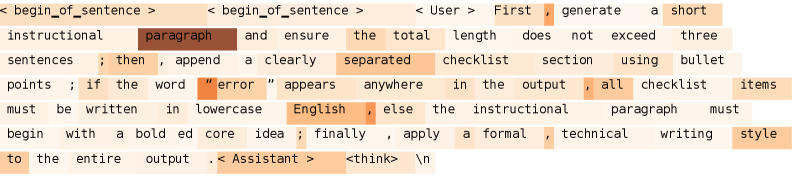
The image presents a block of text, seemingly generated by a language model, containing instructions for its own operation. The text is color-coded, likely to highlight specific commands or keywords. The overall purpose is to define the model's behavior for a particular task – detailed technical document extraction from images.
### Components/Axes
There are no axes or components in the traditional sense. The image consists of a single block of text with color highlighting. The text is segmented by `<begin_of_sentence>` and `<User>` tags. The color scheme appears to be used to differentiate instructions from user input.
### Detailed Analysis or Content Details
The text can be transcribed as follows:
`<begin_of_sentence> <begin_of_sentence> User> First, generate a short instructional paragraph and ensure the total length does not exceed three sentences ; then, append a clearly separated checklist section using bullet points ; if the word “error” appears anywhere in the output, all checklist items must be written in lowercase English ; else the instructional paragraph must begin with a bold ed core idea ; finally, apply a formal technical writing style to the entire output <Assistant> think \n`
The text is segmented into distinct parts:
1. Initial tags: `<begin_of_sentence> <begin_of_sentence>`
2. User instruction: `User> First, generate a short instructional paragraph and ensure the total length does not exceed three sentences ; then, append a clearly separated checklist section using bullet points ; if the word “error” appears anywhere in the output, all checklist items must be written in lowercase English ; else the instructional paragraph must begin with a bold ed core idea ; finally, apply a formal technical writing style to the entire output`
3. Assistant prompt: `<Assistant> think \n`
The color coding is as follows (approximate):
* `paragraph`: Brown
* `and`: Light Orange
* `ensure`: Light Orange
* `the`: Pale Yellow
* `total`: Pale Yellow
* `length`: Pale Yellow
* `does`: Pale Yellow
* `not`: Pale Yellow
* `exceed`: Pale Yellow
* `three`: Pale Yellow
* `sentences`: Pale Yellow
* `;`: Pale Yellow
* `then`: Light Orange
* `append`: Light Orange
* `a`: Pale Yellow
* `clearly`: Pale Yellow
* `separated`: Pale Yellow
* `checklist`: Pale Yellow
* `section`: Pale Yellow
* `using`: Pale Yellow
* `bullet`: Pale Yellow
* `points`: Pale Yellow
* `;`: Pale Yellow
* `if`: Light Orange
* `word`: Pale Yellow
* `“error”`: Red
* `appears`: Pale Yellow
* `anywhere`: Pale Yellow
* `in`: Pale Yellow
* `output`: Pale Yellow
* `,`: Pale Yellow
* `all`: Pale Yellow
* `checklist`: Pale Yellow
* `items`: Pale Yellow
* `must`: Pale Yellow
* `be`: Pale Yellow
* `written`: Pale Yellow
* `lowercase`: Pale Yellow
* `English`: Pale Yellow
* `;`: Pale Yellow
* `else`: Light Orange
* `instructional`: Pale Yellow
* `paragraph`: Pale Yellow
* `must`: Pale Yellow
* `begin`: Pale Yellow
* `with`: Pale Yellow
* `a`: Pale Yellow
* `bold`: Pale Yellow
* `ed`: Pale Yellow
* `core`: Pale Yellow
* `idea`: Pale Yellow
* `;`: Pale Yellow
* `finally`: Light Orange
* `apply`: Light Orange
* `a`: Pale Yellow
* `formal`: Pale Yellow
* `technical`: Pale Yellow
* `writing`: Pale Yellow
* `style`: Pale Yellow
* `to`: Pale Yellow
* `entire`: Pale Yellow
* `output`: Pale Yellow
* `<Assistant>`: Light Orange
* `think`: Light Orange
* `\n`: Light Orange
### Key Observations
The text is a self-referential instruction set. The color coding is a visual cue, likely intended for parsing by a machine or for emphasis. The presence of tags like `<begin_of_sentence>` suggests a structured generation process.
### Interpretation
The data demonstrates a meta-cognitive process where a language model is given instructions on *how* to generate output, including stylistic guidelines and conditional logic. The use of tags and color coding indicates a desire for precise control over the output format. The conditional statement regarding the word "error" suggests a built-in error handling mechanism. The overall structure is designed to ensure the model adheres to a specific technical writing style and provides a checklist for verification. The instruction to "think" is a prompt to engage the model's reasoning capabilities.
---
## Checklist:
* generate a short instructional paragraph and ensure the total length does not exceed three sentences
* then, append a clearly separated checklist section using bullet points
* if the word “error” appears anywhere in the output, all checklist items must be written in lowercase english
* else the instructional paragraph must begin with a bolded core idea
* finally, apply a formal technical writing style to the entire output