## System Diagrams: Conceptual Agent and QA Pipelines
### Overview
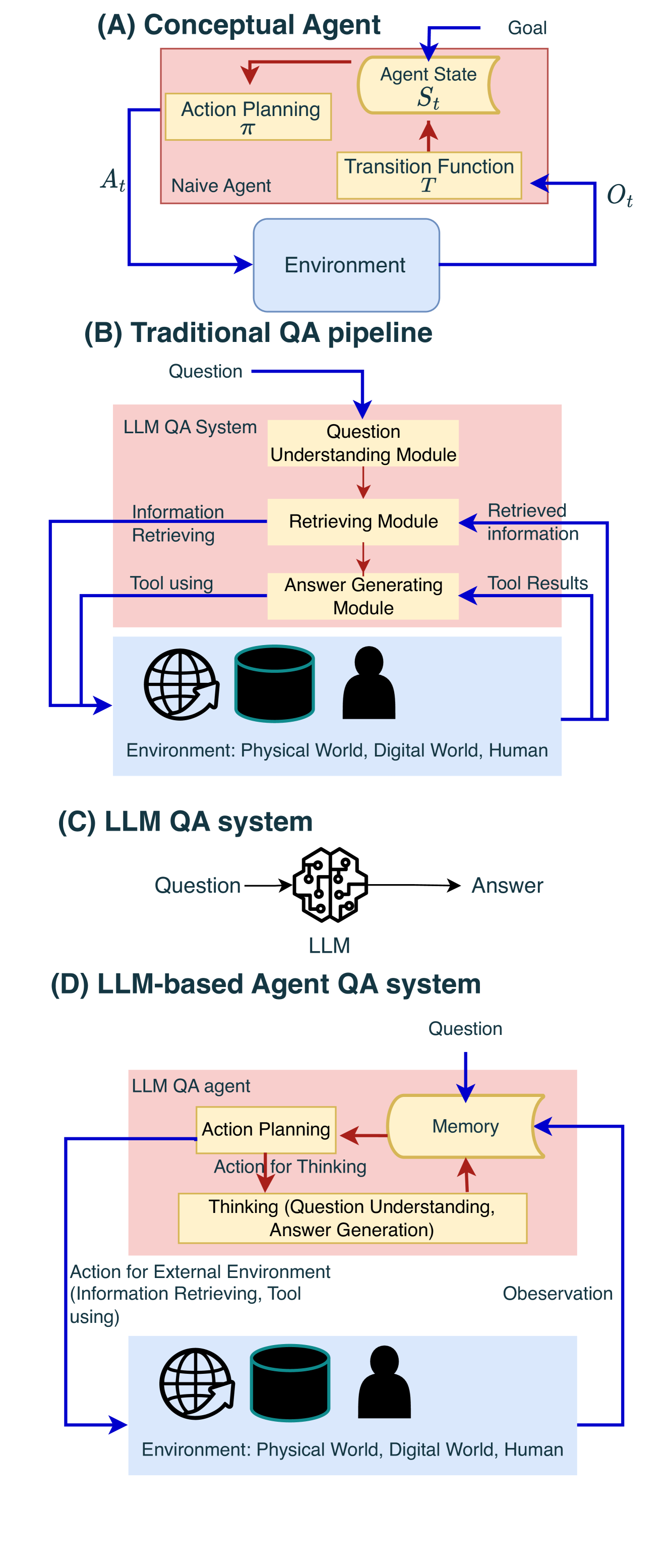
The image presents four system diagrams illustrating different approaches to question answering (QA) systems. These include a conceptual agent, a traditional QA pipeline, an LLM QA system, and an LLM-based agent QA system. The diagrams use boxes, arrows, and text labels to describe the components and flow of information within each system.
### Components/Axes
#### (A) Conceptual Agent
* **Title:** Conceptual Agent
* **Components:**
* Naive Agent (yellow box) containing:
* Action Planning (π)
* Transition Function (T)
* Agent State (St) (yellow box with curved ends)
* Environment (blue box)
* **Inputs/Outputs:**
* At (Action) - Input to the Naive Agent from the Environment
* Ot (Observation) - Output from the Environment to the Agent State
* Goal - Input to the Agent State
#### (B) Traditional QA pipeline
* **Title:** Traditional QA pipeline
* **Components:**
* LLM QA System (pink box) containing:
* Question Understanding Module (yellow box)
* Retrieving Module (yellow box)
* Answer Generating Module (yellow box)
* Environment (blue box) with icons representing the physical world, digital world, and human.
* **Inputs/Outputs:**
* Question - Input to the Question Understanding Module
* Information Retrieving - Input to the Retrieving Module from the Environment
* Retrieved Information - Output from the Retrieving Module
* Tool Using - Input to the Answer Generating Module from the Environment
* Tool Results - Output from the Answer Generating Module
#### (C) LLM QA system
* **Title:** LLM QA system
* **Components:**
* LLM (represented by a brain-like icon)
* **Inputs/Outputs:**
* Question - Input to the LLM
* Answer - Output from the LLM
#### (D) LLM-based Agent QA system
* **Title:** LLM-based Agent QA system
* **Components:**
* LLM QA agent (pink box) containing:
* Action Planning (yellow box)
* Thinking (Question Understanding, Answer Generation) (yellow box)
* Memory (yellow box with curved ends)
* Environment (blue box) with icons representing the physical world, digital world, and human.
* **Inputs/Outputs:**
* Question - Input to the Memory
* Action for Thinking - Output from Action Planning to Thinking
* Action for External Environment (Information Retrieving, Tool using) - Output from the LLM QA agent to the Environment
* Observation - Output from the Environment to the Memory
### Detailed Analysis or ### Content Details
#### (A) Conceptual Agent
The agent interacts with the environment, receiving observations and taking actions based on its internal state and transition function. The goal influences the agent's state.
#### (B) Traditional QA pipeline
The pipeline processes a question through a series of modules: understanding, retrieving, and generating an answer. It interacts with the environment to retrieve information and use tools.
#### (C) LLM QA system
A simplified system where an LLM directly answers a question.
#### (D) LLM-based Agent QA system
This system integrates an LLM with agent-like capabilities, including action planning, thinking, and memory. It interacts with the environment to gather observations and take actions.
### Key Observations
* The diagrams illustrate a progression from a basic conceptual agent to more complex QA systems.
* The LLM-based agent QA system incorporates elements of both traditional pipelines and direct LLM usage.
* The environment is a key component in all systems, providing data and resources for the agents/pipelines.
### Interpretation
The diagrams highlight the evolution of QA systems, moving from rule-based approaches to more sophisticated LLM-based agents. The LLM-based agent QA system represents a more advanced architecture that combines the strengths of both traditional pipelines and LLMs, allowing for more complex and nuanced question answering. The inclusion of memory and action planning suggests a system capable of learning and adapting over time.