## Flowchart Diagram: Agent System Architectures and QA Pipelines
### Overview
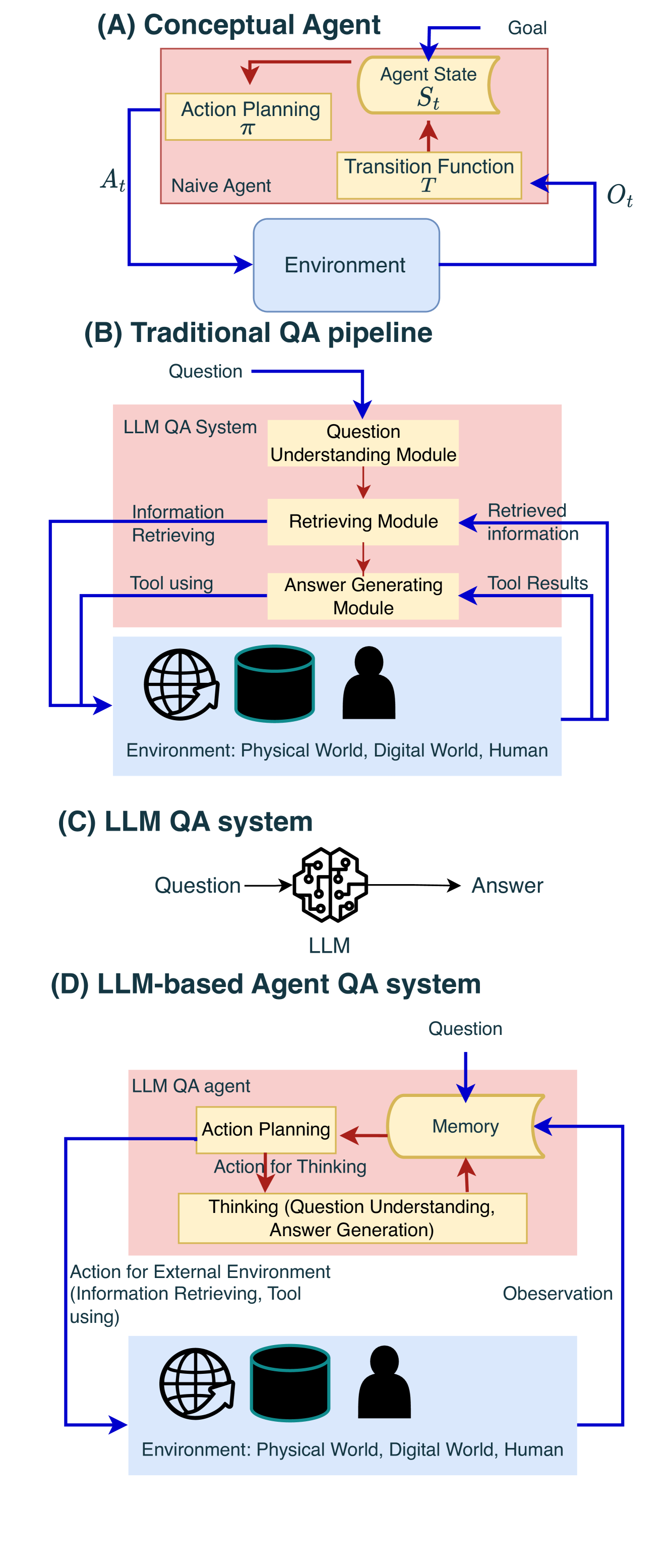
The diagram illustrates four conceptual agent systems and QA pipelines, emphasizing their components, interactions, and environmental integration. Sections (A) to (D) represent progressive abstractions from naive agents to LLM-based systems, with explicit flows between agents, environments, and QA processes.
### Components/Axes
#### (A) Conceptual Agent
- **Components**:
- **Naive Agent**: Contains *Action Planning (π)* and *Agent State (Sₜ)*.
- **Transition Function (T)**: Governs state transitions.
- **Goal**: External input driving the agent.
- **Environment (Oₜ)**: Output to the environment.
- **Flow**:
- Goal → Action Planning → Agent State → Transition Function → Environment.
#### (B) Traditional QA Pipeline
- **Components**:
- **LLM QA System**:
- *Question Understanding Module* → *Retrieving Module* → *Answer Generating Module*.
- **Environment**: Physical World, Digital World, Human.
- **Flow**:
- Question → Understanding Module → Retrieved Information → Answer Generating Module → Tool Results.
#### (C) LLM QA System
- **Components**:
- **LLM**: Directly maps *Question* to *Answer*.
- **Flow**:
- Question → LLM → Answer.
#### (D) LLM-based Agent QA System
- **Components**:
- **LLM QA Agent**:
- *Action Planning* → *Thinking (Question Understanding, Answer Generation)* → *Memory*.
- **External Actions**: Information Retrieving, Tool Using.
- **Environment**: Physical World, Digital World, Human.
- **Flow**:
- Question → Action Planning → Thinking → Memory → Observation.
### Detailed Analysis
- **Section (A)**: Represents a foundational agent with explicit state transitions and action planning, operating in a closed loop with the environment.
- **Section (B)**: Introduces modular QA processing, separating understanding, retrieval, and generation. The environment is explicitly externalized.
- **Section (C)**: Simplifies QA to a direct LLM mapping, bypassing intermediate modules.
- **Section (D)**: Integrates memory and external actions (e.g., tool use) into the LLM framework, enabling dynamic interaction with environments.
### Key Observations
1. **Progression**: From (A) to (D), systems evolve from rigid, state-driven agents to flexible, memory-augmented LLM-based agents.
2. **Modularity**: Traditional QA (B) uses discrete modules, while LLM-based systems (C/D) centralize processing but retain external action capabilities.
3. **Environment Interaction**: All systems engage with Physical/Digital Worlds and Humans, but (D) explicitly incorporates tool use for external tasks.
### Interpretation
The diagram traces the evolution of agent-based QA systems:
- **(A)** models basic agent behavior with explicit state transitions.
- **(B)** introduces structured QA pipelines, separating cognitive tasks.
- **(C)** leverages LLMs for end-to-end QA, sacrificing modularity for simplicity.
- **(D)** combines LLM capabilities with memory and external actions, enabling adaptive, context-aware responses.
The integration of *Memory* and *Action Planning* in (D) suggests a shift toward agents that not only answer questions but also strategize and interact with environments, bridging the gap between static QA systems and autonomous agents. The explicit inclusion of *Tool Using* highlights the practical application of these systems in real-world scenarios requiring external data retrieval or tool execution.