## Multi-Chart Analysis: AIME-24 Accuracy vs. (binned) Length of Thoughts
### Overview
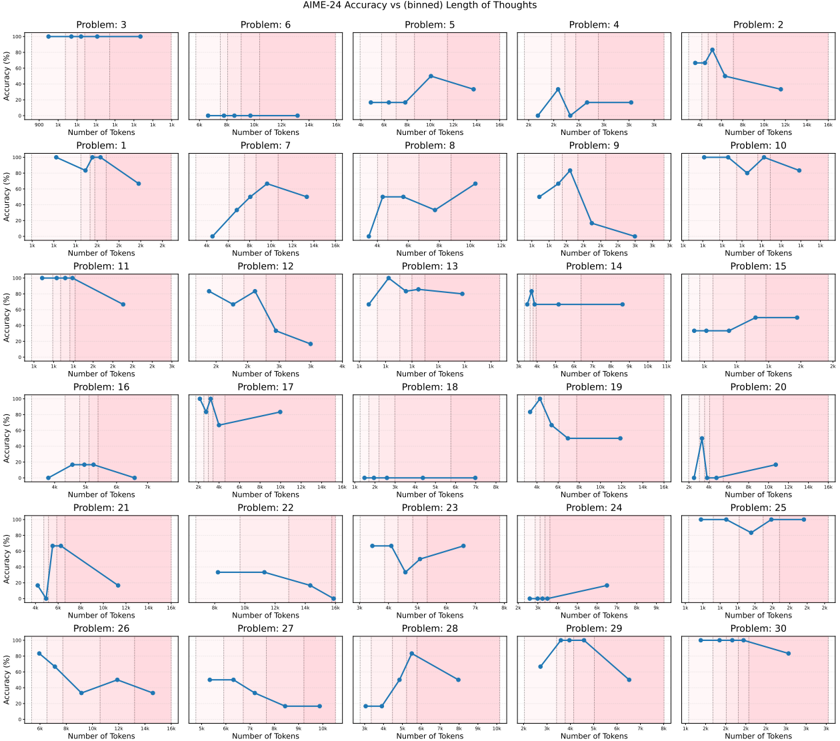
The image is a composite figure containing 30 individual line charts arranged in a 6-row by 5-column grid. The overarching title is **"AIME-24 Accuracy vs (binned) Length of Thoughts"**. Each subplot represents a distinct problem (labeled "Problem: 1" through "Problem: 30") and plots the relationship between the number of tokens in a model's reasoning ("thought") and its accuracy on that problem. The charts collectively analyze how the length of a model's internal reasoning process correlates with its performance across a set of 30 problems.
### Components/Axes
* **Main Title:** "AIME-24 Accuracy vs (binned) Length of Thoughts" (centered at the top).
* **Subplot Grid:** 30 individual charts, each with:
* **Title:** "Problem: [Number]" (e.g., "Problem: 3").
* **Y-axis:** Labeled "Accuracy (%)". The scale is consistent across all charts, ranging from 0% to 100% with major tick marks at 0, 20, 40, 60, 80, and 100.
* **X-axis:** Labeled "Number of Tokens". The scale is logarithmic (base 2), with labeled tick marks at 1k, 2k, 4k, 8k, 16k, 32k, and 64k. The exact range visible varies slightly per chart but generally spans from ~1k to ~64k tokens.
* **Data Series:** Each chart contains a single blue line connecting data points (blue dots). The line represents the accuracy trend as token count increases.
* **Background:** Each chart has a light pink/red shaded background area.
### Detailed Analysis
Below is a chart-by-chart analysis. For each, the visual trend is described first, followed by approximate data points read from the graph. Values are approximate due to visual estimation.
**Row 1:**
* **Problem 3:** Flat, high accuracy. Points: ~100% at 1k, 2k, 4k, 8k, 16k tokens.
* **Problem 6:** Flat, very low accuracy. Points: ~0% at 1k, 2k, 4k, 8k tokens.
* **Problem 5:** Fluctuating, moderate accuracy. Points: ~20% at 1k, ~20% at 2k, ~60% at 4k, ~40% at 8k.
* **Problem 4:** Sharp peak then decline. Points: ~0% at 1k, ~40% at 2k, ~10% at 4k, ~30% at 8k, ~30% at 16k.
* **Problem 2:** Sharp peak then decline. Points: ~60% at 1k, ~80% at 2k, ~40% at 4k, ~30% at 8k.
**Row 2:**
* **Problem 1:** General decline with a peak. Points: ~90% at 1k, ~70% at 2k, ~90% at 4k, ~60% at 8k.
* **Problem 7:** Steady increase. Points: ~0% at 1k, ~20% at 2k, ~40% at 4k, ~60% at 8k, ~50% at 16k.
* **Problem 8:** Increase, then slight dip, then rise. Points: ~0% at 1k, ~50% at 2k, ~50% at 4k, ~40% at 8k, ~70% at 16k.
* **Problem 9:** Sharp peak then steep decline. Points: ~40% at 1k, ~60% at 2k, ~80% at 4k, ~20% at 8k, ~0% at 16k.
* **Problem 10:** High, with a dip. Points: ~90% at 1k, ~90% at 2k, ~70% at 4k, ~90% at 8k, ~80% at 16k.
**Row 3:**
* **Problem 11:** High, then decline. Points: ~100% at 1k, ~100% at 2k, ~90% at 4k, ~60% at 8k.
* **Problem 12:** General decline. Points: ~80% at 1k, ~60% at 2k, ~70% at 4k, ~30% at 8k, ~10% at 16k.
* **Problem 13:** Peak then plateau. Points: ~60% at 1k, ~90% at 2k, ~80% at 4k, ~80% at 8k.
* **Problem 14:** Sharp initial peak, then flat. Points: ~60% at 1k, ~20% at 2k, ~20% at 4k, ~20% at 8k.
* **Problem 15:** Stepwise increase. Points: ~10% at 1k, ~10% at 2k, ~40% at 4k, ~40% at 8k.
**Row 4:**
* **Problem 16:** Low, with a small peak. Points: ~0% at 1k, ~20% at 2k, ~20% at 4k, ~10% at 8k.
* **Problem 17:** Sharp drop then partial recovery. Points: ~90% at 1k, ~60% at 2k, ~80% at 4k.
* **Problem 18:** Consistently very low. Points: ~0% at 1k, ~0% at 2k, ~0% at 4k, ~0% at 8k, ~0% at 16k.
* **Problem 19:** Sharp peak then decline. Points: ~80% at 1k, ~90% at 2k, ~50% at 4k, ~40% at 8k.
* **Problem 20:** Sharp peak then low plateau. Points: ~0% at 1k, ~60% at 2k, ~10% at 4k, ~10% at 8k, ~20% at 16k.
**Row 5:**
* **Problem 21:** Sharp peak then decline. Points: ~0% at 1k, ~60% at 2k, ~50% at 4k, ~20% at 8k.
* **Problem 22:** Gradual decline. Points: ~40% at 1k, ~40% at 2k, ~30% at 4k, ~0% at 16k.
* **Problem 23:** Dip then recovery. Points: ~60% at 1k, ~60% at 2k, ~30% at 4k, ~50% at 8k, ~60% at 16k.
* **Problem 24:** Low, with a slight rise. Points: ~0% at 1k, ~0% at 2k, ~10% at 4k, ~20% at 8k.
* **Problem 25:** High, with a dip. Points: ~90% at 1k, ~90% at 2k, ~70% at 4k, ~90% at 8k, ~90% at 16k.
**Row 6:**
* **Problem 26:** General decline. Points: ~80% at 1k, ~60% at 2k, ~30% at 4k, ~50% at 8k, ~30% at 16k.
* **Problem 27:** Gradual decline. Points: ~40% at 1k, ~40% at 2k, ~20% at 4k, ~10% at 8k.
* **Problem 28:** Sharp peak then decline. Points: ~0% at 1k, ~20% at 2k, ~80% at 4k, ~40% at 8k.
* **Problem 29:** Peak then decline. Points: ~40% at 1k, ~90% at 2k, ~90% at 4k, ~50% at 8k.
* **Problem 30:** High, with a dip. Points: ~90% at 1k, ~90% at 2k, ~80% at 4k, ~70% at 8k.
### Key Observations
1. **High Variability:** The relationship between token length and accuracy is highly problem-dependent. No single trend (e.g., "longer is better") holds across all 30 problems.
2. **Common Patterns:**
* **Peak-and-Decline:** A significant number of problems (e.g., 4, 9, 19, 20, 21, 28, 29) show accuracy peaking at a moderate token length (often 2k or 4k) before declining as thoughts get longer. This suggests overthinking or distraction may harm performance.
* **Monotonic Increase:** A few problems (e.g., 7, 8, 15) show a general improvement with more tokens, indicating that longer reasoning is beneficial.
* **Monotonic Decrease:** Some problems (e.g., 1, 12, 22, 26, 27) show accuracy worsening with more tokens.
* **Flat Performance:** Several problems (e.g., 3, 6, 18) show no change in accuracy across token lengths, indicating the model either always gets it right or always gets it wrong regardless of thought length.
3. **Performance Extremes:** Problems 3 and 18 represent opposite extremes: Problem 3 has near-perfect accuracy at all lengths, while Problem 18 has near-zero accuracy at all lengths.
4. **Token Range:** Most meaningful changes in accuracy occur within the 1k to 8k token range. Beyond 8k, trends often plateau or continue a previously established slope.
### Interpretation
This analysis investigates the "chain-of-thought" scaling hypothesis in AI reasoning. The data suggests that **more reasoning steps (tokens) do not universally lead to better accuracy**. The optimal "thought length" is highly contextual and problem-specific.
* **The "Goldilocks Zone":** For many problems, there appears to be an optimal intermediate length (often 2k-4k tokens) where accuracy is maximized. Shorter thoughts may lack sufficient reasoning, while longer thoughts may introduce errors, lose focus, or incorporate irrelevant information.
* **Problem Difficulty & Type:** The flat, low-accuracy line for Problem 18 suggests it may be fundamentally too difficult for the model, while the flat, high-accuracy line for Problem 3 suggests it is trivially easy. The problems showing a peak likely represent those where the model's reasoning process is effective but fragile—it can succeed with a concise, focused chain of thought but fails when that process is extended.
* **Implication for AI Safety & Efficiency:** This has practical implications. Simply allowing an AI model to "think longer" is not a guaranteed path to better performance and can be wasteful. It highlights the need for methods that can dynamically determine the appropriate reasoning depth for a given task or that can prune unproductive lines of thought. The variability also suggests that benchmarking AI reasoning should consider performance across a spectrum of thought lengths, not just at a single, fixed maximum.