## Diagram: Semantic Rules for Copying in a Shared-Borrowing System
### Overview
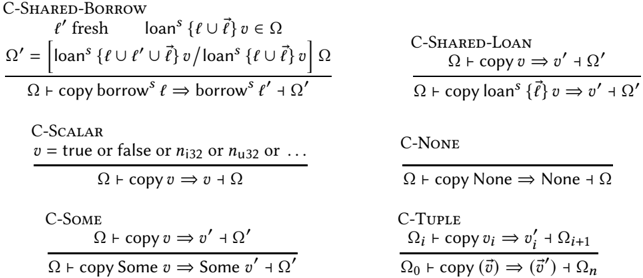
The image presents a set of semantic rules, likely related to a programming language or formal system that incorporates shared borrowing. These rules define how copying operations behave for different data types and scenarios, including shared borrows, scalars, optional values (Some), tuples, and the absence of a value (None). The rules are expressed in a formal notation, using symbols and logical operators to specify the conditions and results of each copying operation.
### Components/Axes
The image is structured as a collection of rules, each labeled with a "C-" prefix followed by a descriptive name (e.g., C-SHARED-BORROW, C-SCALAR). Each rule consists of:
- **Name:** A descriptive name indicating the type of copying operation.
- **Premise (Above the line):** Conditions that must be met for the rule to apply. These conditions often involve variables, types, and the state of the system (represented by Ω).
- **Conclusion (Below the line):** The result of applying the copying operation, including any changes to variables, types, or the system state.
- **Symbols:**
- Ω: Represents the state of the system or memory.
- copy: Indicates a copying operation.
- ⇒: Represents "results in" or "evaluates to."
- ℓ: Represents a location or reference.
- v: Represents a value.
- borrow: Represents a borrowed reference.
- loan: Represents a loaned reference.
- U: Represents a union of sets.
- ∈: Represents "is an element of."
- n_i32, n_u32: Represents signed and unsigned 32-bit integers, respectively.
- Some: Represents an optional value that may or may not be present.
- None: Represents the absence of a value.
- (v): Represents a tuple of values.
### Detailed Analysis or Content Details
**C-SHARED-BORROW**
* **Premise:**
* `l'` is fresh (a new location).
* `loan^s {ℓ U ℓ}` `v` is an element of `Ω`.
* `Ω' = [loan^s {ℓ U ℓ' U ℓ} v / loan^s {ℓ U ℓ} v] Ω` (Ω' is Ω with the loan updated to include l').
* **Conclusion:**
* `Ω + copy borrow^s ℓ ⇒ borrow^s ℓ' + Ω'`
* In English: Copying a shared borrow at location `ℓ` results in a new borrow at location `ℓ'` and the updated state `Ω'`.
**C-SHARED-LOAN**
* **Premise:**
* `Ω + copy v ⇒ v' + Ω'`
* **Conclusion:**
* `Ω + copy loan^s {ℓ} v ⇒ v' + Ω'`
* In English: Copying a shared loan at location `ℓ` results in a copy of the value `v'` and the updated state `Ω'`.
**C-SCALAR**
* **Premise:**
* `v = true or false or n_i32 or n_u32 or ...`
* **Conclusion:**
* `Ω + copy v ⇒ v + Ω`
* In English: Copying a scalar value (boolean or integer) results in the same value and the original state.
**C-NONE**
* **Premise:**
* None
* **Conclusion:**
* `Ω + copy None ⇒ None + Ω`
* In English: Copying `None` results in `None` and the original state.
**C-SOME**
* **Premise:**
* `Ω + copy v ⇒ v' + Ω'`
* **Conclusion:**
* `Ω + copy Some v ⇒ Some v' + Ω'`
* In English: Copying `Some v` results in `Some v'` and the updated state `Ω'`.
**C-TUPLE**
* **Premise:**
* `Ω_i + copy v_i ⇒ v'_i + Ω_{i+1}`
* **Conclusion:**
* `Ω_0 + copy (v) ⇒ (v') + Ω_n`
* In English: Copying a tuple `(v)` results in a tuple of copied values `(v')` and the updated state `Ω_n`.
### Key Observations
* The rules define how copying interacts with shared borrowing, scalars, optional values, and tuples.
* The `C-SHARED-BORROW` rule is the most complex, as it involves updating the state to reflect the new borrow.
* The `C-SCALAR` and `C-NONE` rules are the simplest, as they do not involve any state changes.
* The `C-SOME` and `C-TUPLE` rules recursively apply the copying operation to the contained values.
### Interpretation
The semantic rules define a formal system for copying values in a context where shared borrowing is used. The rules ensure that copying operations preserve the semantics of shared borrows, scalars, optional values, and tuples. The system appears to be designed to prevent dangling pointers or other memory safety issues that can arise in languages with shared borrowing. The rules are likely part of a larger formal specification of a programming language or system that uses shared borrowing. The rules ensure that copying operations are well-defined and predictable, which is essential for ensuring the correctness and reliability of programs written in such a language.