\n
## Formal Logic Definitions
### Overview
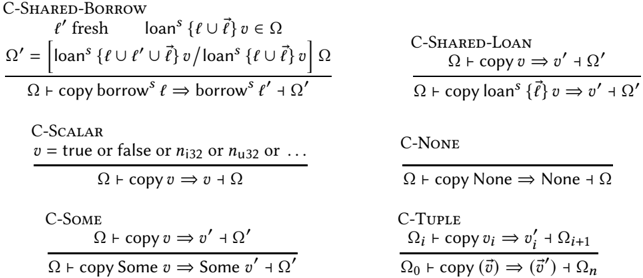
The image presents a set of formal logic definitions, likely related to a system for managing or reasoning about borrowing and copying of data or values. Each definition is labeled with a "C-" prefix followed by a descriptive term (e.g., C-SHARED-BORROW, C-SCALAR). Each definition consists of a symbolic expression and a logical implication.
### Components/Axes
The image does not contain axes or charts. It consists entirely of text-based definitions. The definitions are arranged in a 2x3 grid. Each definition has the following structure:
1. **Label:** A name for the definition (e.g., C-SHARED-BORROW).
2. **Symbolic Expression:** A mathematical or logical expression defining the concept.
3. **Logical Implication:** A statement of the form "A ⇒ B", indicating that if A is true, then B is also true.
### Detailed Analysis or Content Details
Here's a transcription of each definition:
**1. C-SHARED-BORROW**
`ℓ' fresh loanˢ {ℓ∪v̄} 𝑣 ∈ Ω`
`Ω' = |loanˢ {ℓ∪v̄} 𝑣/loanˢ {ℓ∪v̄}| Ω`
`Ω ⊢ copy borrow ℓ ⇔ borrow ℓ' ∧ Ω'`
**2. C-SHARED-LOAN**
`Ω ⊢ copy 𝑣 ⇔ v' ∧ Ω'`
`Ω ⊢ copy loanˢ (v̄) 𝑣 ⇔ v' ∧ Ω'`
**3. C-SCALAR**
`v = true or false or n₁₃₂ or n₃₂ or ...`
`Ω ⊢ copy v ⇔ v ∧ Ω`
**4. C-NONE**
`Ω ⊢ copy None ⇔ None ∧ Ω`
**5. C-SOME**
`Ω ⊢ copy v ⇔ v' ∧ Ω'`
`Ω ⊢ copy Some v ⇔ Some v' ∧ Ω'`
**6. C-TUPLE**
`Ωᵢ ⊢ copy vᵢ ⇔ vᵢ' ∧ Ωᵢ₊₁`
`Ω₀ ⊢ copy (v̄) ⇔ (v̄') ∧ Ωₙ`
### Key Observations
The definitions use a variety of symbols, including:
* `ℓ`, `v`, `v̄`: Variables, potentially representing values or vectors of values.
* `Ω`, `Ωᵢ`, `Ωₙ`: Representing states or contexts.
* `loanˢ`: A function or operator related to borrowing.
* `copy`: An operation representing copying.
* `⊢`: A symbol indicating logical entailment (provability).
* `⇔`: A symbol indicating logical equivalence.
* `∧`: A logical AND operator.
* `|`: A notation for set construction.
* `fresh`: Indicates a new, unused variable.
* `None`: Represents the absence of a value.
* `Some`: Represents the presence of a value.
* `n₁₃₂`, `n₃₂`: Numerical values.
The definitions appear to be building a formal system for reasoning about the copying of borrowed values, with special cases for scalars, the absence of a value (None), and tuples.
### Interpretation
The image presents a formal specification of a copying mechanism within a system that supports borrowing. The definitions aim to ensure that copying operations maintain the integrity of borrowed data and the overall system state.
* **C-SHARED-BORROW** defines how a new variable `ℓ'` is created that borrows a value `v` from a context `Ω`. The context is updated (`Ω'`) to reflect the borrowing.
* **C-SHARED-LOAN** defines the copying of a value `v` and a loan `loanˢ(v̄)`.
* **C-SCALAR** defines the copying of scalar values (true, false, numbers). Copying a scalar simply results in the same scalar value in the new context.
* **C-NONE** defines the copying of `None`. Copying `None` results in `None` in the new context.
* **C-SOME** defines the copying of `Some v`. Copying `Some v` results in `Some v'` in the new context.
* **C-TUPLE** defines the copying of tuples. Each element of the tuple is copied recursively, and the context is updated accordingly.
The use of logical implications suggests that these definitions are intended to be used in a proof system to verify the correctness of copying operations. The definitions are highly technical and require a background in formal logic and programming language semantics to fully understand. The overall goal appears to be to provide a precise and unambiguous specification of a copying mechanism that is safe and reliable.