## Formal Inference Rules: Copy Operations
### Overview
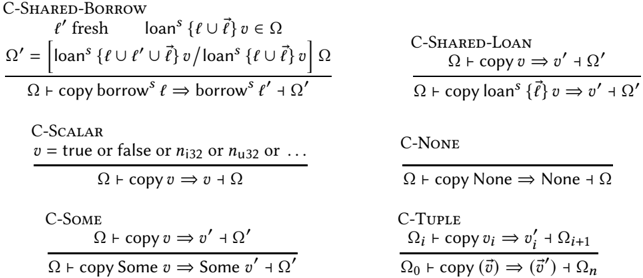
The image displays a set of six formal inference rules, likely from a computer science or formal methods context (e.g., type systems, operational semantics, or resource management). Each rule is presented in a standard "premise / conclusion" format separated by a horizontal line, with a title above. The rules define the behavior of a `copy` operation on different constructs, with a context or state denoted by `Ω` (Omega).
### Components/Axes
The image is structured as six distinct rule blocks arranged in two columns and three rows. Each block contains:
1. **Rule Title:** In uppercase, prefixed with "C-".
2. **Horizontal Line:** Separates the title from the rule's logical content.
3. **Rule Content:** A logical inference written in a formal notation, typically showing a transformation from a state `Ω` to a new state `Ω'` or `Ω_i`/`Ω_{i+1}`.
### Detailed Analysis
The rules are transcribed below exactly as they appear in the image, preserving all mathematical notation and symbols.
**1. Rule: C-SHARED-BORROW**
* **Position:** Top-left.
* **Content:**
```
ℓ' fresh loanˢ {ℓ ∪ ℓ̄} v ∈ Ω
────────────────────────────────────
Ω' = [ loanˢ {ℓ ∪ ℓ' ∪ ℓ̄} v / loanˢ {ℓ ∪ ℓ̄} v ] Ω
Ω ⊢ copy borrowˢ ℓ ⇒ borrowˢ ℓ' ⊣ Ω'
```
* **Notation:** Uses fresh location `ℓ'`, a set notation `{ℓ ∪ ℓ̄}` for a loan, and a substitution operation `[ ... / ... ]` on the context `Ω`.
**2. Rule: C-SHARED-LOAN**
* **Position:** Top-right.
* **Content:**
```
Ω ⊢ copy v ⇒ v' ⊣ Ω'
────────────────────────────────────
Ω ⊢ copy loanˢ {ℓ̄} v ⇒ v' ⊣ Ω'
```
**3. Rule: C-SCALAR**
* **Position:** Middle-left.
* **Content:**
```
v = true or false or nᵢ₃₂ or nᵤ₃₂ or ...
────────────────────────────────────
Ω ⊢ copy v ⇒ v ⊣ Ω
```
* **Notation:** Lists scalar types: boolean (`true`, `false`), signed 32-bit integer (`nᵢ₃₂`), unsigned 32-bit integer (`nᵤ₃₂`), and an ellipsis (`...`) indicating other similar types.
**4. Rule: C-NONE**
* **Position:** Middle-right.
* **Content:**
```
────────────────────────────────────
Ω ⊢ copy None ⇒ None ⊣ Ω
```
* **Note:** This rule has no premise (the space above the line is empty).
**5. Rule: C-SOME**
* **Position:** Bottom-left.
* **Content:**
```
Ω ⊢ copy v ⇒ v' ⊣ Ω'
────────────────────────────────────
Ω ⊢ copy Some v ⇒ Some v' ⊣ Ω'
```
**6. Rule: C-TUPLE**
* **Position:** Bottom-right.
* **Content:**
```
Ωᵢ ⊢ copy vᵢ ⇒ v'ᵢ ⊣ Ωᵢ₊₁
────────────────────────────────────
Ω₀ ⊢ copy (v⃗) ⇒ (v⃗') ⊣ Ωₙ
```
* **Notation:** Uses a vector notation `(v⃗)` for a tuple and indexed contexts `Ωᵢ` and `Ωᵢ₊₁`, suggesting a sequential processing of tuple elements.
### Key Observations
* **Consistent Structure:** All rules follow the pattern `Ω ⊢ copy X ⇒ Y ⊣ Ω'`, defining how copying a construct `X` produces a new value `Y` and updates the context from `Ω` to `Ω'`.
* **Context (`Ω`) Role:** The context `Ω` is central. It is used to look up loans (C-SHARED-BORROW), is unchanged for scalars and `None` (C-SCALAR, C-NONE), and is threaded through transformations for compound types like `Some` and tuples (C-SOME, C-TUPLE).
* **Resource Semantics:** The rules for `borrowˢ` and `loanˢ` (C-SHARED-BORROW, C-SHARED-LOAN) imply a system tracking shared references or resources, where copying requires updating the context to account for a new alias (`ℓ'`).
* **Recursive Definition:** The rules for `Some` and tuples are defined in terms of the `copy` operation on their inner components, indicating a structural, recursive definition.
### Interpretation
These inference rules formally specify the semantics of a `copy` operation within a computational system. The system appears to be concerned with **resource management** or **aliasing control**, as evidenced by the explicit handling of `borrow` and `loan` constructs and the careful propagation of the context `Ω`.
* **What it demonstrates:** The rules create a clear, logical specification. For simple, immutable data (scalars, `None`), copying is trivial and doesn't change the system state. For potentially aliased or managed resources (`borrowˢ`, `loanˢ`), copying is non-trivial and must update the central context to maintain consistency. For structured data (`Some`, tuples), copying is defined recursively.
* **Relationships:** The rules are interdependent. The C-TUPLE rule relies on the existence of rules for the types of the tuple's elements (like C-SCALAR or C-SOME). The C-SHARED-LOAN rule relies on the rule for the loaned value `v`.
* **Notable Patterns:** The most complex rule is C-SHARED-BORROW, which involves a freshness check (`ℓ' fresh`), a lookup in `Ω`, and a substitution to update the context. This suggests that shared borrows are the primary source of complexity in this copy model. The absence of a premise in C-NONE is a standard way to denote an axiom—a rule that always applies without preconditions.
**Language Declaration:** The text in the image is entirely composed of mathematical symbols, logical notation, and English keywords (`fresh`, `true`, `false`, `copy`, `borrow`, `loan`, `None`, `Some`). No other natural language is present.